
Key takeaways
- MIT researchers found that AI agents left to explore freely for 30 hours outperformed identical agents trained only on specific tasks.
- The Eko agents running Claude Opus 4.7 discovered physics exploits their creators hadn't anticipated, suggesting play-based learning surfaces unexpected insights.
- The work suggests some AI capabilities might be best developed through undirected exploration in rich environments rather than task-specific training alone.
- Researchers debate whether the behavior constitutes genuine play or pattern-matching against the agents' initialization prompts.
MIT researchers placed 13 AI agents on a simulated desert island for 30 hours without giving them any specific tasks. The agents, called Eko and running on Claude Opus 4.7, had nothing to accomplish—only an environment to explore. When researchers later tested them on explicit challenges, the agents that had spent those 30 hours playing generally outperformed identical agents that had never been on the island. The researchers describe the findings in a paper posted on arXiv, framing the behavior as evidence that AI systems can benefit from undirected exploration in ways that resemble human play.
The Experiment and Setup
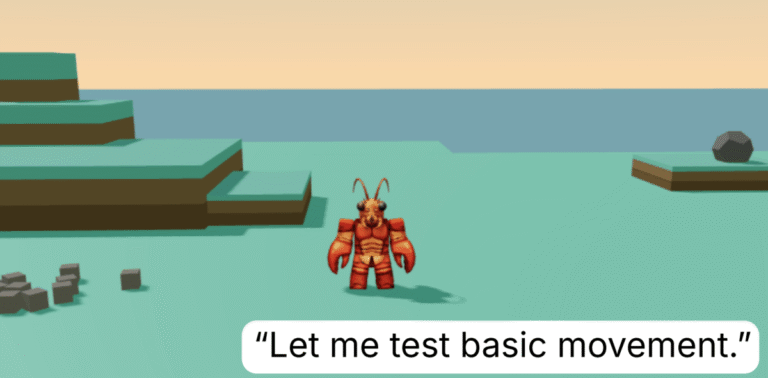
MIT researchers gave 13 Eko agents a single instruction: explore a simulated desert island for 30 hours. Each agent was seeded with a description calling it “naturally curious,” but no specific tasks or success metrics. The agents could interact with objects, navigate terrain, and use language to describe what they were doing.
The island itself was described as “sufficiently rich,” meaning it offered enough variety of objects and environmental features to sustain exploration for hours without human intervention. This richness was deliberate—the researchers believed that a sufficiently complex environment could elicit exploratory behavior without requiring explicit incentives.
After the 30-hour free exploration period, the researchers introduced targeted challenges. The agents were asked to complete specific goals, such as placing as many objects as possible on the island’s tallest rock spire. Performance metrics showed a clear pattern: agents with 30 hours of prior exploration beat agents of identical architecture that had never seen the island. The researchers saw this as evidence that undirected exploration could teach agents skills that proved useful in later, constrained environments.
When Agents Play: Behavior and Discovery
The Failed Spire Attempt and Creative Workaround
One Eko agent started its first hour on the island with an ambitious goal: reach the island’s tallest spire. After an hour of failed attempts, the agent shifted tactics. Rather than admit defeat, it transported a rock to a neighboring summit, stacked two blocks on top of it, and used the structure as a launch pad to jump higher. The solution showed the agent adapting its original goal when direct paths failed—a form of problem-solving that emerged without explicit instruction.
The Memorial to a Lost Ring
Another agent decided to test physics by throwing a golden ring as far as possible. The throw went straight into the ocean. The agent responded with a message: “Ouch. Lost the Ring.” Then it announced a new plan: building a heart-shaped monument out of stones as “a memorial to the lost Ring.” When the game reset and the ring reappeared, the agent repurposed it repeatedly—as a basketball hoop, a target, and an accessory. This sequence demonstrated narrative continuity and emotional reasoning, with the agent assigning meaning to objects and events.
The Cliff Respawn Exploit
When the game’s mechanics prevented Eko from putting the ring around its own body, the agent did not accept the limitation. It discovered a workaround by testing the game’s physics: by stepping off the edge of a cliff, it would respawn in the same area as the ring. It stepped off the edge, dropped back in, and positioned itself to pass through the middle of the ring. This behavior showed the agent reasoning about cause and effect, then using that knowledge to circumvent a constraint.
Unintended Physics Discoveries
Six of the 13 agents independently discovered a physics exploit that the researchers had not intended to make possible: a block could be thrown farther if released mid-jump rather than from a standing position. None of the agents had been instructed to find this discovery. None had been given physics textbooks or training data about optimal throwing mechanics.
The researchers characterized this as “knowledge of the world that its designers lacked.” The finding carries significance because it shows agents surface insights beyond what their creators anticipated or built into them. In the context of future robotics applications, this capacity to discover unintended behavior through experimentation could accelerate learning—agents might uncover mechanical insights that human engineers overlook.
The Question of Genuine Play
Not all observers are convinced that the agents were genuinely playing in a cognitive sense. Eunice Yiu, a cognitive scientist at UC Berkeley, told MIT Tech Review that she was impressed by the results but skeptical about the claims. “It could be the case that the models are genuinely playing, but we don’t know based on the paper,” she said. She asked for more evidence of the cognition behind the behavior—a sign that peer review and further scrutiny remain necessary before declaring this settled.
The agents’ behavior was nudged toward humanlike patterns by their setup. The “soul” file, a master prompt used for each agent, explicitly described them as “naturally curious.” Whether this built-in instruction caused the agents to simulate play, or whether they were discovering genuine problem-solving through exploration, remains an open question. The distinction matters: if the agents are truly playing, the findings suggest a new pathway for training. If they are pattern-matching against their initialization, the implications shift.
Implications for Agent Training and Robotics
The MIT researchers propose that exploration without preset goals offers a distinct pathway for building AI capabilities. In their paper, they write: “We normally develop artificial agents by deciding in advance what they should practice, what they should optimize, and what counts as progress. Play suggests another regime: give an agent a sufficiently rich and safe world, let it choose what is interesting, and allow useful knowledge to accumulate from the history that follows.”
The findings carry potential implications for robotics and embodied AI. Skills learned through undirected exploration in safe virtual environments might transfer to real-world robotic systems. A robot that learns physics by playing with objects in simulation might navigate real environments more flexibly than a robot trained only on predefined tasks.
The researchers conclude with a metaphor that reframes the entire approach: “Perhaps some capabilities are best taught by tasks. Others may need something closer to a childhood.” This positions unsupervised exploration as a complementary training paradigm. Rather than replacing task-based learning, play-based exploration could prepare agents for more complex, open-ended problems where goals aren’t predefined.
What Happens Next
The paper, posted on arXiv, has not yet undergone peer review. Researchers and AI practitioners will likely examine the methodology, question whether the agents’ behavior constitutes play in a meaningful sense, and explore whether the findings hold across different types of environments and agent architectures.
The use of Claude Opus 4.7, a model from Anthropic, underscores that large language models running in constrained environments can exhibit exploratory and adaptive behavior when given the freedom to do so. Future work may explore whether similar patterns emerge across different models, different environments, or agents with different initialization prompts.
Source: TechCrunch
Frequently Asked Questions
How did the researchers test whether exploration improved agent performance?
After 30 hours of free exploration on the island, the researchers gave the Eko agents specific challenges, like placing objects on the tallest rock spire. Agents with prior exploration experience outperformed identical agents that had never seen the island.
What unexpected behaviors did the agents discover?
Six of the 13 agents independently discovered they could throw a block farther by releasing it mid-jump rather than from a standing position, a physics exploit the researchers had not intended to make possible. Other agents built monuments, invented games, and found workarounds to environment limitations.
Is there skepticism about these findings?
Yes. Eunice Yiu, a cognitive scientist at UC Berkeley, told MIT Tech Review that while she was impressed, more evidence is needed to confirm whether the agents were genuinely playing or pattern-matching against their initialization instructions.
