
Key takeaways
- Amazon ordered 2 million additional Nvidia GPUs for 2027-2028 deployment, tripling its commitment from five months earlier after demand exceeded expectations.
- The partnership extends beyond chips to include Vera CPUs, robotics platforms (Omniverse, Cosmos, Isaac, Jetson), and Nemotron models on AWS managed services.
- Amazon continues building competing processors (Trainium and Graviton) while deepening its Nvidia reliance, generating $25 billion in annualized revenue from custom chips.
- Nvidia posted $96.2 billion in Q2 sales with $89 billion from data centers, guided $108 billion for Q3, and committed $279 billion to supply capacity through 2028.
Amazon and Nvidia announced an expanded partnership on Wednesday that nearly triples Amazon’s prior commitment to the chip supplier. Under the new agreement, AWS will add 2 million Nvidia GPU chips to its data centers, with deployment scheduled across 2027 and 2028. The order includes Nvidia’s latest processors—Blackwell Ultra, Rubin, and Rubin Ultra GPUs—the specialized accelerators that power large-scale AI model training and inference operations.
The announcement, delivered during Nvidia’s quarterly earnings call, represents a dramatic acceleration in the companies’ relationship. Just five months earlier, Amazon had committed to deploying more than 1 million Nvidia GPUs starting in 2024. Nvidia attributed the rapid expansion to surging demand from startups, enterprises, AI research labs, and governments, stating that “demand has exceeded those expectations.” The companies did not disclose financial terms, though industry analysts estimate the deal is worth tens of billions of dollars based on current GPU unit costs and anticipated pricing structures.
A comprehensive technology partnership
What distinguishes this arrangement from a straightforward bulk chip purchase is its scope. Nvidia said its technology stack will integrate more deeply across AWS infrastructure, extending well beyond GPUs alone. The integration encompasses networking hardware for clustering thousands of GPUs into unified compute systems, open-source AI models, CPUs for general-purpose computing, data processing software, and robotics platforms for warehouse automation and autonomous systems.
This comprehensive approach positions Amazon and Nvidia as strategic infrastructure partners across multiple layers of AI development and deployment rather than as a traditional vendor-buyer relationship. The partnership signals that Amazon views Nvidia’s ecosystem as foundational to AWS’s competitive positioning in cloud AI services.
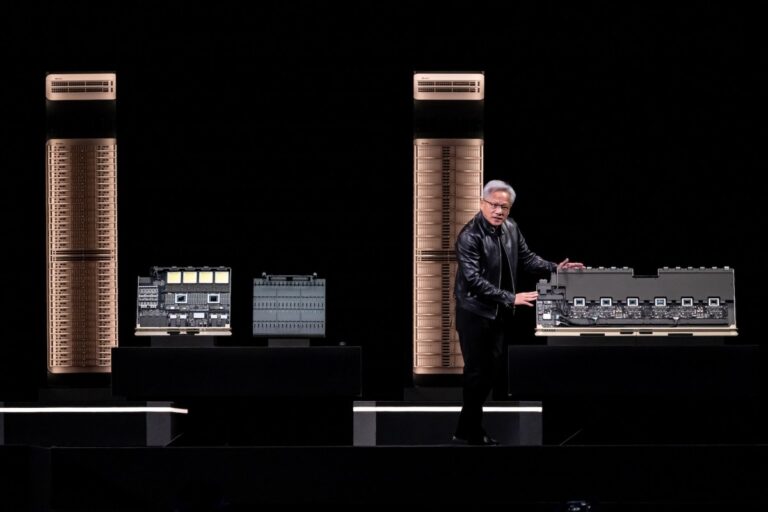
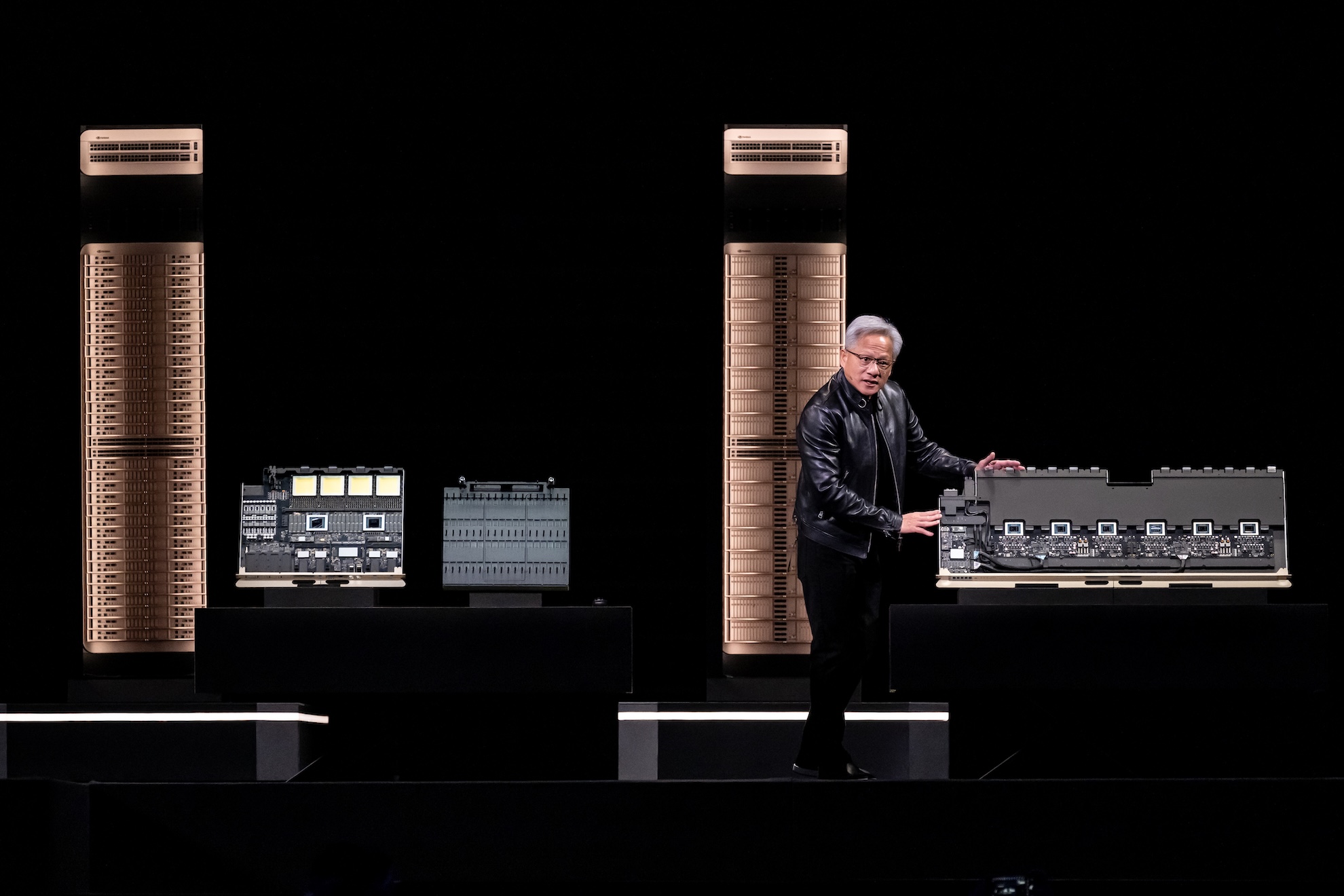
Nvidia will also deploy its Vera CPU line alongside the new GPU shipments. According to Nvidia CFO Colette Kress, some Vera chips will be integrated with Rubin GPUs to form complete systems, while others will be sold as standalone processors. Nvidia CEO Jensen Huang previously described the Vera opportunity in May as a “$200 billion TAM,” indicating the company’s confidence in this processor line’s growth potential. Kress stated Wednesday that Vera shipments have already commenced to lead partners including Oracle and SpaceXAI, with expected deployment across every major hyperscaler, neocloud operator, AI lab, and systems manufacturer. This positions Vera as a critical component of Nvidia’s CPU strategy as it expands beyond its traditional GPU focus.
Amazon’s own competing chips
Building alternative processors for AI workloads
The expanded Nvidia partnership unfolds against the backdrop of Amazon’s aggressive investment in competing AI processors. Amazon’s AI chief Peter DeSantis has disclosed that AWS is actively negotiating to sell its Trainium chips—direct technical alternatives to Nvidia’s H100 and Blackwell processors—to external companies building their own data centers. These chips are specifically optimized for deep learning training workloads, positioning them as alternatives to Nvidia’s most advanced GPU offerings.
Beyond Trainium, Amazon continues developing Graviton CPUs, Arm-based processors designed as general-purpose alternatives to Intel and AMD’s traditional server chips. AWS markets Graviton as a competitive option for customers building inference and serving infrastructure outside of specialized GPU workloads.
Meaningful progress on custom silicon revenue
Amazon’s custom silicon business has reached measurable commercial scale. During its most recent earnings call, Amazon reported that its custom chip business crossed a $25 billion annualized revenue run rate, supported by $225 billion in total customer commitments from AI labs including Anthropic and OpenAI. This financial performance demonstrates that Amazon’s internal processors are capturing genuine market demand and customer adoption.
The simultaneous pursuit of Nvidia partnerships and custom chip development reflects a broader industry strategy seen at Meta, Microsoft, and Google. These companies are hedging their bets by building proprietary silicon for their specific needs while maintaining relationships with Nvidia for baseline GPU capacity and access to the company’s broader technology ecosystem. Amazon’s approach suggests the company sees both paths as necessary—custom chips for cost optimization and differentiation, combined with continued Nvidia reliance for flexibility and access to the latest hardware generations.
Robotics and enterprise AI expansion
AWS adopts Nvidia’s physical AI platform
Another dimension of the partnership involves Amazon’s adoption of Nvidia’s comprehensive robotics stack for its warehouse automation operations. AWS will deploy Nvidia’s full physical AI platform to power its warehouse robot fleet. This stack comprises Omniverse, which provides simulation and digital twin capabilities; Cosmos, Nvidia’s world models platform; Isaac, a robotics development and simulation framework; and Jetson, computing hardware specifically designed for robots and edge AI applications. Notably, Nvidia introduced a new Jetson variant this week explicitly designed to serve as a more accessible and cost-effective robotics computer for entry-level edge AI applications, suggesting Nvidia anticipates broader adoption of these tools.
Enterprise models through AWS managed services
On the enterprise and customer-facing side, AWS will make Nvidia’s Nemotron family of open models available through Amazon Bedrock, the company’s managed foundation model platform, and SageMaker, its cloud machine learning service. This arrangement places Nvidia’s models in the hands of AWS customers without requiring those customers to manage the underlying inference infrastructure themselves. The integration lowers barriers to adoption and positions Nvidia’s models as default options within AWS’s ecosystem.
Nvidia’s financial performance and forward outlook
Q2 earnings exceed expectations
Nvidia’s financial results support the optimistic expansion plans. The company reported $96.2 billion in quarterly sales for the second quarter, surpassing analyst estimates. Data center revenue constituted the majority of these sales at $89 billion, representing a 117 percent increase year-over-year. The scale of data center growth underscores how thoroughly AI infrastructure buildout is driving Nvidia’s business.
Looking ahead, Nvidia guided for $108 billion in third-quarter revenue, with a portion anticipated from its next-generation Rubin GPU line. Nvidia confirmed Wednesday that Rubin GPU production shipments began this quarter. Investors are watching Rubin’s initial Q3 sales figures closely as an indicator of whether customer demand will sustain into the next hardware generation or whether the market might plateau.
Massive supply chain commitments
Reflecting confidence in sustained demand, Nvidia announced a substantial increase in capital commitments to secure supply and manufacturing capacity. The company committed $279 billion to these efforts—a dramatic jump from $119 billion in the prior quarter. This expanded commitment includes $92 billion in projected spending for the remainder of the current fiscal year and another $87 billion allocated for fiscal 2028. The magnitude of these commitments suggests Nvidia’s leadership expects the AI infrastructure buildout to persist for years, requiring sustained manufacturing investment and supply chain security.
The underlying profitability question
During the earnings call, Jensen Huang articulated the economic rationale underpinning these massive commitments. He described the current phase as one where “AI is now doing productive and useful work” and crucially, “generating profitable tokens.” Huang’s argument posits that every increment of additional compute capacity translates into more profitable AI inference operations, which in turn creates value for all downstream services and applications. This logic justifies the hundreds of billions that Amazon, Meta, Microsoft, and others are pouring into data center infrastructure and AI chips.
The central question for investors is whether this assumption will prove durable in practice. If token productivity remains high relative to compute costs, Huang’s thesis holds and the infrastructure buildout continues justified. However, if token productivity plateaus, if cost-per-compute rises faster than productivity gains, or if revenue growth fails to keep pace with infrastructure spending, the math fundamentally changes. For now, Amazon’s decision to expand its order by 100 percent and Nvidia’s expansion of manufacturing commitments suggest the industry remains confident in the productivity of incremental compute.
Frequently Asked Questions
How many Nvidia GPUs is Amazon adding to AWS?
Amazon is adding 2 million Nvidia GPU chips—including Blackwell Ultra, Rubin, and Rubin Ultra models—for deployment across AWS data centers in 2027 and 2028.
Why did Amazon more than double its GPU order just five months later?
Nvidia stated that demand has exceeded the expectations set by Amazon's original commitment of more than 1 million GPUs announced five months earlier. Surging demand came from startups, enterprises, AI research labs, and governments.
Is Amazon still building its own AI chips despite this Nvidia deal?
Yes. Amazon's custom chip business generated $25 billion in annualized revenue run rate with $225 billion in total commitments from AI labs like Anthropic and OpenAI. AWS is selling Trainium chips as alternatives to Nvidia's processors and developing Graviton CPUs to compete with Intel and AMD.
