
Key takeaways
- Modal Motors is building electric motors that eliminate rare-earth magnets entirely to break China's supply chain control.
- Michael Van Steenburg argues existing reshoring efforts fail because they continue relying on rare-earth magnets while domestic supply remains years away.
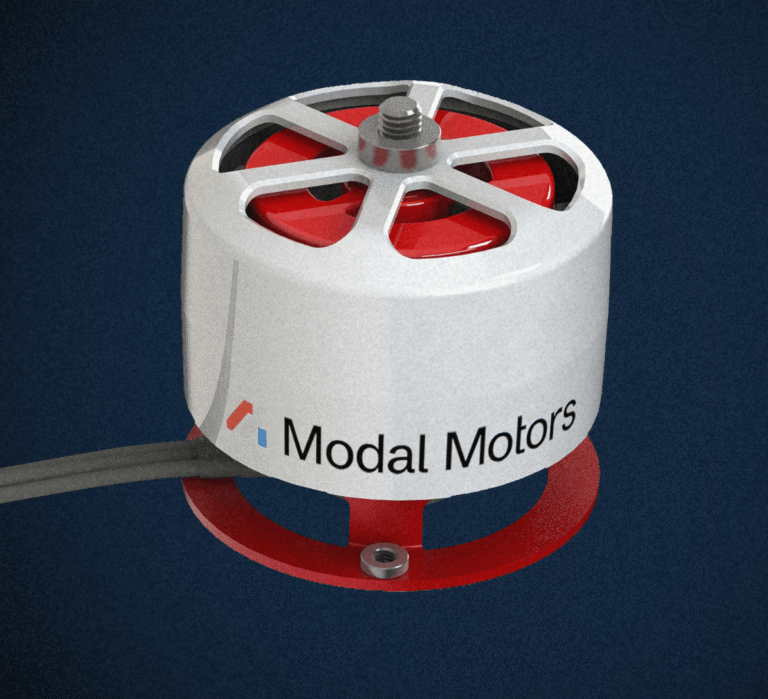
- The startup is developing two motor designs: a compact drone motor and a flat Hybrid Enigma Drive for lower-profile applications.
- Van Steenburg will pitch Modal Motors at TechCrunch Disrupt as part of Startup Battlefield 200.
The push to reshore manufacturing from China into the United States has become a common refrain in hard tech, from drones to robotics. Michael Van Steenburg believes he has found a way to accelerate that transition while removing one of its critical dependencies: an industry-wide vulnerability that few companies are willing to confront directly.
Van Steenburg has spent the past decade developing electric motors domestically across the U.S. and North America. His new startup, Modal Motors, takes that work further by proposing to eliminate rare-earth magnets from the equation entirely, a move he argues is essential for building a truly independent supply chain. He will pitch the company at TechCrunch Disrupt next month as one of the founders selected for Startup Battlefield 200.
Understanding the rare-earth magnet chokepoint
Rare-earth magnets have become the industry standard for electric motors because of their exceptional strength and efficiency. The materials enable compact, high-performance motor designs that power everything from industrial equipment to consumer electronics. China dominates the global supply of rare-earth elements and the manufacturing processes that turn them into magnets, giving the country significant leverage over motor manufacturers worldwide.
The country has demonstrated a willingness to use that leverage. Van Steenburg points to China’s periodic restrictions on rare-earth materials exports as evidence of that geopolitical playbook. “China’s already flexed its muscles a couple times,” he said, referring to those supply cutoffs that have disrupted manufacturers across multiple industries.
The constraint shapes how engineers across the globe approach motor design. Rare-earth magnets deliver superior performance at small scales, which makes them the default choice for applications demanding high efficiency in compact spaces. Shifting away from them requires rethinking fundamental engineering tradeoffs that the industry has relied on for decades.
Why existing reshoring efforts may be falling short
The gap between intention and practice
Numerous companies have announced plans to manufacture electric motors domestically in response to supply chain concerns and geopolitical tensions. However, Van Steenburg contends that most of these efforts do not address the fundamental dependency. Instead, they amount to duplicating proven Chinese motor designs while simply shifting production to the U.S., without questioning whether rare-earth magnets remain necessary.
The timeline mismatch
Those manufacturers are betting that domestic rare-earth magnet production will mature quickly enough to eliminate the dependency. Van Steenburg’s assessment is considerably less optimistic. “Domestic supply of those materials is still years away,” he said. He added that competitors “are hoping that the U.S. rare-earth magnet system is going to get up to speed fast enough. It’s going to still be a while longer before they can actually replace China.”
The implication is that conventional reshoring efforts, no matter how well-intentioned, are racing against a clock they may not beat. By the time domestic rare-earth magnet production reaches scale, geopolitical conditions could shift again, or competing uses could outbid motor manufacturers for available supply.
Modal’s structural advantage
By designing motors that do not require rare-earth magnets, Modal avoids the race altogether. The company attempts to eliminate the dependency rather than hope it resolves itself through incremental improvements to domestic supply chains.
Two motor designs addressing different markets
Modal is preparing two distinct products for commercial launch, each targeting different performance requirements and use cases. The first is a compact electric motor engineered for the drone industry, though the company identifies potential applications across fans, blowers, and actuators. According to Modal’s technical specifications, the design prioritizes minimizing mass while delivering maximum torque density and efficiency. Performance metrics like these have conventionally driven manufacturers toward rare-earth magnets as the only viable solution.
The second product represents a more unconventional engineering approach. Modal calls it the “Hybrid Enigma Drive,” a planar motor with a flat profile suited for applications where traditional cylindrical motor designs will not fit. Lower-profile spaces in consumer electronics, automotive components, and robotics represent a growing design constraint, making a flat-form motor a potentially valuable addition to the market.
Van Steenburg is leveraging decades of automotive industry experience to bring these motors from prototype to customer-ready status. The automotive sector provided him deep familiarity with the performance standards, reliability requirements, and manufacturing constraints that govern motor design in real-world applications.
Van Steenburg’s unconventional perspective
A career working on hard problems
Van Steenburg describes himself as someone driven by a conviction to tackle problems that most of the industry avoids or defers. That same sensibility appears to define how he is approaching Modal Motors. Rather than accept rare-earth magnets as inevitable, he is building motors that eliminate that constraint entirely.
An ironic detour through China
Van Steenburg’s path to founding Modal includes an unexpected chapter in China itself. In the late 1990s, he worked on a hybrid gas-electric drivetrain technology. China expressed interest in deploying that technology in its so-called “People’s Car” initiative. Reflecting on that moment now, he finds the contrast striking and somewhat absurd. “It’s kind of comical,” he said, observing how his work once served China’s automotive ambitions when the geopolitical landscape was entirely different.
A quarter-century of observation
Van Steenburg has been tracking China’s approach to resource acquisition and supply chain control for more than 25 years. His characterization of the trend is unsparing and detailed. “I always tell people that the clock started ticking 25 years ago, and in that whole time, I’ve watched a slow-motion train wreck as China’s been going around the world, grabbing mines, grabbing mineral rights, doing all these things, and slowly but surely monopolizing the entire rare-earth supply chain,” he said.
That vantage point informs Modal’s entire strategy. Van Steenburg views the rare-earth magnet dependency not as a temporary friction in the reshoring movement, but as a structural problem that will persist unless directly addressed at the motor design level.
Market timing and industry implications
Modal’s launch arrives at a moment when hardware startups and supply chain resilience have become increasingly central to investor thinking. Geopolitical tensions, trade restrictions, and manufacturing dependencies are shaping capital allocation in ways they did not five years ago. The company enters a market where the ability to operate outside China’s supply chains is becoming a competitive advantage rather than a nice-to-have feature.
Whether Modal’s motor designs can deliver the performance and reliability customers expect while avoiding rare-earth magnets entirely remains an open question. If the approach works at scale, it could reshape how the entire motor manufacturing industry thinks about design, supply chain strategy, and geopolitical risk. If it does not, the company will become a cautionary tale about the limits of engineering solutions to geopolitical problems.
Frequently Asked Questions
Why does Modal Motors avoid rare-earth magnets?
Rare-earth magnets give China control over global motor supply chains. Van Steenburg argues that existing reshoring efforts will not solve this problem until domestic magnet production reaches scale in several years. Modal eliminates the dependency by designing motors that do not require them.
What products is Modal Motors developing?
The company is developing a compact electric motor for drones (also suitable for fans, blowers, and actuators) designed to minimize mass while maximizing torque density and efficiency, and a flat planar motor called the Hybrid Enigma Drive for lower-profile applications.
Who is Michael Van Steenburg and what is his background?
Van Steenburg has spent over a decade building electric motors in the U.S. and North America, with decades of experience in the automotive industry. He will pitch Modal Motors at TechCrunch Disrupt as part of Startup Battlefield 200.
