
Key takeaways
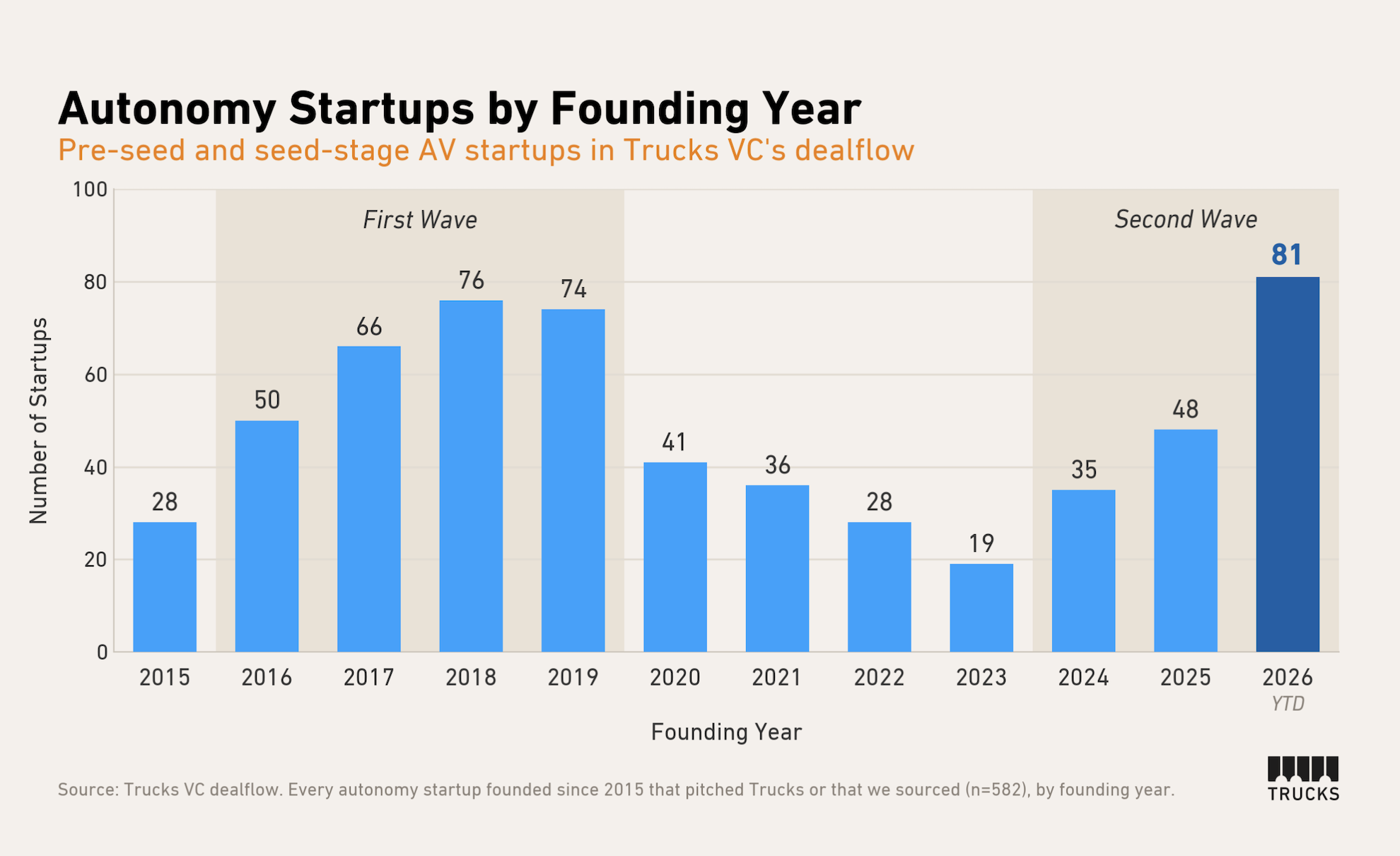
- Trucks VC fielded 81 autonomous vehicle startup pitches in 2026, a two-thirds jump over 2025 and surpassing the 2016-2017 boom, with foundation models making end-to-end architectures feasible.
- Startups can now deploy autonomous systems within months with less than $1 million, contrasting sharply with earlier boom cycles requiring years of capital-intensive development.
- Waymo and Toyota announced a manufacturing partnership to produce AV-ready bZ4X vehicles with Waymo's system integrated; the companies hinted at future licensing deals for consumer vehicles.
- Among 81 startups pitching Trucks VC, many are pursuing robotaxi services as Waymo competitors, though regional and niche players can capture profitable markets without global scale.
The AI-Driven AV Resurgence
The autonomous vehicle industry is experiencing a growth surge that surpasses the frothy funding cycles of 2016 and 2017, but with a crucial difference: foundation models are making the technology practically achievable for startups of all sizes.
According to Trucks VC partner Puneeth Meruva, the venture capital firm specializing in early-stage autonomous vehicle investments has fielded pitches from 81 new AV startups so far in 2026. That number represents a two-thirds increase from 2025 and enough to eclipse the boom years of a decade ago.
How Foundation Models Changed Everything
The inflection point is clear: artificial intelligence is fundamentally altering what’s technically possible in autonomous driving. Foundation models like Nvidia’s Alpamayo and Qwen’s vision-language-action systems are making end-to-end AV architectures feasible in ways that weren’t available during the earlier era dominated by perception-only approaches.
“For a long time AV companies were trying to go from what was AV 1.0 to AV 2.0, which is kind of this holy grail end-to-end architecture for AVs,” Meruva explained. “And I think the foundation models now provide a technical architecture that makes those end-to-end systems possible.” These models excel at generalizing across different environments and driving scenarios, potentially making autonomous vehicles cheaper and faster to bring to market.
The Scale of Growth in 2026
What distinguishes this boom from 2016 is the composition of the 81 startups pitching Trucks VC. While construction, warehouse, agriculture, and mining applications are represented, a significant portion are pursuing robotaxi services and positioning themselves as direct competitors to Waymo. The diversity and ambition suggest that founders see multiple viable paths to commercial success, not just niche industrial applications.
New Deployment Models and Startup Speed
The barrier to entry has collapsed. Trucks VC is seeing startups achieve deployment within months and with less than $1 million in funding. While Meruva declined to name specific companies, the firm has invested in some of these lean operations. This stands in sharp contrast to the capital-intensive, years-long development cycles that characterized earlier generations of AV startups.
The speed and accessibility of modern foundation models have been crucial to this shift. Rather than building perception stacks from scratch, new entrants can leverage pre-trained systems that already understand how to interpret complex visual scenes and make decisions in novel contexts. This modularity allows teams to focus engineering effort on application-specific problems rather than reinventing foundational technologies.
The Robotaxi Wave
Of the 81 startups that pitched Trucks VC in 2026, many are pursuing robotaxi services and positioning themselves as direct competitors to Waymo. While the ambition may seem audacious given Waymo’s scale and maturity, Meruva argues that the market structure supports regional and niche players.
“In this world, smaller, more niche autonomy companies can compete—maybe they’re not competing with Waymo on a global scale, but maybe they’re competing in specific regions or specific types of routes,” he said. The concentration of robotaxi entries signals where founder expectations are highest.
Meruva expects the pace to accelerate further. The firm anticipates receiving even more AV startup pitches in 2027, suggesting that the conditions fueling this wave are structural rather than cyclical.
Infrastructure Investment and Manufacturing
Beyond startups, established infrastructure and capital are mobilizing to support the autonomous vehicle ecosystem.
Re:Build and Strategic Capital
Re:Build, a Massachusetts-based manufacturing accelerator co-founded by Jeff Wilke (Amazon’s former commercial CEO), closed a $2.1 billion funding round led by General Catalyst and JPMorganChase’s Strategic Investment Group. The capital is earmarked to expand Re:Build’s capacity for manufacturing hard tech products and launching new industrial startups.
Bedrock Robotics and Tier-1 Funding
Bedrock Robotics, an autonomous vehicle technology company, raised $600 million in its Series C round at a $4.1 billion valuation. CapitalG and Emergence Capital led the round, with participation from the US Innovative Technology Fund, Bessemer Venture Partners, Temasek, and existing investors including 8VC, Georgian, Valor Equity Partners, Xora, Eclipse, Perry Creek Capital, and Nvidia.
PreScalar, a San Francisco startup developing software and testing infrastructure for factories, raised $7 million in seed funding co-led by Dynamo Ventures and BMW i Ventures. The company’s founding team includes veterans of Cruise, Google, Rivian, and Waymo—a concentration of autonomous vehicle talent that reflects broader industry consolidation around specialized expertise.
Elroy Air, which develops autonomous heavy-cargo drones for defense, rapid response, and commercial logistics, hired Jeremy Hux as Chief Financial Officer in preparation for a public offering.
Partnerships Reshaping the Industry
Waymo and Toyota announced a formal manufacturing partnership, moving beyond exploratory discussions into binding commitments. Toyota will manufacture AV-ready bZ4X vehicles and integrate Waymo’s self-driving system at its factory in Japan. The vehicles will initially operate as robotaxi fleets in Japan, the United Kingdom, and other international markets. Critically, the companies hinted that this partnership could eventually expand into a licensing model, putting Waymo’s autonomous driving technology into privately owned vehicles.
In parallel, Rivian and Volkswagen Group’s $5.8 billion joint venture is expanding its scope to include AI assistants. Rivian’s latest earnings revealed strong demand for its R2 model, prompting the company to raise its 2026 vehicle delivery guidance to at least 67,000 units, up from its prior range of 65,000 to 70,000.
Consolidation and Regulatory Resets
DoorDash completed its acquisition of Instacart for $17 billion, consolidating the grocery delivery and food delivery markets. However, the integration of AI agents into delivery logistics remains nascent; DoorDash reported receiving only a few hundred orders from AI agents in the third quarter, underscoring how early adoption remains despite significant investment in autonomous capabilities.
General Motors agreed to a $220 million settlement with 36 states to resolve allegations that it illegally sold private driving behavior and location data to data brokers. The settlement follows an earlier resolution with California and the Federal Trade Commission. GM is simultaneously embracing hybrid vehicles as part of a strategic pivot toward powertrain diversity.
Ford announced a new charging system for its forthcoming Fathom pickup truck that will allow the vehicle to act as a mobile battery, delivering power to homes or the electrical grid.
Kodiak AI announced its first binding commercial deal for driverless trucks on public highways, committing to deliver 75 autonomous heavy-rig vehicles to freight company DTL Transport beginning in 2028. Tesla is leveraging the car-sharing platform Turo to boost adoption of its Full Self-Driving (Supervised) feature, expanding the user base for its autonomous capabilities. Together, these deployments signal that the commercial viability of autonomous vehicles is moving from concept to execution across multiple use cases.
Source: TechCrunch
Frequently Asked Questions
Why is 2026 seeing more autonomous vehicle startup funding than 2016 and 2017?
Foundation models like Nvidia's Alpamayo and Qwen's vision-language-action systems enable end-to-end autonomous vehicle architectures that were previously impractical. According to Trucks VC, these models allow startups to deploy autonomous systems within months with less than $1 million in funding, dramatically lowering barriers to entry.
Can newer robotaxi startups realistically compete with Waymo?
Trucks VC partner Puneeth Meruva argues that smaller autonomous vehicle companies can compete by targeting specific regions or types of routes rather than pursuing global scale from the start. The 81 startups pitching Trucks VC in 2026 include many pursuing robotaxi services, and Meruva expects the pace to accelerate in 2027.
What manufacturing and partnership developments signal about autonomous driving's future?
Waymo and Toyota's manufacturing partnership produces AV-ready bZ4X vehicles with Waymo's system integrated at a Japan factory for robotaxi fleets in multiple markets. The companies hinted at future licensing deals for personally owned vehicles, suggesting that automakers may distribute autonomous technology rather than developing it independently.
