
Key takeaways
- AxiomMath formally verified the entire Stacks Project, converting 7,654 pages of mathematics into 16 million lines of verifiable computer code to prevent AI-generated mathematical slop.
- Founded by 25-year-old Carina Hong and backed with $200 million in Series A funding, the company trained custom AI models to work in parallel, filling a major gap in algebraic geometry that researchers previously had few verified results to build upon.
- AxiomMath sees formal verification of mathematics as essential infrastructure for future AI agents, positioning verified mathematical proofs as reusable foundations to prevent errors from accumulating when AI systems write code and conduct scientific research.
The mathematics research world receives hundreds of new papers each week. Last month, OpenAI released 719 manuscripts claiming solutions to some of mathematics’ hardest problems. Yet this torrential output carries risk: even computer verification systems can fail. As AI becomes a mathematical research tool, distinguishing rigorous proofs from speculative reasoning has grown harder.
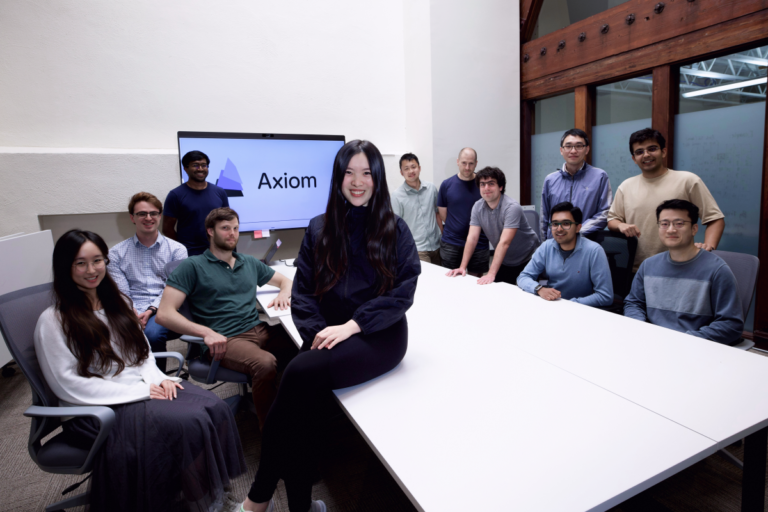
AxiomMath, a $1.6 billion startup, believes mathematics need not follow this dangerous path. Rather than slowing AI’s output, the company is building a verified foundation that AI agents can rely on. On Wednesday, the company announced it had formally verified the Stacks Project, one of the largest and most significant mathematical libraries ever created.
The Stacks Project and Its Importance
A Comprehensive Mathematical Reference
Johan de Jong created the Stacks Project in 2005 at Columbia University as an open-source mathematical reference. Over the past two decades, mathematicians have contributed to it continuously, building a compendium covering everything from undergraduate algebra to cutting-edge algebraic geometry and number theory. Today, the project comprises approximately 7,654 pages of mathematical exposition.
The Stacks Project holds rare significance within mathematics. Columbia mathematician Peter Woit has called it “nothing else really comparable,” drawing parallels to the Bourbaki books, a mid-20th-century series that rebuilt mathematics from foundational principles. For researchers at the frontier of algebraic geometry, Stacks serves as an essential reference.
Formal Verification as the Solution
Formal verification converts mathematical proofs into computer code that can be checked with absolute certainty. A proof assistant examines the code line by line; if it passes, the proof is logically sound with no exceptions. Engineers use this approach to verify chip designs. Researchers in France have used it to catch bugs in software calculating family benefits.
AxiomMath translated Stacks into approximately 16 million lines of Lean code, a specialized programming language for mathematical verification. This translation preserves not just individual theorems but the intricate web of dependencies connecting every result to foundational concepts. The challenge was preserving this structure perfectly across millions of lines.
Building the Verified Foundation
The Company and Its Vision
Carina Hong, 25, dropped out of a Stanford mathematics PhD program and founded AxiomMath in March 2025. That month, the company raised a $200 million Series A led by Menlo Ventures. Hong told TechCrunch that the interconnected nature of Stacks presented a critical challenge: “Things that are big and things that are delicate in life just don’t go together. [Stacks] is a collection of mathematical results that is the foundation of mathematics. You want theorems to be consistent and not paradoxical. You want the definitions to not fight with each other.”
The AI Approach
AxiomMath distinguished itself by training its own AI models for mathematics, a strategy most verification startups had not adopted. The company deployed AI agents to work through Stacks in parallel, allowing agents to identify tasks independently rather than following rigid hierarchical assignment. Ashvin Swaminathan, a member of the technical staff, explained: “With Stacks, we imposed a hierarchy, but it was not a complete hierarchy. The agents were finding tasks for themselves and identified things they could work on in parallel.”
Initially, a human Lean expert taught the agents not just formalization mechanics but what constitutes elegant code. Over time, the agents developed this judgment autonomously, requiring less guidance.
Closing a Massive Gap
For decades, algebraic geometry existed as a black hole in formalized mathematics. Researchers wanting to build on prior work using Lean had almost no verified mathematics to build upon. Swaminathan described the completion simply: “Well, now they do.”
This matters because verified results compound. Terence Tao, UCLA mathematician and Fields Medal winner, observed that “the more formalized proofs you have, the more formalized proofs you can make.” Each verified theorem becomes a foundation for future proofs, accelerating progress without sacrificing rigor.
Foundations for the AI Era
Software Development and Correctness
AxiomMath’s ambitions extend beyond mathematics. Developers worldwide struggle to guarantee code contains no bugs or security vulnerabilities. As AI agents increasingly write code, this challenge intensifies. The company argues that software built on verified mathematical foundations offers stronger correctness guarantees.
Swaminathan articulated the vision: “We believe that mathematics is the domain where you start building these things, and it’s a transferable skill. Agents can read our code, understand it, and build new infrastructure on top of it. Our Lean formalization is now the substrate that agents can build upon.”
The Future of AI-Assisted Work
AxiomMath’s agents constructed Stacks by working independently, selecting their own tasks, and sharing coherent knowledge, an approach that mirrors Hong’s vision for AI’s future. As AI agents take on increasingly complex roles, they require well-constructed, reusable libraries of verified knowledge to prevent errors from accumulating across systems.
Hong emphasized the stakes: “You want agents to have a reusable library for them to build on and keep pushing the frontier. If you slop drop in a way that’s bad engineering choices in the beginning, then it’s very hard for them to grow that boundary.”
She extended an explicit challenge to the industry: “I openly challenge all the coding companies to work on formalization at this scale.”
Source: TechCrunch
Frequently Asked Questions
What is the Stacks Project?
The Stacks Project, started by Columbia mathematician Johan de Jong in 2005, is an open-source mathematical reference comprising about 7,654 pages covering algebra, geometry, number theory, and algebraic geometry. It is considered one of the largest and most significant bodies of mathematics ever assembled by humans.
What is formal verification and why does it matter?
Formal verification converts mathematical proofs into computer code that a proof assistant checks line by line. If the code passes, the proof is guaranteed logically sound. This approach has applications beyond mathematics: engineers use it to verify chip designs, and it can catch security bugs in software.
Why did completing the Stacks Project verification matter?
Algebraic geometry had been almost entirely absent from formally verified mathematics. Researchers had few checked theorems to build upon. According to mathematician Terence Tao, having more formalized proofs enables creation of additional formalized proofs, so Stacks' verification unlocks future research.
