
Key takeaways
- TechCrunch Disrupt 2026 (Oct 13–15) centers on interactive roundtables rather than lectures, allowing founders and investors to discuss shared challenges across 10,000+ attendees in San Francisco.
- AI sessions emphasize agents completing entire workflows, enterprise software layered with AI rather than replaced, and specialized data as the real competitive advantage in a world of commoditized models.
- Physical AI is being evaluated on product reliability and workflow integration rather than demo performance, with applications expanding into construction, energy, and infrastructure beyond autonomous vehicles.
- Fundraising roundtables focus on strategic capital choices and avoiding overfunding traps rather than maximizing check size, with emphasis on building sustainable unit economics and aligned investor incentives.
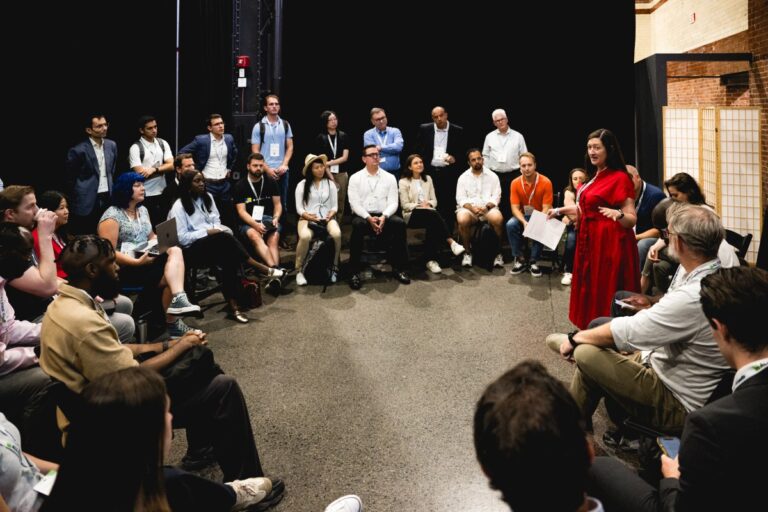
TechCrunch Disrupt 2026 arrives October 13–15 at Moscone West in San Francisco, bringing together more than 10,000 founders, investors, operators, and technology leaders for three days centered on interactive roundtables rather than the traditional keynote-and-panel format. Attendees join small groups with founders and investors working through shared challenges—asking questions directly relevant to their own companies, comparing approaches across the table, and leaving with actionable perspectives on fundraising, hiring, scaling, and how to think about artificial intelligence.
Why Roundtables Replace the Stage Model
Two dedicated roundtable spaces run sessions throughout Disrupt, prioritizing discussion over lecture. Instead of passively absorbing remarks from industry experts, participants bring real questions about their ventures. The format invites comparison rather than consumption, with topics spanning enterprise software architecture, physical AI reliability, fundraising mechanics, and where AI creates defensibility.
Artificial Intelligence: From Assistants to Autonomous Workflows
Layering AI Into Enterprise Systems
A central tension in enterprise technology is whether AI will replace software-as-a-service or transform how it operates. One roundtable explores the second scenario: AI isn’t necessarily displacing SaaS, but exposing fragmentation in how companies manage workflows. The conversation centers on orchestration, organizational context, and running intelligence across disconnected systems—potentially defining the next generation of enterprise applications.
Finance illustrates the shift. IPO readiness traditionally happens late, when bankers impose discipline on accounting and documentation. AI-enabled finance teams can automate these processes earlier, building the rigor public markets require years before filing. Eléonore Crespo, co-founder and co-CEO of Pigment, and Sofia Fatakhova, senior vice president of finance and capital markets at Chime, explore how founders can prepare for exits on a different timeline.
Agents Completing Entire Workflows
The evolution from AI assistants to autonomous agents marks a qualitative shift. Early tools helped humans work faster; agents increasingly complete entire workflows independently. Commerce offers one frontier: shopping is moving from keyword-based search to understanding actual intent, reshaping personalization, transaction handling, and which company ultimately owns the customer relationship. Srishti Chaudhary, senior manager of product for Walmart eCommerce, explores what agentic systems mean for how customers buy and who captures the relationship.
Enterprise software vendors see another immediate opportunity. Fortune 500 companies don’t want to overhaul their core systems—they want intelligent agents working within existing architecture. Why pilots stall and how to evaluate whether a workflow actually needs an agent before committing infrastructure and teams is another session’s focus.
Specialization as Defensibility
As large language models improve and become more accessible, specialized data is becoming the real competitive edge. Which datasets are emerging as valuable, which applications require them most, and which businesses are forming around this layer of the AI stack? For founders, the implication is that access to domain-specific training data can provide defensibility that generic models cannot.
Physical AI Moves Beyond the Demo
Building AI products for the physical world operates under entirely different constraints than software. A successful robotics demonstration isn’t the same as a product customers will actually adopt at scale. Logan Farrell, co-founder and CTO of Rugged Robotics, and Austin Yount, partner at Brick & Mortar Ventures, dig into reliability, workflow integration, trust, ROI calculations, and what it takes to move a physical AI system from prototype to production.
The data challenges for robotics and autonomous systems compound the engineering burden. Edge cases, multimodal sensor data, and building pipelines that operate reliably in unpredictable conditions create friction that scaling models alone doesn’t solve. Physical AI is expanding beyond vehicles into construction, property, infrastructure, and energy—sectors where outdated workflows and underserved industries create openings for new startups, according to Rob Biederman, managing partner at Asymmetric Capital Partners.
Fundraising: Strategy Over Volume
The Full Cycle of Raising Institutional Capital
Raising money involves far more than pitching. Sessions break down the complete journey: choosing investors who align with your strategy, securing warm introductions, managing competitive processes, negotiating terms, and building a capitalization table that serves the company rather than creating misaligned incentives. When institutional investors make early bets, which founder signals matter before traction exists? How do you tell your story in a way that resonates? What common approaches kill momentum?
Learning when to start fundraising, constructing an investor narrative that generates momentum, and navigating the institutional round is the focus of another roundtable with Itamar Novick, founder and general partner of Recursive Ventures, and Brian Sparkes, CEO of Silicon Valley Venture Corp.
The Trap of Overfunding
More capital creates different problems than its absence. Overfunding leads to dilution, misaligned expectations, and incentives that damage the business. Founders can raise enough to execute strategy without creating pressure that undermines decision-making—but it requires clarity on capital needs and discipline in which investors to accept. Growth that looks impressive on paper can quietly drain cash. Forecasting, inventory management, retail terms, and cash flow management matter more than revenue growth alone, with sessions exploring how founders build sustainable companies without losing sight of unit economics.
Emerging Frontiers: Quantum, Science, and Space
Quantum Computing’s Path to Relevance
Quantum computing is moving closer to practical applications. Sessions equip investors with grounding in how the technology actually works, which opportunities are real, and which milestones genuinely separate progress from hype. Jack Hidary, CEO of SandboxAQ, and Stacie Calad-Thomson, global business development lead for life science labs and manufacturing at Nvidia, explore quantum’s trajectory and emerging commercial applications.
AI Grounded in Physical Science
The next generation of AI extends beyond language into physics, chemistry, biology, and mathematics, unlocking possibilities across healthcare, materials science, energy, finance, and industrial systems. What happens when AI can test thousands of scientific hypotheses instead of dozens? Autonomous experimentation and AI-driven discovery could fundamentally accelerate research timelines. Healthcare organizations have adopted AI unusually rapidly. Why, and what obstacles still stand? Founders building lasting value as healthcare companies reshape procurement need to understand both the speed of adoption and why some implementations stall.
Where Hard Tech Concentrates
El Segundo, California has become a concentration point for space, defense, and hard tech startups. What attracts founders, capital, and talent to the region? How does a city create the environment where hard tech companies grow? Kevin Hawkins, head of partnership development and media distribution at the New York Stock Exchange, and Drew Boyles, El Segundo City Councilmember, explore these regional dynamics.
Registration and Event Details
Disrupt runs October 13–15 at Moscone West in San Francisco. Registration is available with discounts up to $100 off standard passes, plus 50% off a second pass for a colleague, partner, or peer. Attendees can explore the full agenda and reserve spots at specific roundtable sessions before the event begins.
Source: TechCrunch
Frequently Asked Questions
When and where is TechCrunch Disrupt 2026 taking place?
TechCrunch Disrupt 2026 runs October 13–15, 2026 at Moscone West in San Francisco.
How many people are expected to attend Disrupt 2026?
More than 10,000 founders, investors, operators, and technology leaders are expected to attend.
What is the main format of sessions at Disrupt 2026?
The centerpiece is interactive roundtables across two dedicated spaces, where attendees join founders, investors, and operators discussing shared challenges rather than listening to prepared remarks from a stage.
