
Key takeaways
- The SPAC merger represents a major milestone for European quantum hardware, which has struggled to access public capital markets compared to U.S.
- IQM’s journey to public markets has been funded by an aggressive private capital campaign that positioned the company as Europe’s most heavily backed quantum hardware firm.
- Academic and industry research published in 2026 has cast doubt on the near-term commercial payoff of quantum computing.
- IQM’s $1.8 billion SPAC valuation sits substantially below that of Quantinuum, the Honeywell-backed quantum hardware competitor that completed its Nasdaq IPO on June 4, 2026 at a $12.7 billion valuation under ticker QNT.
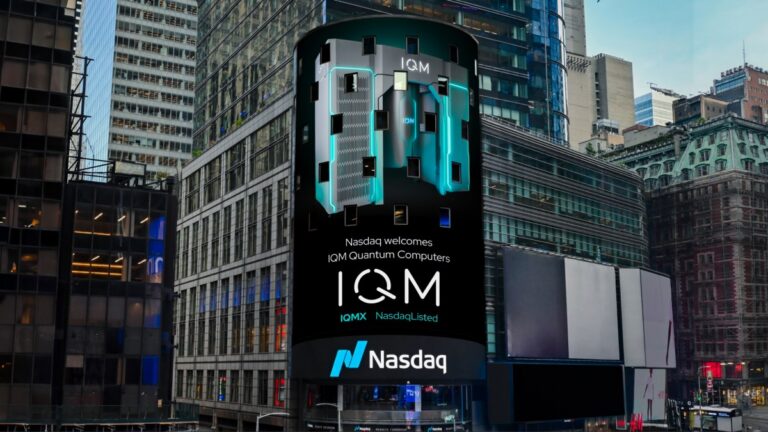
IQM Quantum Computers, a Finnish-German quantum hardware manufacturer, is merging with U.S. SPAC Real Asset Acquisition Corp. (RAAQ) at a $1.8 billion valuation, becoming the first European quantum computing company to list on a major U.S. exchange on February 23, 2026. The deal will deliver more than $450 million in post-transaction liquidity and establish dual listings on Nasdaq under ticker IQMX and potentially on the Helsinki Stock Exchange, positioning IQM as a flagship European deep-tech public company in a sector where most scaling players have opted for U.S.-only listings. Yet the transaction arrives amid a stark mismatch between IQM’s valuation and its commercial traction, raising hard questions about whether the quantum computing industry can deliver on decades of hype.
A Quantum Leap for European Tech—On Uncertain Ground
The SPAC merger represents a major milestone for European quantum hardware, which has struggled to access public capital markets compared to U.S. competitors. IQM’s listing comes as the quantum computing sector attracts intense investor Interest, with governments worldwide committing over $40 billion in public funding for quantum technologies over the next decade. Yet IQM’s path to the public markets reveals the deep tensions within the industry: the company reported $30.9 million in revenue during 2025 and delivered 21 quantum systems to 13 customers, figures that stand in stark contrast to its $1.8 billion equity valuation.
The SPAC deal will be funded by approximately $175 million from RAAQ’s trust account, $134 million from PIPE financing at $10.00 per share, about $24 million from warrant exercises, and $172 million in existing cash from IQM’s balance sheet as of year-end 2025. IQM’s superconducting quantum computers have been installed at research institutions and high-performance computing centers in Finland and Germany, but the company’s order intake and visibility of over $100 million by year-end 2025 remains modest relative to the capital being deployed.
A Unicorn Betting on Tomorrow’s Breakthroughs
IQM’s journey to public markets has been funded by an aggressive private capital campaign that positioned the company as Europe’s most heavily backed quantum hardware firm. In September 2025, the company closed a $320 million Series B round, bringing total funding to $600 million and earning it unicorn status with a valuation exceeding $1 billion. The round was led by U.S. venture firm Ten Eleven Ventures and backed by Finnish state investor Tesi, along with pension funds Elo and Varma, strategic investors from Schwarz Group and Winbond Electronics, and sovereign funds including the European Innovation Council and Bayern Kapital. Goldman Sachs International acted as sole placement agent, underscoring the deal’s scale.
CEO and co-founder Jan Goetz told media outlets in September 2025 that while an IPO was theoretically possible, “there are still attractive routes to secure capital in private markets” and that the company had “no immediate plans for an IPO.” That posture shifted dramatically within months, signaling both the capital intensity of quantum hardware development and the shifting terrain between private funding and public markets. The acceleration toward a public listing reflects the mounting pressure on quantum companies to demonstrate progress toward commercialization, even as the underlying science remains unproven at scale.
The Revenue-Valuation Gap and Industry Skepticism
Academic and industry research published in 2026 has cast doubt on the near-term commercial payoff of quantum computing. A peer-reviewed study analyzing technology roadmaps from providers including IBM and IQM concluded that “according to the available technology roadmaps, there is no clear path to quantum advantage within the next five to eight years” and that “in the short term, no clear benefits from pure quantum devices should be expected.” The paper cites ongoing challenges in qubit scaling, connectivity, error correction, and algorithmic efficiency as barriers to meaningful quantum advantage on real industrial problems.
This skepticism stands in sharp contrast to the capital flowing into the sector. Over 30 governments have committed more than $40 billion in public funding for quantum technologies, yet private venture investment in quantum companies has contracted significantly in 2024 and 2025. IQM’s reliance on both public programs—including national and European Union quantum initiatives—and private capital underscores how the quantum economy has become a hybrid, policy-driven sector where government support often outweighs commercial demand.
A Valuation Puzzle in a Crowded Field
IQM’s $1.8 billion SPAC valuation sits substantially below that of Quantinuum, the Honeywell-backed quantum hardware competitor that completed its Nasdaq IPO on June 4, 2026 at a $12.7 billion valuation under ticker QNT. Quantinuum reported similar revenue scale to IQM—$30.9 million in 2025—but commanded a valuation more than seven times larger, reflecting investor appetite for U.S.-based quantum firms with deep corporate backing. Quantinuum had previously raised $600 million at a $10 billion valuation in 2025, demonstrating how rapidly quantum company valuations have inflated despite minimal commercial traction.
IQM’s more modest SPAC valuation may reflect both the European market’s smaller appetite for pre-revenue deep-tech bets and investor caution about the timeline to quantum advantage. The $1.8 billion price tag values IQM at roughly 50 times its expected 2025 revenue, a multiple that presumes explosive growth in quantum system sales over the next five to ten years. Whether that growth materializes depends on breakthroughs in error correction, qubit fidelity, and algorithmic innovation that remain beyond the horizon of near-term predictions.
The European Quantum Moment—And Its Limits
IQM’s listing marks a symbolic victory for European quantum ambitions, which have historically lagged behind U.S. and Chinese efforts in both public funding and private capital concentration. The company’s dual listing plan—with potential Helsinki Stock Exchange inclusion—signals ambitions to anchor quantum computing development in Europe and attract regional investors. Finland’s government has positioned quantum computing as a strategic technology priority, and IQM’s founders and early investors have leveraged that support to build a world-class hardware team.
Yet the broader quantum ecosystem remains fragmented, with most scaling quantum companies headquartered in the United States and attracting the lion’s share of institutional capital. IQM’s European base and funding structure—while impressive in absolute terms—have not translated into a valuation premium relative to U.S. peers, suggesting that geography and regional policy support matter less than proximity to large corporate customers and U.S. Venture Capital networks.
What Lies Ahead for IQM and the Quantum Sector
The next critical milestone for IQM will be the completion of its SPAC merger and the commencement of trading on Nasdaq, expected in the coming months. Investors will scrutinize the company’s 2026 revenue guidance, customer pipeline, and technical progress on qubit count, coherence times, and error rates. Any delays in product roadmaps or customer wins could pressure the stock, particularly if Quantinuum or other public quantum competitors report disappointing results.
IQM’s public listing will serve as a bellwether for investor appetite for quantum computing hardware at early commercial stages. The company’s ability to scale revenue, secure major enterprise customers, and make demonstrable progress toward quantum advantage will determine whether its $1.8 billion valuation proves prescient or inflated. For European technology investors and policymakers, IQM’s fate will signal whether the continent can build and scale quantum computing champions to compete with U.S. and Asian rivals.
