
Key takeaways
- Pacific Fusion broke ground on a New Mexico facility designed to achieve net facility gain—generating as much energy as the facility consumes—a milestone no commercial fusion company has reached.
- The demonstration facility will produce about 100 megajoules per pulse, roughly 10 times the National Ignition Facility's output, despite being a demonstration-scale system.
- Pacific Fusion aims for net facility gain by 2030 and commercial power plant operation by mid-2030s, competing with similarly well-funded startups including Commonwealth Fusion Systems and Helion Energy.
Fusion power, long confined to research labs and government facilities, may finally be approaching commercial reality. Pacific Fusion announced this week it has begun construction on a demonstration facility in Albuquerque, New Mexico, designed to accomplish a milestone no private fusion company has yet achieved: generating as much energy as the facility consumes in the process.
The breakthrough represents a crucial waypoint in the journey toward commercial fusion power plants. While researchers at the National Ignition Facility demonstrated in 2022 that controlled fusion reactions can produce more energy than the reaction itself requires, a facility powering that reaction still consumes far more energy overall. Pacific Fusion’s facility aims to close that gap, a goal the company targets for 2030, with a commercially viable power plant operating by the mid-2030s.
What Pacific Fusion is building
The demonstration facility, located in Albuquerque, represents a significant bet on the startup’s proprietary approach to fusion energy. Carrie von Muench, the company’s co-founder and chief operating officer, told TechCrunch that the project represents an unprecedented engineering effort. To our knowledge, there’s no such facility being constructed in the country, she said.
The facility will be designed to test Pacific Fusion’s method for achieving fusion, which relies on a carefully orchestrated sequence of electrical pulses to generate a powerful magnetic field. This field confines a fuel target roughly the size of a pencil eraser, compressing it until the atoms fuse together. The compression happens in extraordinarily brief timeframes and requires extreme precision in the timing and intensity of the electrical inputs.
Scale of operation
In its demonstration phase, the facility will be capable of executing only a handful of shots per day, according to Keith LeChien, Pacific Fusion’s co-founder and chief technical officer. A commercial-scale power plant, by contrast, would need to complete one shot every second. That jump in repetition rate—from a few times daily to continuously—represents one of the central engineering challenges for scaling the technology beyond the demonstration phase.
The commercial reactor itself will need to generate approximately five times more energy than the demonstration system, a requirement driven not just by inefficiencies in the scaling process but by the additional equipment a power plant requires to convert the energy into electricity and manage the facility’s own operations.
The electrical architecture
Modular design
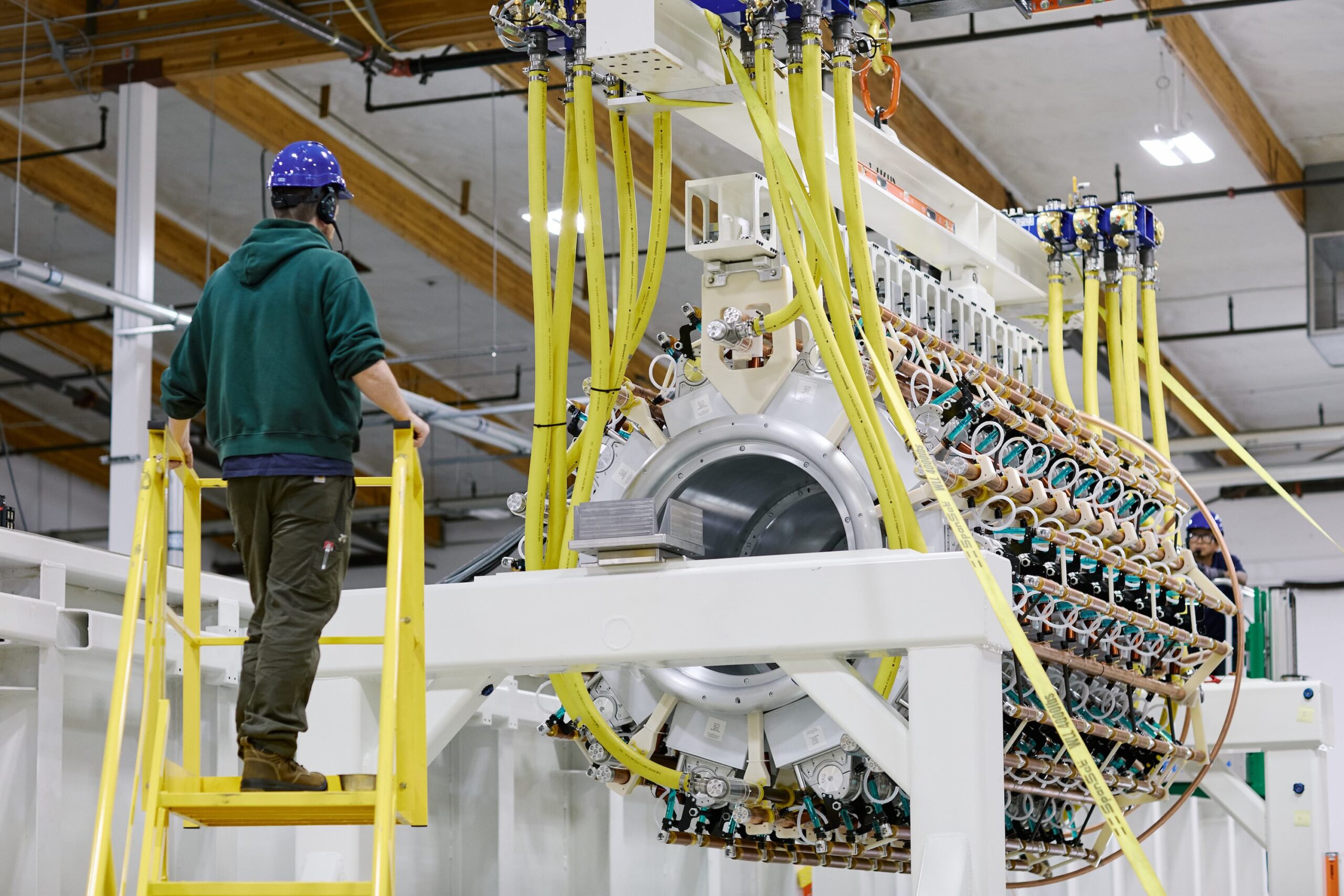
Pacific Fusion’s approach relies on 156 separate pulser modules, each containing 32 circular stages. Each stage consists of 10 brick-shaped units. Every brick houses two capacitors, which store electrical energy, and one switch, which releases it. This modular architecture allows the company to test components at scale before committing to the full system.
Earlier this year, Pacific Fusion tested a one-third-scale version of a single pulser module. The test generated 440 gigawatts of peak power in 80 nanoseconds—an extraordinarily brief window. The performance was sufficient to greenlight the full facility’s construction, suggesting the company has confidence in scaling the approach.
Power output
Each pulse from the completed demonstration facility will deliver approximately 100 megajoules of energy, according to LeChien. This output represents roughly 10 times the energy released by the National Ignition Facility’s pulses. The gain is particularly striking given that Pacific Fusion’s system is still a demonstration device, not a full commercial power plant. The capacity suggests the company’s design may offer a meaningful advantage over other approaches under development.
National security applications
Beyond the demonstration facility’s civilian energy applications, the Albuquerque site will also host experiments related to national security. The U.S. government operates other facilities for similar research, including the National Ignition Facility, which has been in operation for decades and is beginning to show signs of aging infrastructure.
LeChien emphasized the geopolitical dimension of the race to build high-yield fusion facilities. This exists nowhere in the world, he said. China is building these types of facilities, and we intend to be the first to deliver them.
Timeline and commercial goals
Pacific Fusion’s pathway to commercialization is aggressive but grounded in concrete milestones. The company aims to demonstrate net facility gain—the core technical achievement—by 2030. If successful, it would position the startup to operate a commercial power plant by the mid-2030s. The timeline compresses the historical development cycle for fusion technology, which has extended across decades at government labs.
The aggressive schedule became possible partly through the company’s funding structure. Pacific Fusion was founded in 2023, making it one of the younger entrants to the commercial fusion field. It also counts among the best-funded fusion startups globally. Von Muench noted that the capital structure was designed to enable long-term planning without recurring fundraising cycles.
I don’t think it would have been possible to move at this speed if we hadn’t designed the capital stack the way that we have, she said. The large, gated funding round provided the company certainty about its financial runway, allowing engineers and executives to focus on technical progress rather than quarterly fundraising efforts.
The competitive landscape
Rivals pursuing similar timelines
Pacific Fusion is not alone in racing toward commercial fusion power. A cohort of well-funded startups are pursuing similar timelines, each backed by substantial capital and focused on different technological approaches. Commonwealth Fusion Systems, Helion Energy, Proxima Fusion, and Inertia Enterprises are all targeting grid connection for a fusion power plant by the mid-2030s, or in some cases even sooner.
The density of well-funded competitors suggests the market believes commercial fusion is approaching feasibility. Each startup’s choice to pursue such aggressive timelines, backed by substantial investment, represents a collective industry bet that the technical and engineering barriers are surmountable within a decade.
Why the capital structure matters
Pacific Fusion raised over $1 billion in a milestone-based Series A, a funding round notable not just for its size but for its structure. Traditional venture funding for fusion has often required startups to return to investors frequently, asking for fresh rounds every few years. A milestone-based funding approach, by contrast, releases capital as the company hits predefined technical targets, providing more predictable cash flow and reducing the pressure to overpromise or pivot prematurely.
This funding model may give Pacific Fusion an operational advantage over competitors raising capital through more traditional venture structures. It also reflects growing investor confidence in the fundamental physics of fusion and increasing belief that the barriers to commercialization are engineering challenges rather than physics problems—and engineering challenges, given enough capital and talent, can typically be solved.
Frequently Asked Questions
What is net facility gain?
Net facility gain means a fusion reaction produces as much energy as the facility operating it requires. While the National Ignition Facility demonstrated controlled fusion reactions with energy gain, the overall facility still uses more energy than it generates.
When does Pacific Fusion plan to achieve its milestones?
Pacific Fusion targets net facility gain by 2030 and plans to operate a commercial power plant in the mid-2030s.
Who are Pacific Fusion's main competitors?
Commonwealth Fusion Systems, Helion Energy, Proxima Fusion, and Inertia Enterprises are similarly well-funded startups also targeting grid-connected commercial power plants by the mid-2030s.
