
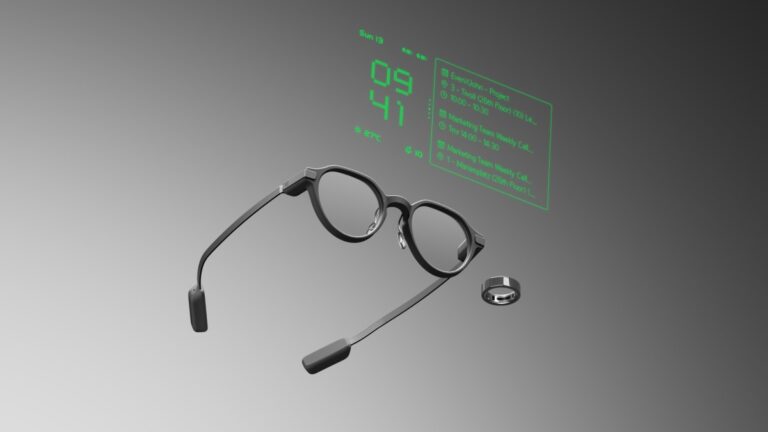
Even Realities, a three-year-old Shenzhen-based smart glasses manufacturer, has secured $150 million in pre-Series B funding at a $1 billion valuation, with Chinese tech giants Meituan and Tencent leading the round. The capital injection arrives just weeks after the company launched its Even G2 smart glasses and Even R1 smart ring on November 12, 2025, positioning the Startup as a serious contender in the competitive augmented reality hardware market dominated by Meta and other established players.
A Privacy-First Hardware Play Backed by Major Chinese Investors
Meituan and Tencent’s joint backing of Even Realities signals renewed confidence in smart glasses as a viable consumer technology category, moving away from the metaverse hype that dominated venture funding in 2021 and 2022. The $150 million round represents one of the largest recent funding events in the AR/smart glasses sector, outpacing VITURE’s $100 million Series B round completed in September 2025. Even Realities’ rapid ascent to unicorn status in just three years demonstrates investor appetite for hardware startups with differentiated product strategies and strong founding teams.
The company’s flagship product, the Even G2 smart glasses, launched at $599, featuring a display 75% larger than its predecessor G1 model while maintaining a lightweight 36-gram form factor. The accompanying Even R1 smart ring, priced at $249, serves as a control Interface for the glasses without requiring cameras or speakers on the eyewear itself. Both products became available for immediate purchase following their November 12 announcement, indicating the company has moved beyond prototype stage into full-scale production and distribution.
Tencent’s Strategic Pivot Toward AI Hardware Infrastructure
Tencent’s participation in Even Realities’ funding round reflects CEO Pony Ma’s explicit strategic pivot, with the executive declaring that “AI is now the only area worth investing.” The Chinese internet conglomerate has begun systematically exiting non-core investments, including stakes in JD.com and Meituan, to concentrate capital on artificial intelligence initiatives. This marks a dramatic shift from Tencent’s 2022 pullback from metaverse and XR projects, signaling that the company now views ambient AI applications in wearable form factors as the next major computing frontier.
Meituan, which Tencent first invested in during 2014, also participated as a lead investor in this round, underscoring confidence from one of China’s largest e-commerce and delivery platforms. The dual backing from these major players provides Even Realities with not only capital but also potential distribution partnerships, marketing channels, and integration opportunities within Meituan’s massive user base and Tencent’s cloud and AI infrastructure ecosystem.
Conversate: The AI Feature Differentiating Even Realities From Competitors
Even Realities’ standout competitive advantage centers on “Conversate,” a contextual AI feature powered by the company’s proprietary Even LLM that generates answers three times faster than previous iterations while maintaining conversation memory across sessions. The feature proposes follow-up questions during conversations, generates real-time subtitles, summarizes meetings, and delivers immediate answers—all without requiring the user to constantly engage with a screen or device. The company positions Conversate as a “quietly extraordinary power” for professionals and knowledge workers seeking to remain engaged in human interaction without constant digital distraction.
The privacy-first design philosophy underlying Even G2 distinguishes the product from camera-equipped competitors like Google Glass and early Meta prototypes that triggered consumer backlash over surveillance concerns. The G2 contains no camera or speaker on the glasses themselves, instead relying on four strategically placed microphones—one directional mic for the wearer and three ambient sound microphones—to enable live translation and voice command activation via the “Hey Even” wake phrase. This architecture directly addresses the “creepy factor” that plagued earlier generations of smart eyewear.
Hardware Specifications Position Even G2 as Premium Consumer Product
The Even G2 display delivers 100% improved uniformity and 50% sharper resolution compared to previous generations, with peak brightness reaching 1,200 nits—sufficient for comfortable outdoor use even in direct sunlight. Battery performance has extended to more than two days on a single charge, with the included charging case capable of delivering seven full recharges before requiring AC power. The device integrates health-tracking sensors including a PPG sensor for heart rate and blood oxygen monitoring, skin temperature measurement, an accelerometer, and a geomagnetic sensor for head-movement-adaptive navigation.
The $599 price point positions Even G2 above Meta’s Ray-Ban Meta glasses, which retail at $299, reflecting the company’s strategy to target a premium segment prioritizing privacy, battery life, and AI capabilities over mass-market accessibility. This pricing segmentation suggests Even Realities sees opportunity in serving professionals and early adopters willing to pay for differentiated features rather than competing directly with Meta’s volume-focused approach.
The Smart Glasses Funding Boom Amid Broader Startup Market Consolidation
Even Realities’ unicorn status arrives during a period of significant consolidation in the broader startup ecosystem. As of mid-2025, approximately 1,600 private companies carried valuations exceeding $1 billion, yet over 60% of these companies had not raised new funding rounds within the preceding three years and many continued burning cash without clear paths to profitability. Bloomberg Businessweek characterized the landscape in early 2025 as a “billion-dollar startup bubble deflating,” with over $1 trillion in value locked within companies facing uncertain commercial futures.
Even Realities’ achievement of unicorn valuation in just three years stands as a notable exception to this broader trend of stagnating valuations and dwindling investor confidence. The company’s rapid progression from founding to $1 billion valuation, paired with immediate product launches and major investor backing, suggests strong commercial traction and differentiated technology that resonates with both Venture Capitalists and consumers. Other smart glasses competitors like XPANCEO, which raised $250 million for smart contact lens technology in January 2025, indicate sustained investor interest in the wearable computing category despite overall market caution.
What Comes Next for Even Realities and the Smart Glasses Market
The key storyline to monitor involves Even Realities’ ability to scale production and distribution beyond early adopters in China to international markets, particularly North America and Europe where privacy-conscious consumers and enterprise buyers represent significant addressable markets. The company’s next critical milestone will be demonstrating meaningful user adoption metrics and retention rates for the Even G2 and R1 products, which will directly impact future valuation rounds and investor sentiment toward the broader smart glasses category.
Even Realities’ $1 billion valuation and $150 million funding round validate the smart glasses market’s recovery from metaverse-era skepticism toward practical, AI-driven applications. As Tencent, Meituan, and other major investors increasingly concentrate capital on AI hardware rather than software platforms, Even Realities’ privacy-first approach and advanced LLM capabilities position the company to capture significant market share in the next generation of wearable computing devices.
