
Key takeaways
- Starcloud raised $250 million, pushing the company's valuation to $2.3 billion, with CEO Philip Johnston emphasizing that the priority is securing launch capacity before SpaceX retires Falcon 9 in 2028.
- The orbital AI startup plans rideshare missions for two Starcloud-2 satellites in 2027 and is developing Starcloud-3 for eventual deployment on Starship, but both depend on available launch windows and Starship's cost economics.
- Nvidia invested $25 million strategically after analyzing performance data from Starcloud's H100 GPU operations in orbit, and the two companies are jointly developing Vera Rubin Space-1, the first GPU designed specifically for space computing.
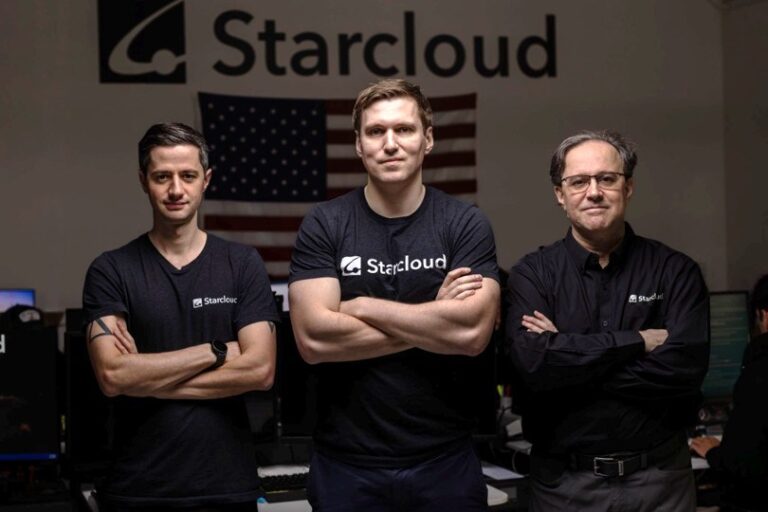
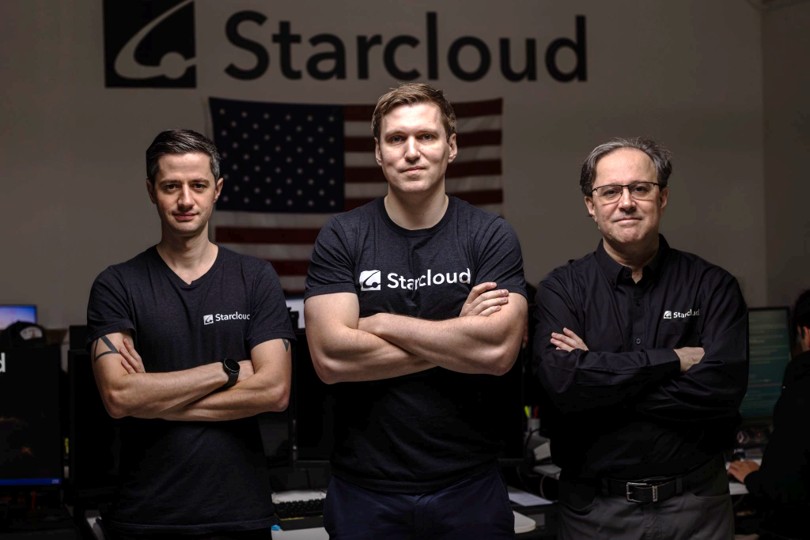
Starcloud, a startup developing satellites capable of performing artificial intelligence inference in orbit, has raised a $250 million extension to its Series A funding round from March. The extension values the company at $2.3 billion, but the real driver behind the capital raise is not manufacturing scale or technical ambition—it is the urgent need to secure rocket launch capacity before SpaceX retires its most reliable vehicle.
CEO Philip Johnston explained the core constraint to TechCrunch: “We can see what’s coming—we’re going to need to book an enormous amount of launch. One of the biggest costs is now on securing your launch capacity. Launch is pretty constrained right now because SpaceX’s Falcon 9 program is scheduled to end in 2028.” The timing is not theoretical. The company has already requested FCC permission to operate 88,000 spacecraft, a constellation that requires launch capacity far beyond what any existing vehicle provides on a frequent, reliable basis.
Launch Capacity as the New Constraint
Falcon 9’s 2028 Retirement and the Alternative Shortage
SpaceX plans to phase out Falcon 9, its most successful and heavily-used rocket, by 2028. The vehicle has become the industry standard precisely because it launches frequently and reliably. Replacing it with Starship, though more powerful, introduces uncertainty. Starship is larger and theoretically capable of carrying more cargo to orbit, but the vehicle has yet to demonstrate the reusability and operational cadence necessary to serve as a primary launch platform.
Competitors have not closed the gap. Alternative launch vehicles remain either grounded or unreliable:
- Blue Origin’s New Glenn has not reached the launch pad
- ULA’s Vulcan does not operate on a regular schedule
- Rocket Lab’s Neutron remains in development
SpaceX CEO Elon Musk announced this week that the company will delay its next attempt to catch a returning Starship booster by several months, pushing a full-reusability flight attempt to late 2027 or early 2028 at the earliest. For satellite operators planning missions, the timeline is increasingly difficult to predict. Every delay at SpaceX adds months or years of uncertainty to downstream infrastructure plans.
The Scale Problem and the Competitive Window
Starcloud’s ambition is large enough that the launch constraint is genuinely limiting. The company requested FCC approval to operate 88,000 spacecraft—a scale impossible to deploy under present conditions. Even deploying a fraction of that constellation requires many dozens of launches, and with Falcon 9 sunsetting and Starship unproven, the available launch capacity may not exist.
Johnston framed the calendar pressure bluntly: “As soon as we can, we want to get under contract with things like Starship. Obviously if we can’t book any SpaceX launch capacity in 2029, that will be challenging for us.” The math is unforgiving: Falcon 9 retires in 2028; Starship reliability in 2029 is uncertain; the window for locking in capacity is closing now.
Immediate Deployment Strategy
2027 Rideshare Missions and Near-Term Operations
Starcloud is not waiting passively for Starship. The company plans to launch two Starcloud-2 satellites in 2027 aboard rideshare flights, where spare capacity on scheduled rockets is available to smaller payloads. Each Starcloud-2 carries 8 kilowatts of compute capacity and will perform orbital inference work for customers including U.S. government agencies. The missions are modest compared to the 88,000-spacecraft vision, but they serve a critical purpose: gathering real-world performance data that validates whether orbital AI inference can compete economically with terrestrial data centers.
Booking Larger Capacity
Beyond the rideshare approach, Starcloud is considering booking a dedicated Falcon 9 launch to deploy more spacecraft, and the company is negotiating with other launch providers as a hedge against SpaceX delays or unavailability. The longer-term centerpiece is Starcloud-3, an orbital data center satellite intended to fly aboard Starship. This spacecraft is substantially more ambitious than Starcloud-2, but it is also entirely dependent on Starship achieving both operational status and cost-per-kilogram economics low enough to justify infrastructure investment.
Johnston remains confident in SpaceX’s long-term direction, even as near-term timing remains uncertain: “Starcloud is ultimately built around the potential of SpaceX’s Starship to drive down launch costs enough to build out an orbital inference layer that can compete with terrestrial data centers.”
Nvidia’s Strategic Investment and Partnership
Orbital H100 Performance as Investment Signal
The $250 million funding extension was led by Manhattan West Ventures and included participation from Cisco. Nvidia’s contribution of $25 million stands out not for the dollar amount but for what it signals about Starcloud’s technical achievement. Starcloud is the only company operating an H100 GPU, Nvidia’s flagship data center processor, in orbit. More significantly, the startup has successfully trained machine learning models using the H100 in space—the first organization to do so at operational scale.
Nvidia’s investment decision turned on this unique data. Johnston explained the calculus: “The reason they’ve chosen to do this investment now is because of all of this data that we got from Starcloud One. They, more than any other VC, did way more technical duty on this than anybody else.” For Nvidia, the investment represented less a venture bet and more a strategic partnership with a company capable of validating hardware performance in the harshest possible operating environment.
Vera Rubin Space-1 and Purpose-Built Space Hardware
The H100 data is driving Nvidia’s next major move: developing Vera Rubin Space-1, a GPU designed from the ground up specifically for orbital workloads. Unlike terrestrial GPUs modified for space radiation tolerance, Vera Rubin is being engineered as a space-native processor. The chip does not yet exist in prototype form, but Starcloud plans to fly it into orbit in late 2028.
Engineering for space introduces design constraints that terrestrial chip development avoids. Starcloud’s team is tracking three critical variables as the design evolves: the relationship between operating temperature and radiator size (processors in vacuum dissipate heat differently than those with air cooling), the placement and thickness of radiation shielding (to protect against cosmic rays and trapped radiation at orbit), and the structural reinforcement required for the silicon and packaging to survive the vibration and acceleration of rocket launch. Each variable affects power consumption, thermal efficiency, and ultimately the performance advantage of a space-native design.
Manufacturing and Organizational Scaling
Starcloud operates a 100,000-square-foot manufacturing facility in Woodinville, Washington, a location chosen strategically for its proximity to SpaceX’s Starlink satellite production and Amazon’s Kuiper constellation manufacturing. The region has accumulated expertise in space hardware production that makes it an attractive hub for a satellite manufacturing operation.
The company currently employs 25 people. The $250 million capital extension is explicitly earmarked for expanding the manufacturing footprint and increasing engineering headcount to support accelerated development of Starcloud-3 and production scaling for near-term missions. Other investors in the extension included Benchmark, EQT, Soma, NFX, 776, Cedar Capital, Goanna Capital, and Standard Capital.
Frequently Asked Questions
Why is launch capacity suddenly the biggest constraint for Starcloud?
SpaceX plans to retire Falcon 9, the industry's primary reliable launch vehicle, in 2028, and competing rockets like Blue Origin's New Glenn and ULA's Vulcan remain grounded or infrequent. With an 88,000-spacecraft constellation approved by the FCC, Starcloud needs extensive launch capacity, which becomes scarce after 2028 unless Starship proves reliable and affordable.
What is Vera Rubin Space-1?
Vera Rubin Space-1 is a GPU Nvidia is developing specifically for orbital operations in partnership with Starcloud. Unlike terrestrial processors modified for space, Vera Rubin is being engineered from the ground up for zero-gravity computing. The satellite is planned to launch in late 2028.
Why did Nvidia invest $25 million in Starcloud?
Nvidia invested because Starcloud operates the only known orbital H100 GPU and has successfully trained machine learning models in space. The real-world performance data informed Nvidia's decision to develop its own space-native GPU, making Starcloud's operational experience uniquely valuable to Nvidia's hardware strategy.
