
Key takeaways
- The RDRE harnesses supersonic detonation waves propagating around an annular combustor to achieve historic efficiency, reusability, and throttling capabilities that traditional subsonic combustion engines cannot match.
- On May 14, 2025, Venus Aerospace completed the first-ever test flight of a rotating detonation rocket engine from U.S.
- Venus Aerospace’s ultimate commercial objective extends beyond military and launch applications into hypersonic passenger flight.
- The RDRE represents a fundamental departure from rocket engine design principles established during the Cold War and refined through the Space Shuttle era.
Venus Aerospace, a Houston-based propulsion Startup founded in 2020, has secured more than $106 million in total funding, including a strategic investment from Lockheed Martin Ventures announced in October 2025, to accelerate production and deployment of its Rotating Detonation Rocket Engine (RDRE). The breakthrough technology represents the first fundamental leap in rocket propulsion since the Apollo Program, delivering 15% greater efficiency than any rocket engine in history while operating at significantly lower manufacturing costs.
Strategic Capital Injection Powers Production Scaling
Sarah “Sassie” Duggleby, CEO of Venus Aerospace, announced the Lockheed Martin Ventures investment at the Axios Future of Defense Summit in Washington, D.C., framing the capital infusion as essential for “further scaling its production of the systems.” The investment validates Venus’s technical achievements and positions the company to move from experimental demonstrations into manufacturing readiness for defense and commercial applications. Lockheed Martin’s participation signals major defense industry confidence in the viability of rotating detonation propulsion as a next-generation platform.
Prior to the Lockheed announcement, Venus Aerospace had accumulated $78.3 million in total investments from top-tier venture backers including Airbus Ventures, America’s Frontier Fund, Trousdale Ventures, and Prime Movers Lab. The company has executed what insiders describe as the “most capital efficient rocket engine development in history,” achieving major milestones—from initial engine firing in December 2024 to the first U.S. flight test in May 2025—on a compressed timeline and lean budget relative to traditional aerospace development programs.
The Physics Behind the Breakthrough
The RDRE harnesses supersonic detonation waves propagating around an annular combustor to achieve historic efficiency, reusability, and throttling capabilities that traditional subsonic combustion engines cannot match. Unlike conventional rocket engines with numerous moving parts and complex manufacturing requirements, the RDRE operates with no moving parts, relies on standard materials, and uses storable and stable liquid propellants. This design eliminates boil-off issues, accelerates launch preparation timelines, and dramatically reduces operational complexity.
The engine’s manufacturing advantages compound its performance benefits. Advanced manufacturing techniques enable the RDRE to be built at least an order of magnitude cheaper than most market rocket engines while maintaining the ability to scale across a wide range of performance parameters. The resilient supply chain and use of conventional materials position Venus to achieve sustainable, repeatable production at commercial volumes—a critical requirement for both defense contracts and eventual civilian hypersonic flight applications.
Flight Test Validates Operational Readiness
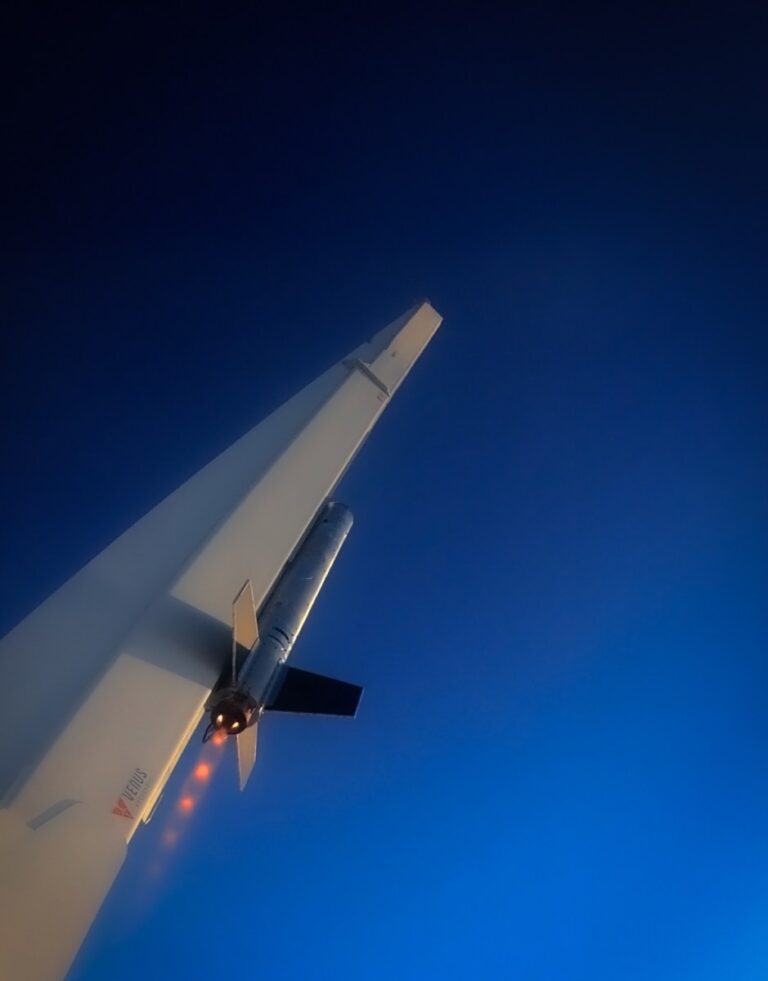
On May 14, 2025, Venus Aerospace completed the first-ever test flight of a rotating detonation rocket engine from U.S. soil, launching a small rocket equipped with the RDRE at Spaceport America in New Mexico at 9:37 a.m. EDT. The successful flight test moved the technology from laboratory demonstration into real-world operational validation, proving the engine performs reliably under flight conditions and confirming design predictions from ground testing. Industry observers view the rapid progression from initial firing to flight test as evidence of mature engineering and manufacturing discipline.
The company is now planning full-scale propulsion testing and vehicle integration for undisclosed government partners, signaling a transition from research and development into operational deployment. Venus Aerospace’s ability to reach this inflection point in under two years positions it ahead of competing propulsion startups and attracts further institutional backing from established defense contractors seeking next-generation engine suppliers.
From Experimental Milestone to Commercial Vision
Venus Aerospace’s ultimate commercial objective extends beyond military and launch applications into hypersonic passenger flight. The company is developing the Stargazer M4, a Mach 4-capable passenger aircraft designed to cruise at six times the speed of conventional commercial aircraft. The Stargazer would enable transcontinental flights from Los Angeles to Tokyo in under two hours, covering approximately 5,000 miles at sustained hypersonic velocity while maintaining passenger safety and environmental performance.
While the company estimates a first Stargazer flight in the 2030s, the RDRE technology pathway demonstrates that hypersonic commercial aviation is no longer theoretical. The engine’s efficiency gains, manufacturing simplicity, and demonstrated reliability form the technical foundation for vehicles operating at 4 to 6 times the speed of sound. Success in military and orbital applications during the next five years will establish the operational track record and regulatory framework necessary for civilian hypersonic flight certification.
Propulsion Innovation Reaches Critical Mass
The RDRE represents a fundamental departure from rocket engine design principles established during the Cold War and refined through the Space Shuttle era. Since the Apollo Program ended, incremental improvements to combustion efficiency and materials science have extended conventional engine performance, but no breakthrough in propulsion physics has emerged—until now. Venus Aerospace’s validation of rotating detonation as a practical, manufacturable, and scalable technology breaks a half-century stasis in propulsion architecture.
The first RDRE firing occurred in December 2024, followed by the May 2025 flight test, compressing a development cycle that traditionally spans decades into less than two years. This acceleration reflects both the maturity of computational fluid dynamics and materials science, and the disciplined engineering execution of Venus’s founding team led by CEO Sassie Duggleby and co-founder Andrew Duggleby, who holds a Ph.D. in the field.
Milestones to Track Through 2026
Investors and industry analysts should monitor Venus Aerospace’s progress on full-scale propulsion testing for government partners, expected to commence in the coming months. The company’s ability to achieve performance targets in government-sponsored testing will determine the pace of production scaling and the volume of initial defense contracts. Additional funding rounds or strategic partnerships with prime contractors could signal accelerated timelines for operational deployment.
The broader significance of Venus Aerospace’s funding and technical progress lies in validating hypersonic propulsion as an achievable near-term capability rather than a distant possibility. With Lockheed Martin’s institutional backing, production-scale capital, and a demonstrated flight-tested engine, Venus Aerospace has transitioned from promising startup to essential technology supplier. The coming 18 months will determine whether rotating detonation engines become the standard for next-generation defense systems and whether hypersonic commercial aviation enters the engineering phase.
