
Key takeaways
- The username feature allows WhatsApp users to create custom handles independent of their phone numbers, reducing the need to share personal contact details with strangers or businesses.
- India’s government has launched a formal examination of WhatsApp’s username rollout, with senior officials signaling that a notice to Meta may follow after legal implications are assessed.
- The coming months will reveal whether Meta’s safeguards prove sufficient to prevent widespread impersonation as the username feature rolls out globally later in 2026.
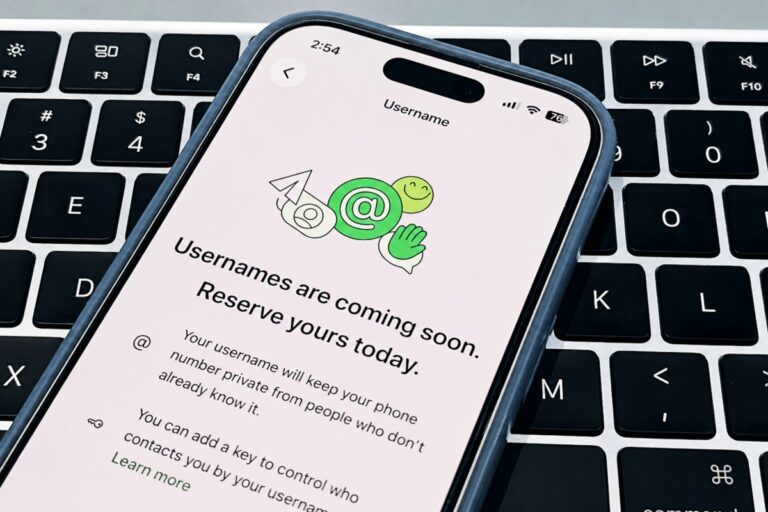
WhatsApp began allowing users globally to reserve usernames this week, marking its first major shift from relying solely on phone numbers for contact identity—a move that Meta says enhances privacy but has already triggered government scrutiny and cybersecurity warnings over impersonation and fraud risks. Announced Monday evening in June 2026, the optional feature represents a fundamental redesign of how users identify themselves on the messaging platform, which counts approximately 850 million users in India alone. The rollout comes as regulators and security experts raise red flags about lookalike accounts, username squatting, and the potential for Meta to monetize identity verification across its platform ecosystem.
Meta’s Privacy Redesign Arrives With Built-In Safeguards
The username feature allows WhatsApp users to create custom handles independent of their phone numbers, reducing the need to share personal contact details with strangers or businesses. Meta introduced layered security measures alongside the launch, including an optional authentication step called a “username key”—essentially a PIN that must be entered by anyone attempting to contact a user via username for the first time. This extra verification layer is designed to prevent unauthorized messaging and reduce the surface area for impersonation attacks.
Meta’s automated systems will detect and ban accounts displaying common impersonation and abuse patterns, according to a company spokesperson. The platform will also limit how many new people any account can contact through usernames, block repeated attempts to guess someone’s username key, and restrict lookalike variations of known names. High-profile handles tied to government entities, celebrities, and verified Meta accounts are being reserved exclusively for legitimate owners, preventing bad actors from claiming premium identities during the reservation period.
India’s Government Moves to Examine Fraud and Impersonation Risks
India’s government has launched a formal examination of WhatsApp’s username rollout, with senior officials signaling that a notice to Meta may follow after legal implications are assessed. The Centre’s probe focuses on impersonation, fake profiles, and username squatting—concerns that carry particular weight given WhatsApp’s dominance in India’s messaging market and the country’s history of digital fraud. The regulatory action underscores tensions between Meta’s product innovation and government demands for stronger safeguards in a market where the platform’s user base dwarfs most competing services.
The timing of the Indian government’s scrutiny reflects broader global concerns about identity verification on messaging platforms. Unlike traditional social networks where verification badges have become standard, WhatsApp has historically maintained a more minimal approach to user identity signals. The introduction of usernames without a corresponding verification system creates ambiguity for users trying to confirm whether they are communicating with legitimate contacts or impostors.
Experts Warn of Monetization Strategy and Cross-Platform Profiling
Cybersecurity expert Jiten Jain argues that while usernames improve privacy by decoupling identity from phone numbers, they may increase impersonation risk and could eventually become a vehicle for Meta to monetize verification through paid badge features. Internet Freedom Foundation lawyer and founding director Apar Gupta emphasizes that linking WhatsApp usernames with Facebook and Instagram accounts could deepen user profiling and calls for stronger digital market regulation in India. Both experts flag concerns that Meta is using the feature to strengthen its ability to track and monetize user behavior across its interconnected platforms.
Meta is already reserving existing Facebook and Instagram usernames during the WhatsApp reservation window, allowing users to claim identical handles across platforms by linking accounts through Meta Accounts Center. This cross-platform consolidation raises questions about data aggregation and whether the company plans to leverage unified identities for targeted advertising or other commercial purposes. Kanishk Gaur, CEO of Athenian Tech, stresses that usernames alone cannot stop cyber fraud and that robust identity verification mechanisms beyond simple handles are essential to tackle impersonation and digital scams effectively.
Telegram’s Username System Offers a Cautionary Tale
WhatsApp’s username rollout mirrors Telegram’s earlier introduction of username functionality, which security researchers criticized for enabling widespread impersonation and fraud due to insufficient verification protocols. Telegram’s open username directory allowed scammers to create lookalike handles for brands and individuals, undermining user trust and facilitating financial fraud schemes. WhatsApp’s architects have attempted to learn from those failures by implementing reservation systems for high-profile names and automated abuse detection, but experts warn that determined bad actors may still find exploitable gaps in the verification framework.
The parallel between WhatsApp and Telegram highlights a recurring challenge in the messaging app industry: balancing user privacy and pseudonymity with the need to prevent identity fraud at scale. Both platforms prioritize end-to-end encryption and minimal data collection, philosophies that complicate the implementation of robust identity verification systems. WhatsApp’s approach of making usernames optional and pairing them with optional PINs reflects this tension between privacy protection and fraud prevention.
What Regulators and Users Should Monitor Next
The coming months will reveal whether Meta’s safeguards prove sufficient to prevent widespread impersonation as the username feature rolls out globally later in 2026. Indian regulators are expected to issue formal guidance or notices to Meta following their assessment, potentially shaping how the company implements the feature in its largest market. Users should monitor whether verified badge systems emerge on WhatsApp—a development that would signal Meta’s shift toward monetized identity verification similar to Twitter and Instagram.
The username feature represents a pivotal moment for WhatsApp’s evolution from a phone-number-based service to a platform with persistent digital identities. Success depends on whether Meta can implement verification and fraud prevention at sufficient scale without compromising the privacy principles that have defined the platform. As regulators scrutinize the rollout and cybersecurity experts identify gaps in the current safeguards, the coming months will determine whether usernames enhance WhatsApp’s utility or create new vectors for fraud and impersonation.
