

Key takeaways
- Instinct raised $1 billion in September 2026, reaching a $10 billion valuation as investors back text messaging as the primary interface for AI agents.
- Family-focused agents like Fambot, Ohai, and Ollie are competing to coordinate household information from schools, calendars, and group chats into actionable plans.
- Specialized agents target travel planning (Miso), content creation (Stanley), and workplace tasks (Town, Comma), while privacy-focused alternatives like Underdog keep processing entirely on users' devices.
- Agents now operate through iMessage, WhatsApp, Telegram, and Signal rather than requiring separate app downloads, reducing friction for users adopting AI assistants.
The AI agent market has found its primary interface: the text message. Rather than requiring users to download yet another application, a growing number of AI assistants now operate through familiar messaging platforms: iMessage, WhatsApp, Telegram, and Signal, performing tasks that previously demanded switching between multiple tools.
These agents can remember context across conversations, connect to services you already use, and handle everything from scheduling appointments and managing calendars to researching trips, sending emails, making reservations, shopping, and setting reminders days in advance.
Major Players and the Funding Boom
Instinct has attracted the most attention and capital. The company raised $1 billion in September 2026, bringing its valuation to $10 billion following an earlier $350 million round that valued it at $2.5 billion. The always-available agent accepts text and voice input, connects to apps including email, calendar, and Google Workspace, and can handle everything from trip planning to grocery shopping to subscription cancellations.
In September, Instinct began providing users with dedicated email addresses for their assistants. This feature lets the agent create and manage accounts without filling a user’s personal inbox—the assistant can sign up for services, contact businesses, and handle tasks that require email. The company has also begun rolling out support for placing calls. However, giving an agent this degree of autonomy has raised privacy and security concerns.
Other venture-backed entrants are also drawing significant investment. Town, a professional-focused personal assistant reachable through email, Slack, calendars, and documents, raised a $55 million Series A in June 2026 led by Andreessen Horowitz. Tab emerged from stealth in early October 2026 with a $300 million valuation, having already attracted backing from SV Angel, Valar Ventures, and American Spirit. The assistant lets users delegate everyday tasks like ordering groceries or finding gifts through iMessage or WhatsApp.
Poke launched as a general-purpose text-based assistant in March 2026 and gained prominence when Apple approved it as the first AI agent on its Apple Messages for Business platform in June. That visibility attracted the attention of AI coding startup Cognition, which acquired Poke’s parent company, The Interaction Company of California, in a deal valued in the low nine figures by July.
Folk, which launched its beta in May 2026, takes a different technical approach. It runs on its own private cloud computer rather than relying solely on remote inference, and can execute code and handle multi-step tasks. The service is free during beta but offers a Pro subscription for $8.33 per month for unlimited background tasks.
Family Coordination and Household Management
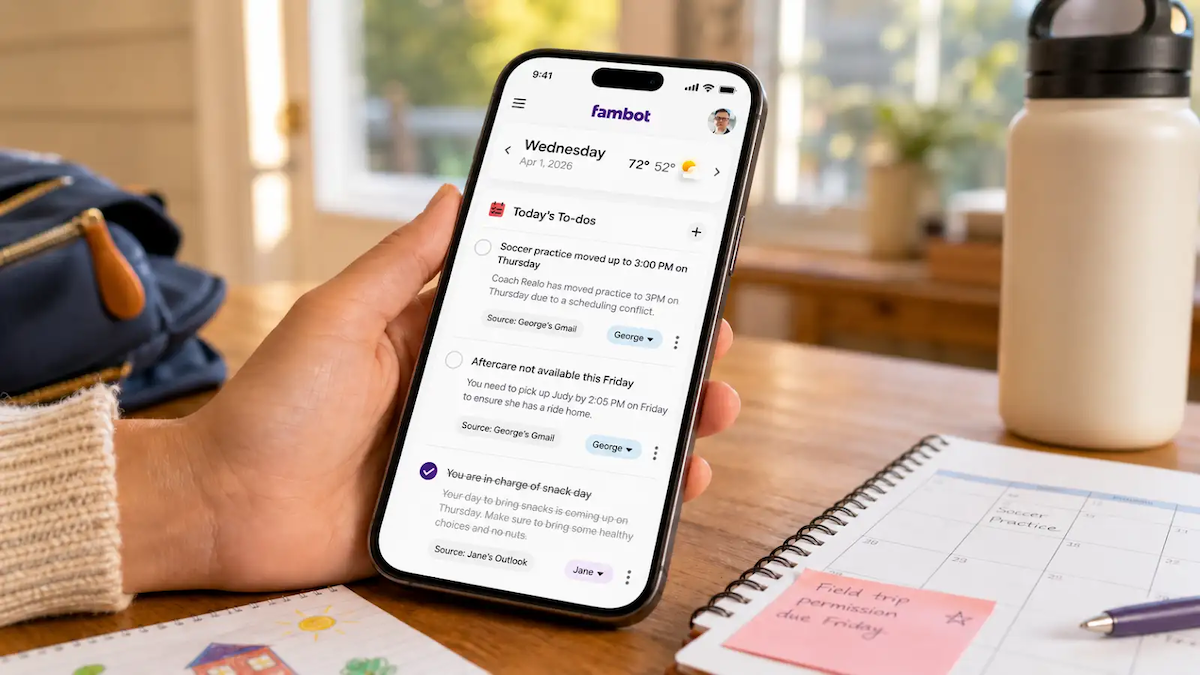
A distinct category of agents targets the coordination challenges families face. Fambot, launched in beta in early September 2026, positions itself as a “chief of staff” for households. It aggregates information about school communications, sports activities, meal planning, and daily responsibilities, then surfaces an organized plan through both an app and SMS. Each night, Fambot sends a summary of the next day’s events, to-dos, and logistical details such as required school uniforms or packing lists. Parents can reply to adjust information or answer questions.
Fambot raised $3.5 million in pre-seed funding and is currently free during its beta period, though the company plans to eventually charge roughly the cost of a Netflix subscription. It currently integrates with Gmail, Google Calendar, Outlook, and WhatsApp, with Apple Calendar support planned.
Competing Family Assistants
Ohai operates similarly, helping families manage the constant information flow across school messages, calendars, task lists, and group chats. The assistant transforms incoming messages, forwarded emails, and voice requests into schedules, reminders, and plans while coordinating calendars, chores, and meals across multiple family members. Launched in June 2026, Ohai offers a free tier and paid plans starting at $9.99 per month, scaling up to $100 per month for 1,000 messages.
Ollie differentiates itself through security compliance. Launched in June 2026, it is one of the first mainstream family-focused AI assistants to achieve SOC 2 certification. The free basic tier includes options for paid plans starting at $25 per month for 150 messages.
Orbits, backed by investors including Andreessen Horowitz’s Speedrun fund, N49P, and Garage Capital, brings calendars, lists, and conversations together through both its app and text messaging. Beyond scheduling, it can search the web, make purchases, book restaurants, change appointments, and coordinate household responsibilities.
Specialized Agents by Use Case
Travel and Content Creation
Miso narrows the AI assistant concept to travel coordination. Operating through iMessage, it combines AI-driven trip planning with access to dedicated travel professionals. Users can arrange flights through messaging while the agent considers their preferences, loyalty points, and priorities. The assistant also provides trip details, flight updates, and personalized recommendations.
Stanley targets content creators rather than general productivity users. Available via iMessage, Telegram, and the web, it functions as an AI head of content. The tool can generate ideas, turn them into posts, maintain publishing schedules, connect to Instagram accounts to suggest content based on actual activity, convert voice notes into scripts and captions, and schedule posts. It automates much of what typically requires dedicated planning sessions.
Work and Business Tasks
Comma is designed for task management across work and daily life. It carries tasks through to completion, checks its own work, determines when tasks finish, and surfaces completed work for review when decisions are needed. It maintains context across browsers, computers, and files while remaining accessible through Signal, Telegram, and WeChat. Comma delivers daily briefings, flags urgent matters, and summarizes recorded calls.
Martin provides general professional assistance through SMS, phone, WhatsApp, email, Slack, and an iOS app. It manages calendars, email, reminders, tasks, notes, and communications, and can send messages or make calls on a user’s behalf while providing daily summaries. At $21 per month, it is among the pricier options.
Szn coordinates tasks and follow-ups through a single conversation thread, accepting text messages, voice notes, photos, and forwarded emails. The company reports having served over 7,500 businesses across 16 countries, completed more than 10,000 jobs, and handled 95 hours of calls.
Novel Technical Approaches
Agent Identity and Privacy Models
Wajo’s agent, Fo, takes an unusual approach by giving the AI its own identity. Rather than acting on behalf of a user using their personal credentials, Fo has its own email address, phone number, and payment card. This allows the agent to interact with businesses independently. When Fo encounters a task it cannot complete alone, Wajo says it can escalate to a human assistant. Fo launched publicly in September 2026 with a free tier and a paid Pro offering for heavier workloads.
Underdog represents a different technical philosophy. Launching with an invite-only beta in early October 2026, it runs entirely on a user’s device rather than relying on cloud infrastructure, keeping personal data on hardware the user already owns. The initial release supports Mac and Windows, with Linux, iPhone, and Android versions planned. The company intends to offer the app free of charge and has committed to never including advertising.
Additional Players
Iris, powered by Hermes Agent, lets users delegate tasks through iMessage while retaining context from previous interactions and following up proactively. Rene, available on iMessage, Telegram, and WhatsApp, functions as a “best contact” rather than another productivity tool, maintaining context across conversations and capable of writing code, shopping, and creating slides and images.
Skye, from Signull Labs, takes yet another approach, positioning itself as an “agentic homescreen” for the iPhone. Rather than waiting for users to open an app, it analyzes connected services and surfaces relevant information through contextual cards, suggestions, and daily briefings. The company raised approximately $3.6 million in seed funding in 2025, entered private testing in April 2026, and has not yet announced a public launch date.
Caddy connects scattered information across a phone into actionable items. For iPhone users it operates through iMessage; for Android, through RCS. It identifies items that require action, such as appointments buried in emails or shopping lists in messages, and can add calendar events, set reminders, track follow-ups, and conduct research.
Pally offers a friendship model rather than a strict productivity angle. Users interact with the assistant as they would with a person, granting access to WhatsApp, Gmail, calendars, and Google Drive. The service offers 15 minutes of calls monthly on its free plan, with paid tiers at $25 per month for 30 minutes and $100 per month for 60 minutes.
The diversity of approaches reflects a market still defining what AI agents in messaging should be. Whether they coordinate households, manage work, plan travel, or protect privacy, these services share a common bet: the text message thread has become the most natural interface for delegating work to machines.
Source: TechCrunch
Frequently Asked Questions
What can these AI agents do through text messages?
They can schedule appointments, manage calendars, research trips, send emails, make reservations, shop online, and send reminders. Some can place calls, create accounts with their own email addresses, execute multi-step tasks across connected services, and coordinate household responsibilities.
Which AI agent has raised the most funding?
Instinct has raised the most capital, with $1 billion in September 2026 that valued it at $10 billion. Other notable rounds include Town's $55 million Series A in June 2026 and Tab's $300 million valuation at launch in October 2026.
How do family-focused agents like Fambot work?
They aggregate information from schools, calendars, and task lists, then send families a daily summary through SMS or app. Parents can reply to adjust schedules or ask questions. Fambot integrates with Gmail, Google Calendar, Outlook, and WhatsApp, with Apple Calendar support planned.
