
Key takeaways
- Counterpoint Research attributed India’s Q2 2026 shipment decline directly to record-high memory prices that forced original equipment manufacturers to raise prices across nearly every segment.
- The root cause of India’s smartphone crisis traces directly to artificial intelligence projects consuming unprecedented volumes of memory chips.
- The current memory crisis marks a departure from previous smartphone market cycles, which typically saw price adjustments driven by competition, technology transitions, or macroeconomic shocks.
- The memory shortage will persist through at least 2027, as major suppliers have committed their production capacity to AI infrastructure projects with multi-year contracts.
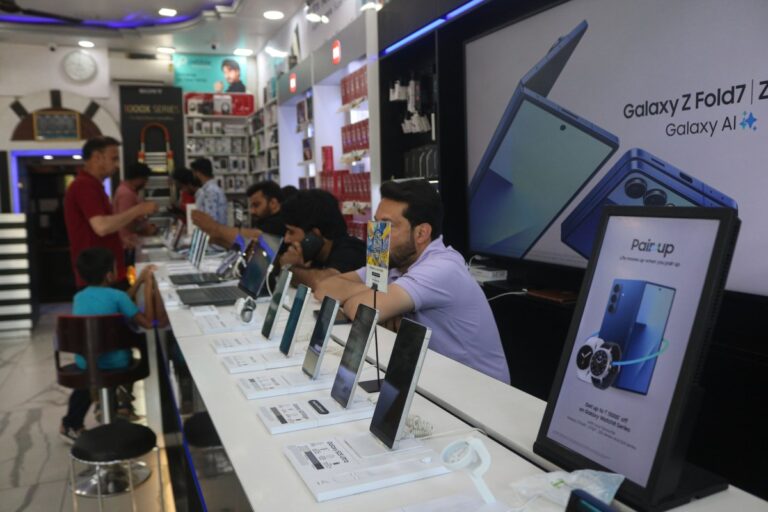
India’s smartphone market shipments collapsed 10% year-on-year in the second quarter of 2026, marking the steepest June-quarter decline in six years, as artificial intelligence infrastructure projects have starved consumer electronics of memory chips and forced manufacturers to raise prices across nearly every segment. Record-high memory costs have pushed average smartphone prices up roughly 15% by the end of the quarter, pricing millions of price-sensitive consumers out of the world’s second-largest smartphone market. The memory crunch reflects a fundamental shift in global semiconductor supply chains, where AI data centers now command priority access to chip production that once flowed to consumer device makers.
Memory Shortage Triggers India’s Sharpest Market Decline in Six Years
Counterpoint Research attributed India’s Q2 2026 shipment decline directly to record-high memory prices that forced original equipment manufacturers to raise prices across nearly every segment. The market contraction represents the steepest June-quarter drop since 2020, signaling a structural disruption in India’s smartphone ecosystem rather than seasonal weakness. With average prices rising approximately 15% by quarter-end, consumers in India’s price-conscious market faced a sudden affordability barrier that dampened demand across budget and mid-range categories.
Navkendar Singh, Associate Vice-President at IDC India, forecast India’s smartphone shipments will drop to 132 million units in 2026, down from 152 million in 2025—a decline driven by device prices rising 15% to 40% across key models. This trajectory represents a fundamental reset for a market that has long depended on ultra-affordable smartphones to drive volume growth. The price escalation has made even entry-level devices unaffordable for vast segments of India’s consumer base.
AI Infrastructure Diverts Global Memory Supply Away from Consumer Phones
The root cause of India’s smartphone crisis traces directly to artificial intelligence projects consuming unprecedented volumes of memory chips. In October 2025, OpenAI signed agreements with Samsung and SK Hynix for up to 900,000 DRAM wafer starts per month through 2028, locking up approximately 40% of global DRAM output for OpenAI’s Stargate project—a $500 billion AI infrastructure program developed with SoftBank, Oracle, and MGX. This single deal has effectively removed a massive portion of global memory supply from the consumer electronics market, redirecting it toward training and inference infrastructure for large language models.
SK Hynix confirmed that its entire DRAM, NAND, and HBM production through 2026 is sold out, mostly committed to Nvidia for AI accelerators. Samsung simultaneously expanded its DRAM capacity to 60,000 wafers per month specifically for HBM4 production, further reducing the supply available for smartphones. These supply commitments have created a structural shortage that will persist well into 2027, permanently altering the economics of smartphone manufacturing.
Manufacturers and Analysts Sound Alarm on Affordability Crisis
Prachir Singh, Senior Analyst at Counterpoint Research, stated plainly: “The market is facing a clear affordability squeeze, driven by sharp memory-led cost inflation and currency pressures that have forced OEMs to raise prices across key models.” His assessment reflects growing consensus among industry observers that memory has become the dominant cost driver in smartphone pricing, eclipsing processor costs and other traditional components. The affordability squeeze hits hardest in India, where consumers have historically demanded sub-$100 devices and where price sensitivity remains acute.
Sumit Singh, SVP and Product Head at Lava International, noted that “the structure of smartphone pricing has changed significantly over the past year, with memory emerging as the biggest pressure point.” Memory’s share of a low-end phone’s cost has surged from under 10% to over 40% since October 2025, driven by RAM prices more than tripling during that period. Xiaomi’s Chief Financial Officer warned that memory costs will drive up retail prices in 2026, with analysts projecting approximately a 25% increase in DRAM expense per device as OEMs budget for sustained inflation.
The Sub-$100 Segment Faces Permanent Extinction
IDC research director Nabila Popal delivered perhaps the most sobering forecast: the sub-$100 smartphone segment, which currently accounts for 171 million devices annually, will become “permanently uneconomical” even after memory prices stabilize by mid-2027. This represents what Popal termed a “structural reset of the entire market,” suggesting that the budget smartphone category that has driven India’s smartphone penetration for over a decade may cease to exist in its current form. The implications extend far beyond India, affecting emerging markets across Southeast Asia, Africa, and Latin America where affordable devices have powered smartphone adoption.
IDC forecasts a global smartphone shipment decline of 12.9% in 2026, the lowest in over a decade, with average selling prices rising 14% worldwide. This global contraction reflects the systematic diversion of memory supply toward AI infrastructure by Meta, Google, Microsoft, and other hyperscalers that now prioritize data center buildouts over consumer electronics supply chains. The shift represents a fundamental reordering of semiconductor economics, where artificial intelligence development has leapfrogged consumer devices in manufacturing priority.
A Market Inflection Point Unlike Any in Recent History
The current memory crisis marks a departure from previous smartphone market cycles, which typically saw price adjustments driven by competition, technology transitions, or macroeconomic shocks. This episode stems instead from a deliberate supply reallocation toward AI infrastructure, driven by contractual commitments that lock up production capacity for years. The sub-$100 segment’s predicted extinction would represent the first permanent elimination of a smartphone category in the market’s history, fundamentally reshaping how manufacturers approach product portfolios and market segmentation.
India’s market contraction foreshadows broader disruption across price-sensitive regions that have relied on ultra-affordable devices to expand smartphone penetration. The 10% year-on-year decline in Q2 2026 represents not a cyclical downturn but rather the opening phase of a structural transformation in how memory supply flows through global semiconductor ecosystems.
Supply Commitments Lock in Scarcity Through 2028
The memory shortage will persist through at least 2027, as major suppliers have committed their production capacity to AI infrastructure projects with multi-year contracts. SK Hynix and Samsung’s production commitments extend through 2026 and beyond, with no indication that consumer electronics will regain priority access to DRAM and NAND output. Smartphone manufacturers must navigate a landscape where memory availability remains severely constrained and pricing power remains firmly in suppliers’ hands, leaving limited room to absorb costs without passing them to consumers.
India’s smartphone market enters 2027 facing a bifurcated future: premium devices with ample memory allocation and sharply reduced ultra-budget competition from a permanently eliminated sub-$100 segment. This structural reset will reshape competitive dynamics, manufacturer strategies, and consumer purchasing patterns across Asia’s largest smartphone market for years to come.
