
Key takeaways
- AI-generated food images exhibit an uncanny valley effect where near-realistic depictions trigger more disgust than obviously fake ones, according to research from the University of Duisburg-Essen.
- Models trained on professional restaurant photography and advertising learn to optimize for idealized aesthetics, creating food with perfect geometry and surfaces that humans instinctively recognize as artificial.
- Repeated edits to AI menus make the problem worse, as each iteration pushes the images further toward the model's learned center of acceptability, reinforcing convergence toward a single narrow aesthetic.
- The convergence problem in AI imagery raises broader questions about verifying authenticity in legal and cultural contexts as photographic evidence becomes harder to distinguish from AI-generated content.
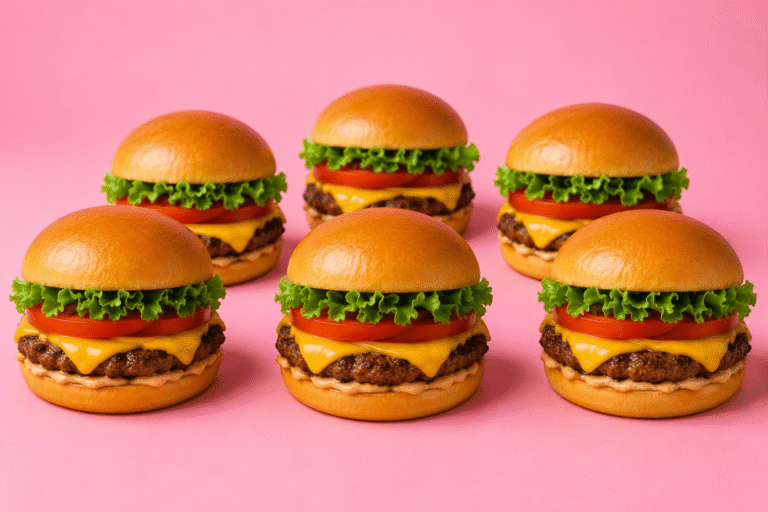
When you first notice it, the reaction feels irrational. A cafe displays photographs of food—bagel sandwiches, burritos, sundaes—each rendered in pixel-perfect detail with surfaces gleaming too brightly and geometries that feel subtly wrong. The shapes are suspiciously symmetrical. The colors optimize for maximum appeal. Something registers as off, even if you can’t immediately name what’s bothering you.
What you’re experiencing is the artifact of how generative AI models learn and reproduce visual patterns. These systems, trained on massive datasets to predict what images and text should look like in response to a prompt, end up creating food that looks better than food should—and that paradoxically makes it less appetizing.
“It’s almost like an alien trying to make a pizza without understanding its core principles,” says Alex Lisle, CTO of Reality Defender, a company that develops tools to detect and verify AI-generated content. The issue is pronounced enough that restaurants across the country have begun noticing customer backlash over menus using AI imagery, even when those images are technically proficient and professionally presented.
The Uncanny Valley on the Plate
The problem manifests in specific, identifiable ways. Cheese on a generated burrito bubbles and melts in patterns that are geometrically impossible. Shrimp in seafood illustrations curl back on themselves in configurations that evoke what Lisle calls “Lovecraftian food horrors.” Ice cream scoops maintain perfect spherical shapes no actual frozen dessert can hold. Each element reaches a degree of idealization that human viewers unconsciously recognize as artificial.
What the Science Shows
This reaction isn’t mere aesthetic preference. Researchers at the University of Duisburg-Essen in Germany documented what they call an “uncanny valley” effect specific to AI-generated food imagery. Their findings showed that images appearing almost—but not quite—realistic actually elicit more disgust and unease than images that are obviously artificial. The closer AI gets to photorealism without achieving it, the stronger the visceral rejection.
Lee Rainie, Director of the Imagining the Digital Future Center at Elon University, frames this as a broader pattern in AI output. “People have an almost unexplainable sense about when they’re looking at something that’s AI-generated, compared with something that was real in the first place,” Rainie told TechCrunch. “There’s just a sensibility that people sometimes find hard to articulate, but they kind of know it when they see it.”
How Training Data Creates the Problem
The reason AI food looks this way traces directly to how these models are built. Large language models and diffusion models—the same technology powering ChatGPT and Midjourney—are trained on vast quantities of data. The systems identify statistical patterns within those datasets to predict what output should follow a given input.
When someone asks a model to “make a menu for a burger restaurant,” the model draws on patterns from thousands of existing burger restaurant menus. But that training data comes from a limited set of sources, primarily major chains and professional restaurant photography. “A lot of this stuff looks like a Chili’s menu from 2015, and there’s a reason for that,” Lisle explained. “That was the corpus of work from which [the models] drew their function.”
Optimization for Pleasingness
Restaurant menus and food advertising have always been optimized for appearance in ways that surpass reality. A Big Mac in a McDonald’s commercial has every layer arranged by prop designers for maximum visual impact. That idealization is baked into the training data. When AI models optimize for “pleasingness”—a goal often built into how they’re trained—they amplify this tendency.
“The optimization of the data sets is for pleasingness, or you know, not being offensive, and so there’s a way that turns into homogenization,” Rainie said. “What AI is known to do both in images and language is to shave off the edges.” This shaving-off extends beyond individual images. When AI-generated content becomes numerous enough to enter training datasets for future models, it reinforces these patterns. Each cycle of learning, generation, and re-training pushes outputs further toward the same narrow aesthetic.
Convergence Rather Than Collapse
When AI models train extensively on their own generated outputs, a phenomenon called “model collapse” can theoretically occur. Lisle describes it bluntly: “Model collapse is almost like a mad cow disease… when you feed the outputs from one model back into itself, eventually the inbreeding becomes too much, and the whole thing collapses.” The entire system degrades to uselessness.
What’s happening with restaurant menus isn’t that extreme. Instead, these images exhibit “convergence”—a less catastrophic but still degrading effect where output quality diminishes without the model becoming completely broken. The difference matters: convergence is reversible and partial, whereas collapse represents systemic failure. In the case of AI food imagery, convergence appears as a narrowing of aesthetic possibility, with more images clustering toward the center of what training data considers acceptable and marketable.
Iteration Accelerates the Degradation
The problem accelerates when humans repeatedly edit AI-generated images. A user on X named Labtec conducted an experiment: generate a restaurant menu using ChatGPT, then edit it 100 consecutive times, making small tweaks like adjusting prices or rewording item names. With each edit cycle, the food in the images became progressively rounder, smoother, and less like actual edible objects. “The end result actually makes me uncomfortable,” Labtec wrote.
This happens because each edit passes through the model again. Minor refinements in one dimension push the model toward its learned center, smoothing and idealizing further each time. Restaurants using AI menus for real work likely follow this exact pattern—adjusting prices, rewording descriptions—and with every adjustment, the food grows more visually artificial. The cumulative effect turns what might have been borderline acceptable into something visibly uncanny.
Implications Beyond Restaurant Marketing
The issue extends far beyond restaurant branding into fundamental questions about trust and evidence. Alex Lisle raises concerns about how society processes visual evidence. “Seeing and hearing has always been believing, to the point where even our court systems are entirely tuned to the idea that the gold standard in evidence is taped confessions and videotaped evidence,” he said. “That’s no longer the case. The world has fundamentally shifted, for good or for ill.”
If AI can generate images that are visually compelling yet subtly artificial—images that people find deeply unsettling without being able to articulate why—then the traditional reliance on photographs and video as proof requires reassessment. The uncanny valley in food photography is just the most visible symptom of a larger crisis in verifying authenticity. As AI-generated content becomes more prevalent, human intuition for detecting it will become increasingly important, even as that intuition remains hard to explain or systematize.
Frequently Asked Questions
Why do AI-generated food images trigger disgust when they look almost realistic?
Researchers at the University of Duisburg-Essen found that AI food images create an uncanny valley effect, where near-realistic but imperfect depictions elicit more disgust than images that are obviously artificial. AI models optimize for idealized aesthetics from professional food photography, creating perfect geometry and overly smooth surfaces that humans unconsciously recognize as artificial.
What is convergence and how does it differ from model collapse?
Convergence occurs when AI output quality diminishes as images cluster toward the same narrow aesthetic, especially when models train on their own generated content. Model collapse is a more extreme failure where the entire system becomes unusable. Convergence is reversible and partial, while collapse is catastrophic and permanent.
How does the AI menu problem relate to trust in photographic evidence?
As AI-generated imagery becomes harder to distinguish from real photography, the traditional reliance on video and photographs as proof in legal and cultural contexts faces challenges. The visceral but difficult-to-articulate human rejection of AI food photography reveals a broader reckoning with how society verifies authenticity in a world where generative AI can convincingly replicate visual evidence.
