
Key takeaways
- Binance launched Agent OS, allowing AI agents to trade autonomously within user-controlled sub-accounts that limit losses to deposited funds.
- Binance cannot observe the reasoning behind agent trading decisions, limiting its ability to detect manipulation or faulty logic.
- Daily limits on DeFi and payment transactions ($100,000 for DeFi, $20 for x402 payments) add restrictions beyond trading sub-accounts.
- Kraken, Coinbase, and OKX have launched competing agentic trading platforms using similar Model Context Protocol integrations.
On Thursday, Binance—the world’s largest crypto exchange with more than 300 million registered users—launched Agent OS, a platform that enables AI agents to analyze financial markets and execute trades directly on behalf of users. The move marks a significant shift in how cryptocurrency exchanges are adapting to autonomous AI systems that can act independently rather than simply respond to queries.
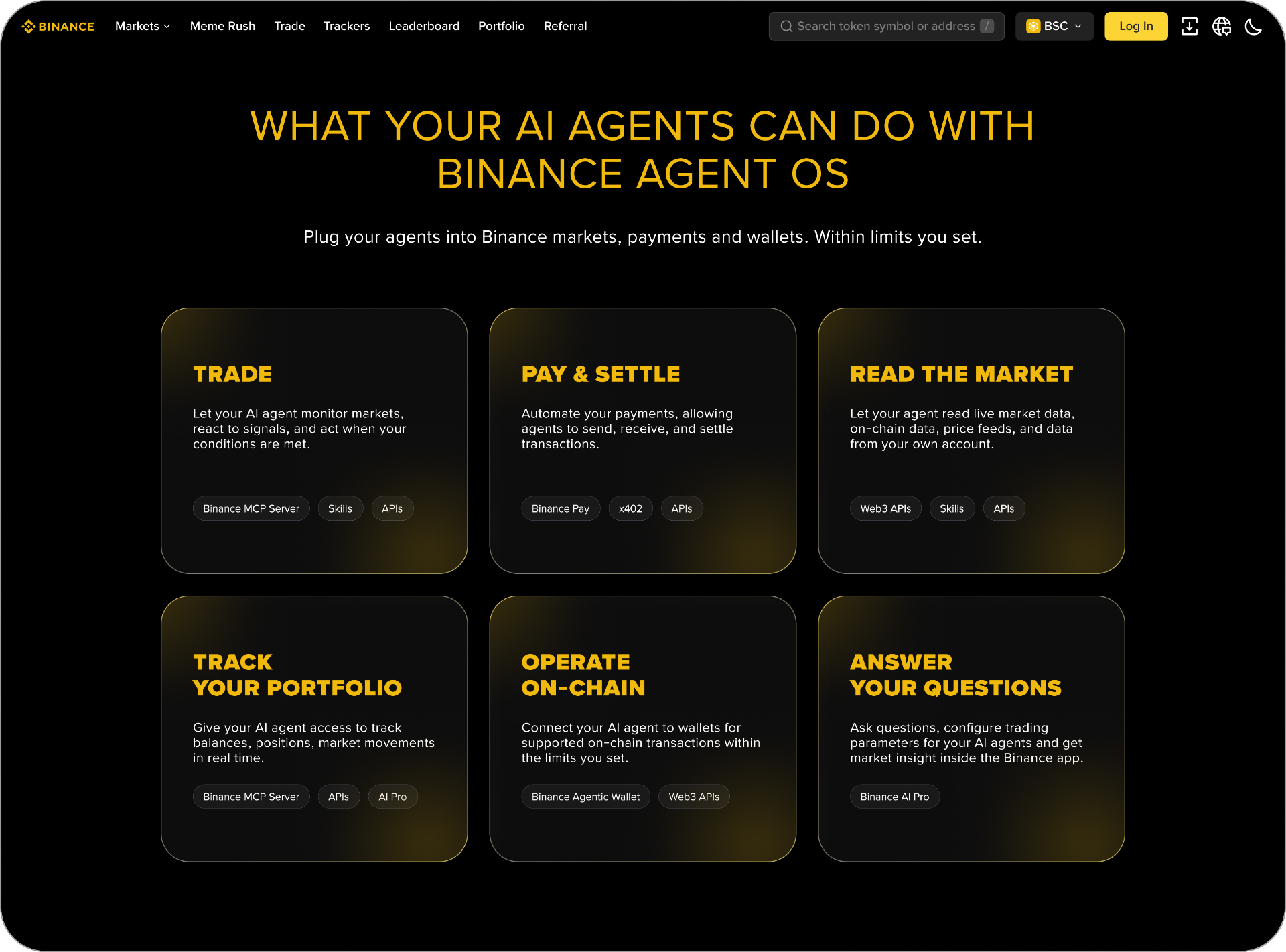
Agent OS integrates Binance’s existing infrastructure with new capabilities built specifically for agentic workflows. The platform combines the exchange’s APIs, Wallet Agentic Hub, x402 transaction verification system, Skill Hub, and newly added support for the Model Context Protocol (MCP). These tools work alongside AI systems including OpenAI’s ChatGPT and Codex, Anthropic’s Claude Code, and Cursor, granting authorized agents access to market data, account information, and trading execution.
How Agents Connect to Binance Infrastructure
The technical architecture centers on granting AI applications direct connections to Binance’s financial systems while maintaining user oversight. Agents can perform multiple functions within these connections: they analyze market conditions, execute trades based on predetermined parameters, conduct research and risk analysis, and react to market signals. For payment and settlement, agents can also send funds and interact with decentralized-finance protocols through Binance’s x402 integration.
Jeff Li, vice president of product at Binance, framed the approach as a balance between functionality and control. “Instead of total freedom, we put the power in users’ hands to give them the granular access control of what they can do through the agent,” Li said in an interview with TechCrunch. “We put [the control] at the account level to protect the users’ funds.”
Sub-Accounts as Sandboxes
The primary safety mechanism relies on sub-accounts—separate trading accounts that users can create and assign to specific agents. Each sub-account can be configured for distinct trading activities, whether spot trading, futures trading, or other functions. Withdrawals from these sub-accounts are blocked by default, creating a containment structure around the agent’s operations.
Users configure the permissions granted to each agent before it begins trading. Binance representatives indicated that users can choose whether an agent must request approval for each order or whether it can execute trades autonomously once its permissions are set. The amount of cryptocurrency a user transfers into a sub-account effectively becomes the trading limit, since Binance does not impose a separate cap on losses within that account.
What Users Decide
The responsibility for determining what agents can access and trade rests primarily with users rather than enforced at the platform level. Each user decides which sub-account to link to an agent, what permissions to grant, and what trading strategies to allow. This delegation of control means that users must actively manage their agent permissions rather than relying on Binance to restrict agent behavior through platform-wide rules.
The Visibility Problem: What Binance Cannot See
A significant limitation of the Agent OS architecture is that Binance lacks visibility into the reasoning behind trades that agents execute. The reasoning process occurs outside Binance’s systems—either on the user’s local computer or within the AI application itself. “We really cannot see the reasoning of the user’s action,” Li acknowledged.
This creates a gap in Binance’s ability to detect whether an agent has been manipulated through a prompt-injection attack or whether faulty information influenced a trading decision. While Binance can observe the trades that result from an agent’s operation, it cannot assess whether those trades were justified by accurate analysis or compromised by external manipulation.
Limited Detection of Manipulation
When asked what protections exist against an agent being compromised through a prompt-injection attack or other interference, Li pointed back to the sub-account system as the primary defense. The amount of funds accessible to the agent—limited to what was transferred into the sub-account—restricts the maximum damage that a compromised agent could cause. Binance stated that its existing security, risk-control, and anti-money-laundering policies for sub-account APIs apply to Agent OS at launch, but these measures do not directly monitor or verify the integrity of agent reasoning.
Payment and DeFi Integration
Beyond trading, Agent OS supports autonomous agents conducting financial transactions and interacting with decentralized protocols. Binance’s x402 integration allows agents to send and settle payments, while the Agentic Wallet component enables agents to interact with tokens and decentralized-finance protocols directly.
Unlike the open-ended trading limits within sub-accounts, transactions involving payments and DeFi activity carry Binance-imposed daily caps:
- Regular token swaps: $50,000 per day
- Decentralized-finance transactions: $100,000 per day
- x402 payments: $20 per day
These restrictions represent Binance’s attempt to add an extra layer of loss prevention for non-trading activities.
Competitive Adoption of Agentic Trading
Binance is not the first major crypto exchange to give AI agents direct access to trading systems. The industry has seen a wave of similar integrations over the past several months.
Kraken launched an open-source command-line tool in March that includes a built-in Model Context Protocol server, allowing AI agents to execute spot and futures trades directly. Coinbase introduced Coinbase for Agents in June, which connects agents to user accounts with the ability to trade, process payments, and execute other financial workflows within user-defined limits. OKX enabled agentic trading earlier this year by adopting an open-source MCP toolkit.
Li described Agent OS as Binance’s “first step” toward providing developers with a platform to build AI applications capable of acting across both cryptocurrency and traditional financial markets. The statement suggests that Binance views this launch as an initial phase of functionality rather than a complete product, with potential expansions planned.
What Comes Next
The shift toward agentic trading represents a change in how financial platforms are beginning to interpret user instructions. Rather than executing individual transactions based on explicit user commands, agents can now autonomously decide when and how to trade based on market conditions and programmed parameters. This shift transfers decision-making authority from the user to the agent, even though users retain the ability to revoke permissions or restrict agent access.
The reliance on users to manage agent permissions, combined with Binance’s inability to observe agent reasoning, distributes responsibility for agent behavior across multiple stakeholders: the user who sets permissions, the developer who builds the agent, the AI model provider whose system generates the reasoning, and the platform that hosts the agent’s actions. This distributed model differs from traditional trading platforms, where a single operator makes each transaction decision. How this shared responsibility model performs under stress—whether through a major agent failure, a successful manipulation attack, or a market event that triggers unexpected agent behavior—remains an open question.
Frequently Asked Questions
What is Agent OS?
Binance's platform launched Thursday that connects AI agents to its financial infrastructure, allowing agents to analyze markets and execute trades on behalf of users.
How does Binance prevent agents from losing too much money?
Binance uses sub-accounts with configurable permissions, blocks withdrawals by default, and sets daily limits on DeFi ($100,000) and payment transactions ($20). The amount deposited in a sub-account serves as the trading loss limit.
Can Binance see why an agent makes a particular trade?
No. The reasoning happens outside Binance's systems—either on the user's computer or within the AI application itself—so Binance has limited visibility into whether trades were influenced by manipulation or faulty information.
