
Key takeaways
- Calendly launches a meeting note-taker with AI assistant Callie, targeting sales and marketing teams with meeting-heavy workdays.
- Calendly differentiates by automating post-meeting tasks like scheduling follow-ups and drafting emails rather than competing on transcription accuracy alone.
- The platform notifies meeting attendees of recordings via calendar invitations, allowing them to decline before the meeting starts.
- Calendly's existing scheduling infrastructure provides attendee availability and prior meeting context, giving it an advantage over standalone note-taker competitors.
Meeting note-taker products have become a core feature in the modern workplace software ecosystem. Calendly, known primarily for its appointment scheduling system, is launching its own meeting transcription and note-taking product, positioning itself differently from the growing crowd of competitors by emphasizing post-meeting workflow automation rather than recording quality alone.
Core Product Features and AI Assistant
Calendly’s note-taker performs the baseline functions expected in this category: it joins meetings as a participant, captures audio and video, transcribes the conversation, and generates summaries and action items. The platform can also draft follow-up emails automatically. The company is testing a system-audio transcription feature, similar to Granola’s approach, that captures meeting audio directly from the user’s computer without requiring the bot to be present as a participant. This method addresses scenarios where meeting platforms block third-party software or where transcript quality suffers due to audio compression.
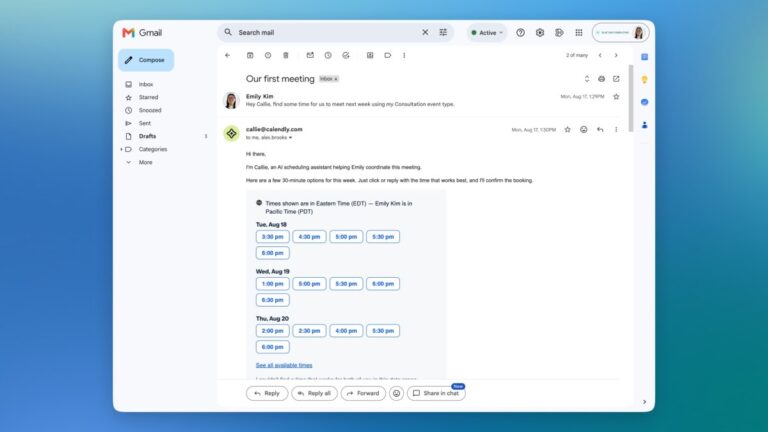
Beyond note-taking, Calendly is planning to release an AI assistant called Callie that operates within its existing scheduling infrastructure. Callie will propose meeting times by checking attendee availability, set up sessions automatically, and retrieve context from prior meetings with the same people. Read AI, a competing note-taker company, launched a similar email-based assistant earlier this year, suggesting that moving beyond transcription into scheduling automation is becoming a recognized opportunity across multiple vendors in the space.
The Market Landscape and Competitive Fragmentation
The meeting note-taking space has split into distinct segments. Specialized companies like Granola, Fireflies, Read AI, Otter, and Fathom focus primarily on transcription and summary generation. Broader productivity platforms—Notion, ClickUp, and Wispr—have integrated note-taking features into their larger suites. Calendly represents a third positioning: leveraging an installed base of scheduling users and attempting to extend into adjacent workflows. This strategy differs from both pure-play competitors and generalist productivity suites, creating a unique position that depends on the intersection of scheduling and post-meeting work.
Targeting Users With Meeting-Heavy Schedules
Calendly CEO Tope Awotona identified the company’s core audience: people in outward-facing roles like sales and marketing whose workdays consist largely of back-to-back meetings. For these users, the problem isn’t capturing what was said—it’s managing everything that needs to happen afterward. Sales representatives managing dozens of prospect relationships face a cascade of follow-up tasks after each call. Marketing professionals coordinating cross-functional projects must synthesize decisions and assign action items. These workflows represent the real bottleneck in a meeting-heavy workday, not the act of recording.
Awotona framed the opportunity in explicit terms: while every note-taker company excels at recording and transcribing, the real efficiency gains come from automating the downstream work that follows a meeting. “There’s a litany of notetakers, and all of them do a great job of recording and transcribing notes. But a lot of work happens after the meetings. And we think that really that’s where the opportunity for our note-takers to be efficient,” he said.

Automation After the Meeting Ends
Most note-taker companies market themselves on transcription accuracy and summary quality. Calendly is banking on a different value proposition: that users prioritize action over accuracy. Turning a transcript into a perfect summary requires one language model call and some prompt engineering. Automating what happens next—sending follow-ups, assigning tasks, scheduling callbacks, updating customer records—requires business context and system integration. The difference between these two approaches is enormous. A user might tolerate a summary that missed a nuance, but they cannot tolerate a follow-up email that gets the attendee’s name wrong or proposes a time when they are unavailable.
How Calendly’s Scheduling Data Creates an Advantage
Calendly’s existing infrastructure provides context that standalone note-takers lack. The system already knows who attended the meeting, what has been discussed with those attendees in previous sessions, and when they might be available for follow-up. Callie can use this data to propose next-step meetings and draft follow-up emails informed by actual conversation history rather than generic templates. For a sales professional managing dozens of prospect relationships or a marketing manager coordinating across teams, this degree of context-aware automation could meaningfully reduce manual overhead. A standalone note-taker has no knowledge of the organization, the attendee relationships, or the calendar constraints that would make a proposed time slot realistic.
Privacy Safeguards in a Controversial Space
The meeting note-taking industry has faced scrutiny over user consent and data handling. Both Otter and Granola have faced privacy allegations, raising questions about how these tools obtain permission before recording. The concern is not hypothetical: meeting participants may not realize they are being recorded if a bot joins silently. Calendly’s approach emphasizes transparency at multiple stages, attempting to establish clear consent before recording begins.
Transparency Before and During Meetings
When Calendly’s note-taker joins a meeting, it sends a message in the meeting chat notifying all participants that recording is underway. Any participant can request that the bot leave the conversation. Calendly’s advantage is timing: because it owns the calendar where the meeting was created, it can inform attendees ahead of time—in the actual Calendly invitation itself—that the session will be recorded. This makes the recording announcement part of the normal meeting setup rather than a surprise at meeting start, and gives attendees the option to decline the meeting entirely if they object to being recorded. The notification appears in the same place where attendees already look to confirm meeting details, removing the risk that someone misses a disclosure buried in meeting notes or chat.
Competing in a Saturated Market
Whether Calendly’s entry succeeds depends partly on execution and partly on market dynamics. The note-taking space is crowded with both specialists and generalists, each claiming efficiency gains. Calendly has a distinct advantage: millions of existing users already trust the platform with their calendar. Extending that trust to a note-taker that integrates seamlessly with the same system requires less user acquisition effort than convincing someone to adopt an unfamiliar tool. A user who opens Calendly to schedule a meeting and sees a note-taking option already integrated faces a lower friction barrier to trying it than someone encountering the product for the first time.
The company is not building a productivity suite to compete with Notion or ClickUp, nor is it trying to match the transcription depth of pure-play specialists. Instead, it is narrowing its focus to the meeting-to-action pipeline—turning calendar entries into automated post-meeting work. That specialization and distribution advantage may ultimately be what matters in a field where features have begun to converge. The core question is whether the benefit of avoiding a separate tool outweighs the benefits of using a dedicated note-taker built specifically for transcription and summary quality. For users already paying for Calendly and working in meeting-heavy roles, the integrated approach may prove sufficient.
Frequently Asked Questions
What is Calendly's meeting note-taker designed to do?
It joins meetings, records audio and video, transcribes conversations, and generates summaries, action items, and draft follow-up emails. The company is also testing system-audio transcription and plans to release Callie, an AI assistant that uses calendar data to set up meetings, check availability, and surface context from prior meetings.
How does Calendly differentiate from competitors like Granola and Read AI?
Rather than competing on transcription quality, Calendly is focusing on automating the work that happens after meetings, such as scheduling follow-ups and drafting emails. Its integration with Calendly's existing scheduling system gives it access to attendee availability and prior meeting context that standalone note-takers lack.
What privacy safeguards does Calendly's note-taker include?
The platform sends a chat message when it joins a meeting to notify participants that recording is underway, and any participant can ask it to leave. Calendly can also pre-notify attendees in the calendar invitation that the meeting will be recorded, allowing them to decline if they object to being recorded.
