
Key takeaways
- Bumble ended its signature women-message-first rule, allowing anyone to initiate contact as the dating app confronts revenue decline and user attrition.
- A company survey found that 66% of women users actually prefer men to send the first message, contradicting Bumble's decade-old positioning.
- The longer 72-hour response window is part of a broader pivot including swipe-free features, in-person events, and AI tools aimed at reversing user fatigue.
- The change reflects broader industry struggles as the swipe-based dating app model loses appeal, particularly among younger users.
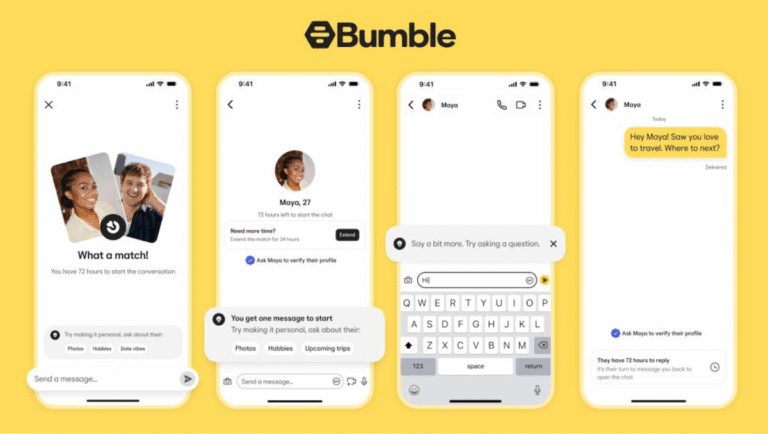
Bumble announced this week that it is ending the messaging rule that has defined the dating app since its 2014 launch. Starting immediately, anyone in a match can send the first message, reversing a decade-long policy that restricted women to initiate conversations with men. The platform is also extending the response window to 72 hours, double the previous 24-hour limit, aiming to reduce the time pressure users feel when replying to messages.
The shift represents a major strategic recalibration for Bumble, which built its reputation as an alternative to Tinder by positioning women as gatekeepers of conversation. That approach initially set the company apart in a crowded market. But mounting pressure from both users and declining financial performance has forced the company to rethink its core mechanics.
Why Bumble’s Rule Mattered
Positioning Against the Status Quo
When Bumble launched in 2014, the women-message-first rule was conceived as a response to problems endemic to other dating apps. Tinder and its competitors had become known for unsolicited messages, harassment, and an overwhelming volume of low-quality interactions. By giving women control over who could initiate conversations, Bumble positioned itself as the considerate alternative—one that recognized women’s needs and gave them agency.
A Defining Brand Feature
That positioning stuck. For over a decade, the feature remained central to Bumble’s identity and marketing. CEO Whitney Wolfe Herd had built her pitch around empowerment, framing the rule as both a practical tool against harassment and a philosophical statement about women’s agency in dating. The rule became synonymous with the brand itself—it was, essentially, what made Bumble different from every other player in the space.
What Users Are Actually Asking For
The Preference Data
Despite the rule’s prominence in Bumble’s brand story, survey data revealed a more complex reality. According to Bumble’s own polling, 66 percent of women surveyed said they prefer men to send the first message. Beyond that preference, many respondents reported that the shorter response window created stress rather than relief—they felt pressure to craft the perfect opening within 24 hours or lose the match entirely.
The Time Pressure Problem
The longer 72-hour window addresses this directly. More than half of survey respondents indicated that extending the response period improved their experience on the platform. The change acknowledges that what Bumble marketed as empowering—forcing women to make the first move—had begun to feel like an obligation to many users. The new rules give people flexibility to respond on their own schedule rather than racing against a ticking clock.
CEO Wolfe Herd attempted to reframe the change as consistent with the company’s original vision rather than a departure from it. In a statement, she said the company’s women-first positioning was “never about prescribing just one way to connect. It was about designing an experience with women’s needs in mind to create better outcomes for everyone.” She added that the update represented a fulfillment of the founding mission: “Today, our community is asking for more flexibility, less pressure, and more opportunities to create real, meaningful connections, and that is what this new experience provides.”
The Business Case Behind the Shift
Bumble’s decision arrives against a backdrop of weakening financial performance. In its second-quarter earnings report released last week, the company reported revenue of $210.5 million, down 15.2 percent year over year. More concerning, the company signaled that its number of paying customers would decline in the third quarter—a metric closely watched by investors as a signal of user retention and satisfaction.
The broader dating app industry is wrestling with structural challenges that go beyond any single company’s feature set. User fatigue has become widespread, as the novelty of swiping through hundreds of profiles has worn off. The market itself is increasingly saturated, with established players competing for the same pool of users. The simple mechanic of endless swiping no longer holds the appeal it once did, particularly for younger cohorts.
A Platform Under Transformation
Beyond the Swipe Model
The messaging rule change is one element of a larger shift in how Bumble is approaching its business. The company has begun moving away from its core swipe-based interaction model entirely. In recent weeks, Bumble revealed plans to explore a swipe-free future—a fundamental redesign that would move the platform toward different ways of connecting.
New Features and Target Demographics
Alongside this, the company is investing in in-person events and new AI-powered features aimed at generating engagement and appeal, especially among Gen Z users who may never have felt drawn to the swipe model in the first place. This pivot toward AI and away from swiping reflects industry-wide recognition that the traditional dating app formula is losing traction. Younger users in particular appear fatigued by the swiping paradigm, and companies that once built their entire value proposition around it are now scrambling to offer alternatives.
A Year of Loosening Restrictions
The move is not entirely unexpected. Bumble had already begun softening its signature rule in 2024 when it introduced a feature called Opening Moves, which allowed women to post a question on their profile that men could answer without waiting for the woman to message first. That feature suggested the company was testing flexibility around its core mechanic even as it maintained the official policy.
Tuesday’s announcement makes clear that the testing period has ended and a new direction is now official policy. By giving all users the ability to initiate, Bumble is effectively saying that control and empowerment can take many forms—and that forcing women to message first, whatever the original intent, had become an impediment rather than a feature. The changes take effect immediately across Bumble’s platform globally.
Frequently Asked Questions
Why is Bumble ending its women-message-first rule?
Bumble's own survey data showed that 66% of women users prefer men to send the first message, and many found the 24-hour response window stressful rather than empowering. The change is also part of a broader strategic shift as the company faces declining revenue (down 15.2% year over year) and user fatigue across the dating app industry.
What else is changing on Bumble?
The response time window is being extended from 24 hours to 72 hours. The company is also exploring a swipe-free future, launching in-person events, and adding AI-powered features to appeal to Gen Z users who have largely abandoned the swiping model.
How did Bumble's leadership justify the change?
CEO Whitney Wolfe Herd framed the update as an evolution rather than a retreat from the company's women-first mission, saying it was 'never about prescribing just one way to connect' but rather 'designing an experience with women's needs in mind to create better outcomes for everyone.'
