
Key takeaways
- European tech leaders view the Mythos and Fable incident as exposing their dependence on U.S. and Chinese AI providers, prompting urgent discussions about sovereignty and infrastructure control.
- Meredith Whittaker warned that AI integration into operating systems creates surveillance infrastructure, though she noted privacy-first solutions still represent an untapped market opportunity for Europe.
- Emad Mostaque framed AI control as a political question—arguing whoever controls AI controls the country—while Mia Negru suggested society must rethink democracy, work, and economic participation itself.
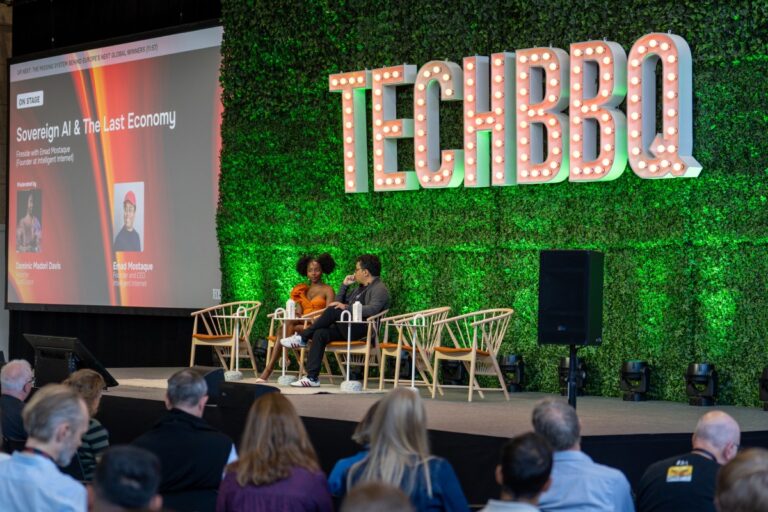
At TechBBQ, an annual Nordic conference that concluded on August 27 in Copenhagen, discussions among European founders, investors, and operators circled repeatedly around a single concern: Who owns and controls the AI infrastructure shaping the continent’s future?
The question dominated conversations both on stage and in informal settings throughout the event, which adopted the theme “Emerging from Agency” this year. That focus proved prescient, arriving in the wake of an earlier 2026 incident when Anthropic restricted access to its Mythos and Fable models for users outside Europe.
The incident that sparked a continent-wide reckoning
When Anthropic made Mythos and Fable unavailable to European users, the disruption rippled through the startup ecosystem. One software executive told me the move seriously impacted his team’s operations. Another founder acknowledged the longer-term risk while remaining pragmatic: European reliance on U.S. and Chinese AI providers might eventually pose severe challenges, but the current situation remains manageable.
That calculation—weighing immediate practical needs against future geopolitical exposure—became the unspoken backdrop for nearly every AI-focused discussion at the conference. The Mythos and Fable incident crystallized what many European technology leaders had begun to suspect: the continent’s technological independence now depends on decisions made in Silicon Valley and Beijing.
Ellen de Brever, an angel investor and head of partnerships at the Novo Nordisk Foundation Cellerator, observed that this year’s theme resonated more powerfully than organizers may have anticipated. “The conversation shifted from what AI can do to what we’re actually willing to let it do,” she told me during the event.
Privacy as a boundary
Meredith Whittaker, president of Signal, participated in a panel exploring whether privacy and AI coexistence remain possible. She offered a direct assessment: AI companies are constructing “a data collection apparatus,” and marketing narratives frequently obscure the true costs of gathering such massive datasets.
Whittaker objected specifically to the integration of AI assistants into operating systems, citing the example of ChatGPT’s integration with iMessage. She argued that this trend amplifies the erosion of user agency and data security.
The market for privacy persists
Her central point cut against techno-optimism: “There is still a huge market need for privacy.” She suggested that European sovereignty concerns create an opening for solutions that genuinely protect user data, even as most major AI platforms move in the opposite direction.
The position reflected a tension running through the conference—between the appeal of cutting-edge AI capabilities and the risks those capabilities introduce. Whittaker’s argument framed privacy not as a legacy concern but as an emerging competitive advantage.

Who really holds power
Emad Mostaque, co-founder of Stability AI and Intelligent Internet, approached the sovereignty question from a different angle in a separate panel. He defined sovereignty directly: “the ability to resist power being exerted over you.”
Mostaque focused on the concentration of AI development among a handful of laboratories and research teams. He made a stark claim about the implications: “Inevitably, every country will be run by AI” and “the person that controls the AI controls the country.”
That framing recast AI development as a fundamentally political question, not merely a technical one. The winners and losers in this transition, under Mostaque’s logic, would be determined not by algorithmic superiority but by control of the infrastructure itself.
Rethinking the foundations
Mia Negru, advocacy and engagement director at the nonprofit Life With Artificials, sent a message reflecting on what she’d heard from the panels. She posed a possibility that extended beyond the conference’s immediate focus: “If intelligent agents perform cognitive work and robots increasingly perform physical work, we may be approaching something much bigger than another technological revolution.”
Democracy and participation at stake
Her concern went deeper than efficiency or labor displacement. The emergence of autonomous AI systems, in her view, forces fundamental questions: “We may have to rethink ownership, work, democracy, economic participation and eventually even who gets to participate in society.”
This perspective shifted the conversation from concrete infrastructure debates to the architecture of society itself. The stakes, framed this way, extend far beyond which nation builds the most advanced models.
Agency as a human choice
De Brever captured the paradox embedded in the conference’s theme: “The age of AI agents isn’t really a story about machines gaining agency. It’s a story about humans deciding what to give up.” That formulation reorients the typical framing, positioning technological adoption as an active choice with consequences, not an inevitable drift.
The various panels and sessions—covering women’s health innovations, Nordic and African ecosystem collaboration, and capital allocation in Europe—all touched on AI without making it the explicit subject. AI remained the underlying current, the force reshaping which problems seemed solvable and which choices seemed inevitable.
The conference beyond the panels
When formal sessions ended, TechBBQ shifted into a series of networking events where the philosophical urgency gave way to more routine community building. Lovable, Nvidia, OpenAI, AWS Startups, and HSBC organized a rooftop barbecue where conversation turned to Denmark’s emerging technology hubs. Ada Ventures hosted a cocktail gathering at the Bird bar in London where discussion of women’s brain health innovation led to broader reflections on investment patterns. Speakers attended a dinner on an island within Copenhagen itself, followed by late-night celebrations at an attached bar.
The convivial atmosphere of these events contrasted with the morning’s serious tones, yet de Brever argued both mattered equally. “In a room full of conversations about machines, the most memorable moments still come from the simplest thing,” she reflected. “Human connection, face-to-face, building relationships, sharing ideas, and reminding each other of what technology can never quite replace.”
That observation closed a loop: a conference ostensibly about machines and control kept returning to the irreducible value of human presence and choice—not as nostalgic sentiment but as practical recognition. The questions about European AI sovereignty, data privacy, and democratic participation remained open when the event concluded on August 27. But TechBBQ’s conversations established that these questions had moved from abstract concern to urgent priority across the European technology ecosystem.
Frequently Asked Questions
What incident prompted Europe's urgent AI sovereignty debate at TechBBQ?
Anthropic's restriction of its Mythos and Fable models to European users earlier in 2026 highlighted how European tech companies depend on decisions made by U.S. AI providers, crystallizing concerns about geopolitical control of AI infrastructure.
What concerns did Meredith Whittaker raise about AI's integration into daily tools?
Whittaker argued that integrating AI assistants like ChatGPT into operating systems and messaging apps creates "a data collection apparatus," though she noted Europe's sovereignty concerns create a market opportunity for privacy-focused alternatives.
How did the conference frame the implications of concentrated AI power?
Panelists argued AI control would reshape fundamental aspects of society—Emad Mostaque claimed whoever controls AI controls the country, while Mia Negru suggested societies must rethink ownership, democracy, and economic participation.
