
Key takeaways
- Figma's new Specs markdown editor lets teams define design languages for AI agents to follow, reducing unpredictability in AI-generated designs.
- Code layers moved from private to public beta, enabling users to convert designs to code or modify code to refine prototypes with AI help.
- Figma integrated Payload CMS with Make for dynamic websites and expanded MCP support to over 20 tools, including Indian AI startup Sarvam.
- India is Figma's largest market outside the United States, with 40% of the Bombay Stock Exchange's top 100 companies using the platform.
Figma announced a comprehensive suite of features aimed at governing how artificial intelligence agents operate within its design platform during the company’s inaugural Config conference in India. The announcements address a fundamental challenge in AI-assisted design: reducing unpredictability and ensuring agents respect brand and system rules. The releases span a markdown-based design language editor, expanded code generation capabilities, extended tool integrations, and deeper connections to content management systems.
Markdown Specs for Design Language Definition
The Specs Editor
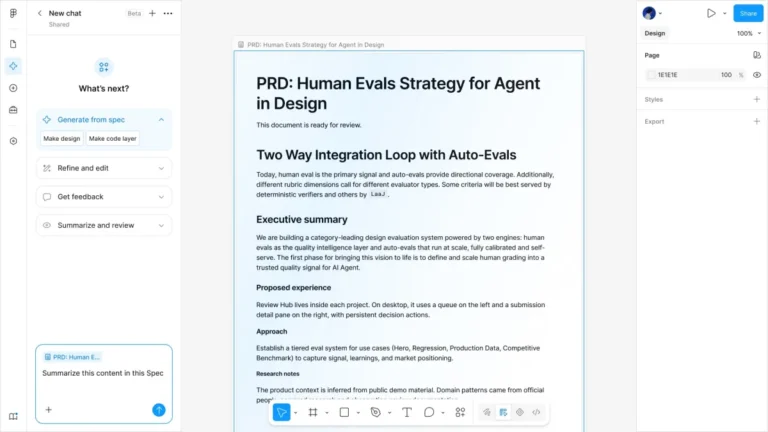
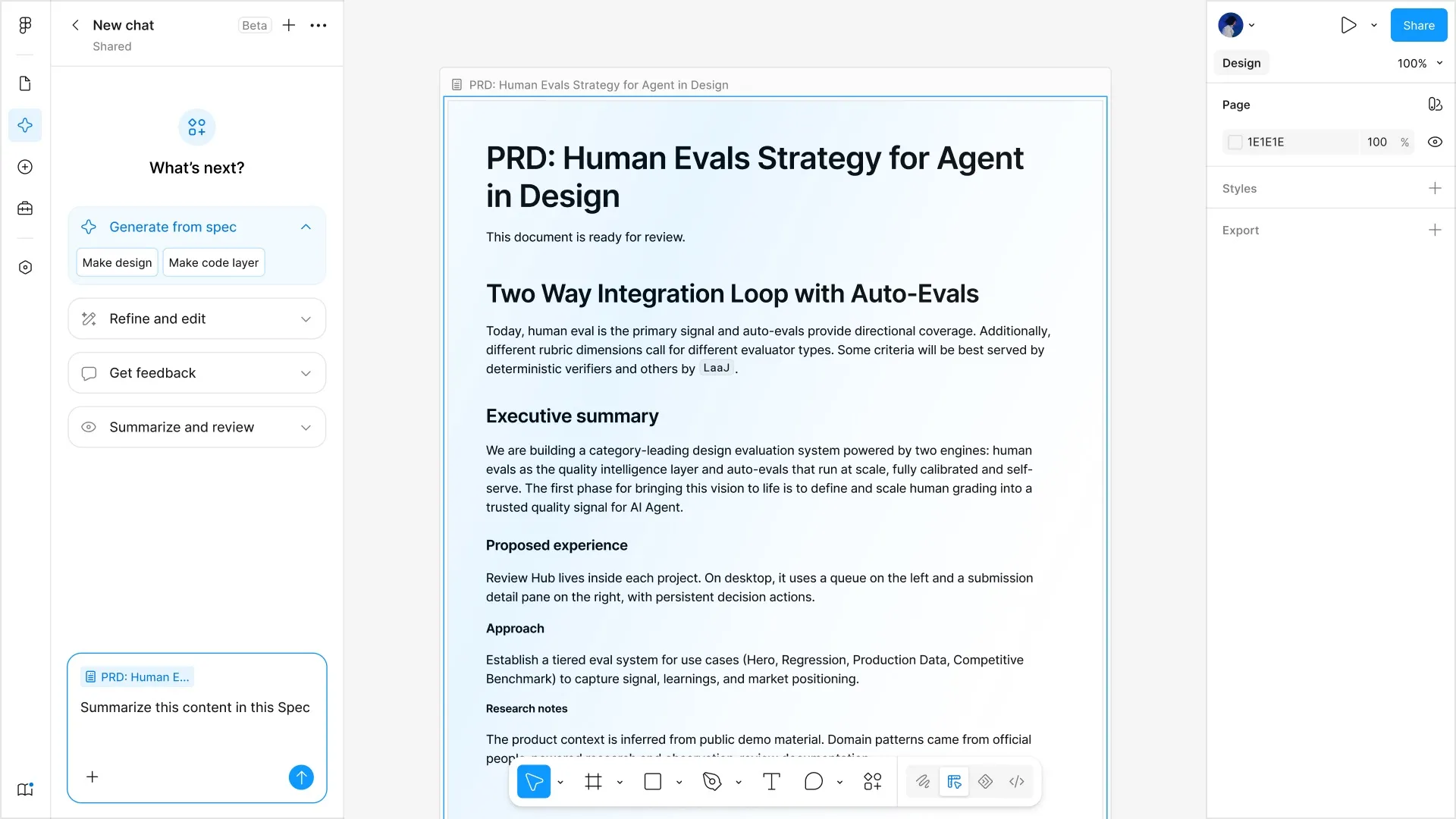
At the center of Figma’s announcement is Specs, a new markdown editor that enables design teams to document and formalize their design language. Rather than scattering guidelines across documents or wikis, Specs allows teams to write their design rules in a single, structured document within Figma. Users can create the document as a standalone file or embed it directly on the canvas. The editor functions as more than a text tool—it supports references to other Figma elements, embedded FigJam diagrams, code layers, and designs, transforming the markdown document into an interactive reference guide.
Centralizing Design System Context
Figma allows teams to consolidate design system context in one place alongside Specs. Design libraries containing reusable components, code libraries showing how components are built, and written guidelines detailing usage patterns can all coexist with the Specs document. This centralization serves both human designers requiring clear rules and AI agents needing precise instructions for generating or modifying designs. By surfacing design libraries, code libraries, and guidelines to agents, Figma aims to make AI behavior more predictable and aligned with brand standards.
Confronting the Unpredictability Problem
Figma explicitly acknowledges that artificial intelligence’s non-deterministic nature creates obstacles in design workflows. The company positioned its recent feature releases as mechanisms to steer AI toward more reproducible and controllable behavior. Given AI’s inherent variability, Figma is providing tools to push outcomes toward more predictable results. Earlier this week, the company extended access to its agent on canvas to a broader user base, moving the capability beyond limited access.
Code Generation and Prototype Iteration
Code layers, a feature Figma previewed in private beta in June, is now entering public beta. This feature embeds coding capability directly into the design canvas, allowing users to build interactive and dynamic prototypes. Users can instruct the agent to convert a design into working code or to modify specific code sections to iterate on a prototype. This capability bridges the gap between design and development, reducing handoff friction. The agent can interpret design changes and propagate them into code, or take code modifications and reflect them back into the visual design.
Expanding Integrations Through MCP
Figma’s support for the Model Context Protocol has expanded significantly. The company is now supporting over 20 new tools through MCP, including Open Code, Dia, Grok Bot, and Sarvam, an AI startup based in India. MCP enables Figma users to connect with external services and specialized tools without leaving the platform. This approach allows teams to bring context from other systems, code repositories, design tools, or AI services directly into their Figma workflow. The expansion reflects Figma’s strategy to position itself as a central hub where design, code, and external tools converge.
Payload Integration and Content Management
Figma acquired Payload, an open-source headless content management system, in the prior year. The company is now integrating Payload directly with Figma Make, the product for generating dynamic websites. This integration allows teams to design web interfaces in Figma and manage the underlying content through Payload without context switching. Designers can prototype a website layout and content structure simultaneously, and developers can access both design and content schema from a single source.
Payload’s adoption trajectory suggests demand for this type of integrated workflow. Downloads of Payload have increased sixfold over the past 12 months, a significant acceleration reflecting growing interest in headless CMS platforms. For Figma, this adoption signals that teams are ready to tighten feedback loops between design decisions and content structures.
India’s Emergence as a Strategic Market
Figma’s decision to hold its first Config conference in India underscores the country’s importance to the company’s growth. Late last year, Figma established its first office in India, staffed with teams focused on sales, partnerships, go-to-market operations, and product support. India has become Figma’s largest market by user count outside the United States. The company reports that 40% of India’s top 100 companies listed on the Bombay Stock Exchange use Figma, indicating deep penetration among the country’s largest enterprises.
Code, Design, and Discovery
Loredana Crisan, Figma’s chief design officer, connected these announcements to broader trends in software development. Speaking with TechCrunch, Crisan observed that the volume of code produced today has grown dramatically without corresponding increases in product releases. “There are 17-times more lines of code being produced today than in the past. But when you’re looking at releases, only 1.3-times more releases,” Crisan said. “A lot of that code actually is not necessarily built to ship, but really built to discover what the product is. It’s built to design.”
For Figma, this observation positions design and interactive prototyping as discovery tools rather than final outputs. AI agents that can generate designs quickly and reliably become accelerants for the discovery process. Crisan framed Figma as “the place where software teams come to decide what they build and ship,” suggesting that the platform’s role is to explore possibilities efficiently before commitment to production. The new Specs feature, code layers, and agent integrations all serve this vision, making design exploration faster, more rule-bound, and more aligned with team standards.
Source: TechCrunch
Frequently Asked Questions
What is Figma Specs?
Specs is a markdown-based editor that lets teams define their design language in a single document. It can exist as a standalone file or alongside the canvas, and supports references to Figma elements, FigJam diagrams, code layers, and designs, serving as a reference for both human designers and AI agents.
How does Figma address AI unpredictability in design?
Figma provides Specs as a design rule reference and centralizes design system context, including design libraries, code libraries, and guidelines, that agents can access. Users can also ask agents to convert designs into code or modify code to iterate prototypes, giving more control over AI behavior.
Why is India strategically important to Figma?
India is Figma's largest user market outside the United States. The company opened its first office there late last year and reports that 40% of the top 100 companies listed on the Bombay Stock Exchange use Figma, indicating deep enterprise adoption.
