
Key takeaways
- Fusion startups are turning to defense contractors for funding as climate tech venture capital slows.
- Xcimer's partnership with RTX funds laser development while allowing the defense giant to explore military applications.
- Pacific Fusion's NNSA deal positions its New Mexico facility for both power plant demonstration and nuclear weapons research.
- The trend reflects how fusion energy originated from weapons research and is returning to that domain.
Fusion power startups are increasingly turning toward an unlikely source of investment and partnership: the defense industry. As traditional climate technology funding has dried up, several fusion companies are embracing — or returning to — military applications that trace back to the science of thermonuclear weapons.
The pivot marks a return to fusion’s origins. The sector emerged decades ago when physicists sought peaceful applications for the physics behind Cold War nuclear weapons. The 2022 breakthrough at the National Ignition Facility, considered a landmark moment for fusion energy, took place at an institution that has supported national security applications for over 25 years. That national security dimension never fully disappeared, even as the industry pursued commercial power generation.
The Cold War Foundation of Fusion Science
Fusion energy itself grew from weapons research. Physicists during the Cold War looked for constructive uses for the science underlying thermonuclear bombs that proliferated during that era. That dual-use heritage meant that even as fusion startups focused on grid power in recent years, the underlying technology retained military interest.
The 2022 National Ignition Facility success, widely celebrated as a breakthrough toward commercial power, occurred within an institution deeply embedded in national security work. For more than 25 years, the facility has supported defense applications alongside its civilian research mission. This history means fusion startups operating in this space inherit relationships and expertise that span both civilian and military domains.
Climate Tech Funding Slows, Redirecting Capital
Venture capital committed to climate technology has stalled significantly, creating financial pressure across the sector. Fusion startups had captured a substantial share of recent climate tech funding, but the inherent expense of fusion research made them particularly vulnerable to funding shifts. As venture capitalists grew cautious about climate commitments, portfolio companies began seeking alternative revenue streams.
The defense industry emerged as a natural alternative. Defense contractors have long explored laser-based weapons systems, but recent geopolitical shifts have intensified that interest. The evolution of drone warfare has exposed gaps in traditional air defense approaches designed for manned aircraft. That mismatch between existing defenses and new threats created an opening for novel weapons technologies — including those developed by fusion startups.
Rethinking Air Defense in the Drone Era
The Cost Problem with Traditional Systems
Traditional air defense systems were engineered to target human-piloted aircraft, which are typically large and few in number. This logic breaks down against drone swarms or individual small unmanned systems. Around a decade ago, a U.S. ally fired a $3 million Patriot missile to destroy a $200 consumer drone. The shot was effective but economically absurd.
Why Laser Weapons Change the Equation
Laser-based weapons fundamentally alter the cost structure. Rather than firing single-use, expensive missiles, they can fire repeatedly using electricity from a generator, ship reactor, or other power source. The firing cost per shot drops dramatically. Fusion startups working on laser-based reactor designs became obvious partners for developing such systems, since their technology directly produces the powerful laser systems defense contractors needed.
Xcimer and RTX Strike a Partnership
Xcimer, a Denver-based fusion startup, announced a partnership with RTX last week — a conglomerate that owns Raytheon and other major defense contractors. The deal includes an investment from RTX Ventures, positioning Xcimer to develop both its power plant ambitions and defense applications simultaneously.
The Laser System Behind the Deal
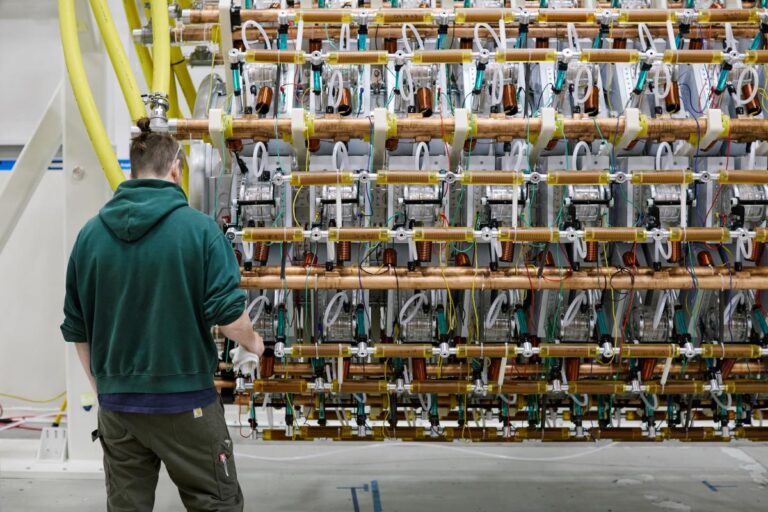
Xcimer currently operates what it describes as the largest privately owned laser system globally. The company plans to use this laser infrastructure to build a fusion power plant. Within that plant, lasers would bombard fuel targets, compressing them until atoms fuse and release energy. The startup’s current system, called Phoenix, operates at an order of magnitude lower power than a commercial power plant requires, yet that power level proved sufficient to attract defense interest.
What the Partnership Means
The RTX investment funds Xcimer’s development while allowing RTX to explore using Xcimer’s lasers for its own defense purposes. This arrangement lets the startup access capital without abandoning its power generation goals, while RTX gains early access to a potentially transformative weapons technology. Both parties benefit: Xcimer gets funded, RTX gets optionality on advanced laser systems.
Pacific Fusion’s Government Laboratory Partnership
Xcimer is not alone. Pacific Fusion announced a memorandum of understanding with the National Nuclear Security Administration (NNSA) last month. The partnership centers on high-energy-density fusion experiments conducted at a demonstration facility Pacific Fusion recently broke ground on in New Mexico, positioned near Sandia and Los Alamos National Laboratories.
The facility’s stated primary purpose is proving that Pacific Fusion’s design generates more power than it consumes. But that same facility also supports something else: nuclear weapons experiments far more powerful than those the government currently conducts. According to Keith LeChein, Pacific Fusion’s co-founder and chief technical officer, the facility has “utility in this world-leading defense application” — a dual-purpose design that wasn’t accidental.
Expertise Built on National Security Work
Pacific Fusion’s founders bring deep experience in weapons research. LeChein previously worked at Sandia National Laboratories, Lawrence Livermore National Laboratory, and the NNSA itself. Co-founder and chief operating officer Carrie von Muench confirmed that defense applications were “always on our mind.” This wasn’t a recent pivot but a deliberate positioning from inception.
The team’s backgrounds reveal the intention. LeChein developed Pacific Fusion’s core technology while embedded in the national security research establishment. That experience shaped both what the company builds and how it structures partnerships. The NNSA partnership appears less like a surprise opportunity and more like a natural extension of the founders’ existing networks and expertise.
A Cycle Returning to Its Origins
Fusion energy is returning to the applications that first motivated its scientific development. The sector emerged from weapons research, pivoted toward clean power during decades of VCs and government interest in climate technology, and is now cycling back as that funding model falters. For well-positioned startups with teams experienced in national security work, the defense industry offers both capital and a clear path to deployment. Whether this partnership strategy accelerates fusion’s path to the power grid remains unclear, but it certainly accelerates these startups’ ability to fund development.
Frequently Asked Questions
Why are fusion startups partnering with defense contractors?
Fusion startups are seeking alternative funding as venture capital for climate technology has stalled. Defense contractors are interested because laser-based fusion technology can be applied to weapons systems, particularly addressing the need for cost-effective air defense against drones.
What is Xcimer's partnership with RTX?
Xcimer announced an investment and partnership with RTX last week. RTX Ventures provides funding while RTX explores using Xcimer's powerful laser systems for defense purposes. Xcimer operates what it says is the largest privately owned laser system globally, called Phoenix.
How does Pacific Fusion's NNSA partnership work?
Pacific Fusion announced a memorandum of understanding with the National Nuclear Security Administration to conduct high-energy-density fusion experiments at a demonstration facility in New Mexico near Sandia and Los Alamos labs. The facility serves dual purposes: proving the company's design generates net power while supporting advanced nuclear weapons experiments.
