
Key takeaways
- ChatGPT Work achieved 98% adoption among OpenAI employees but only 17% among organizational subscribers and under 1% among individual users, exposing a fundamental gap in how the product scales beyond software engineering.
- Anthropic's Claude Code proved that back-and-forth agent interaction works better than autonomous operation, forcing OpenAI to redesign Codex after launch and add checkpoint-based user confirmations throughout task execution.
- Permission systems, interface complexity, and ambiguous effort settings create friction that currently limits adoption to power users and experimenters willing to cede substantial access to their work systems.
When Andrew Ambrosino, lead engineer for OpenAI’s desktop application, decided to test the company’s newest product, he handed it the keys to his digital life. His inbox, Slack account, phone, and connections to Notion and Figma all became accessible to an AI agent running on his laptop. The risk of data leakage exists—a model might pull from a private message without understanding it should stay private. Ambrosino accepted that trade-off. “I’ll do it for the job,” he told TechCrunch. “I haven’t had to” regret the decision.
That willingness to cede control to an artificial intelligence represents OpenAI’s fundamental bet: that the next wave of AI productivity will come not from answering questions, but from autonomous agents that handle entire workflows. The company released ChatGPT Work last month as a $20-per-month add-on on its lowest subscription tier, targeting white-collar workers whose days revolve around email, spreadsheets, databases, and cloud platforms. The vision is straightforward—let artificial intelligence operate the digital tools that accountants, investors, doctors, and administrators already use, without requiring them to learn new interfaces or write code.
But there’s a problem. While OpenAI’s own employees have embraced the technology at near-total rates, adoption in the outside world flatlines.
The Adoption Chasm
An OpenAI-backed study found stark differences in how Codex—the coding-focused predecessor to ChatGPT Work—reached different audiences. In June, 98 percent of OpenAI employees used the tool. That number collapsed outside the company: only 17 percent of organizational subscribers and less than 1 percent of individual subscribers deployed the agentic coding version. The desktop and mobile applications combined serve about 20 million users, a fraction of the more than 1 billion people who interact with ChatGPT through web prompting.
That gap between internal enthusiasm and external indifference shapes the entire challenge facing OpenAI and competitors building similar products. Thibault Sottiaux, who leads the company’s core product development including Work, frames it as a mission: “Bring everyone along.” But the data suggests the bridge between those already building with code and those managing without technical skills remains unconstructed.
Why Software Engineers Got It First
The reason engineers adopted coding agents so quickly is structural. A command-line interface that lets a model write and test code against existing systems changed how software got built and deployed. Software either works or breaks—outcomes are immediate and measurable. An engineer watches a model generate code, evaluate its own output, and iterate. That feedback loop created instant value.
The Measurements Problem for Office Work
Knowledge work doesn’t track the same way. Is a business strategy good or bad? Was a presentation effective? Did a sales pitch land? These questions resist easy evaluation. Ambrosino noted the core challenge: “One of the unique challenges with a product like this is just that it can really do anything.” When asked which specific workflows his team optimizes for, the engineers deferred to OpenAI’s research division, which pointed to an internal benchmark called GDPval, drawn from 44 occupations and hundreds of knowledge work tests, supplemented by user feedback. But much of the real guidance comes from watching OpenAI’s own staff solve problems. “We have to always parse out … are we doing the workflow that everybody else will be doing, or are we weird?” Ambrosino said.
What Makes an Agent Work
Understanding the adoption gap requires understanding the machinery. Every large language model needs what engineers call a “harness”—the software framework that decides what information the model receives, which tools it can access, and how it presents results. For a model to function as an agent on long-term tasks, the harness must grant it access to external systems and supply instructions for deploying them over hours or days, not seconds.
The Interface Question
For software developers, a text-based interface was enough. Most people don’t use command-line tools—Windows replaced DOS for that reason. OpenAI’s team recognized that getting a billion-scale audience meant building something that handles “the messy world of your life and your tools and websites that were built in 1995 and never updated,” as Ambrosino put it. Products like Claude Code proved that abstracting away technical complexity—letting users describe what they want rather than specifying how to build it—could work. OpenAI aims to bring similar abstraction to everyday office tools, abstracting away the complexity of integrating email, calendars, spreadsheets, and chat platforms into coherent workflows.
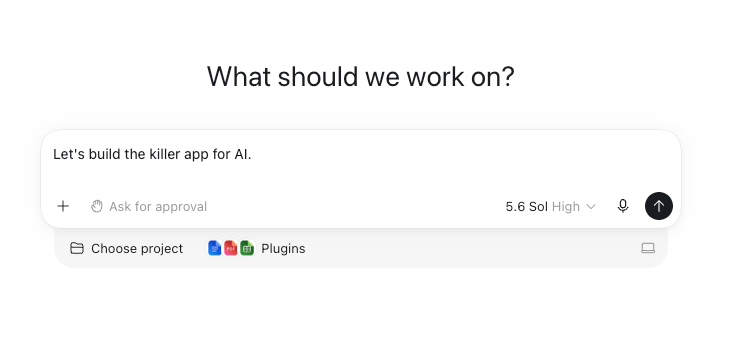
The company’s design philosophy treats this interface layer seriously. Internal debates center on whether features should exist at all if a user could simply ask the model to do something. “We push back on [that]—because it’s very early,” Ambrosino said. “Discoverability matters in this phase, and at some point we won’t have the button.” ChatGPT Work retains buttons for selecting projects and plugins, which Ambrosino compares to skeuomorphism—making digital tools resemble physical objects they replace. The practice fell out of fashion, but Ambrosino defends it: “That actually helped get people into this [and] make the transition.”
Integration and Permission Complexity
Theory and practice diverge sharply when users attempt to connect their own systems. Setting up agent access to cloud storage turned out confusing—attempts to grant only read permissions failed with opaque errors. The model offered little help; eventually, a mobile app dialog explained that full access was required. Major settings appear only on the web version, forcing users to juggle between desktop and browser. Some limitations feel arbitrary: link the agent to a Google Calendar and it can create events, but not new calendars. Tasks requiring minimal reasoning produce unusable results.
Real-World Use and Friction
For problems that demand sustained effort, ChatGPT Work delivers. VCs use it to assemble relevant communications and analysis into investment memos. Operations teams spin up custom dashboards and data visualizations. One engineer asked it to examine a Slack conversation about a technical problem, generate charts, and received back visualizations that revealed insights he hadn’t considered. Sam Altman reportedly uses it to plan vacations.
A preschool calendar buried in email posed no challenge—the agent extracted the oddly-formatted dates and populated Google Calendar correctly, saving tedious data entry. Financial analysis on publicly traded companies returned auto-updating metric dashboards. A queryable space launch database emerged from a task that previously required Python scripts to accomplish.
But these successes require trust and configuration. Testing the tool meant accepting significant access to email, source documents, and research. Refusing deeper permissions—declining to grant access to financial accounts, for instance—reduced utility noticeably. Users must also accept uncertainty about what the model will produce: effort settings, meant to guide reasoning depth, remain opaque to newcomers. Joe Gershenson, engineering lead for OpenAI’s harness, acknowledged the friction: “There are things that we can do better to help them get the right level of reasoning.”
Claude Code’s Design Lesson
OpenAI’s architects didn’t invent the autonomous agent model. They invented it first, then didn’t execute it well. When Codex launched as a web application, the team, as Ambrosino admits, got “a bit more AGI-pilled”—betting the model was intelligent enough to run unsupervised, needing minimal human input. Anthropic’s Claude Code, built afterward, took a different bet: continuous back-and-forth conversation. When a user posed a problem, Claude would surface options and request confirmation before proceeding, then check in again as it made progress, leaving less room for silent failures.
That approach proved more effective despite demanding more work from users. “Our product was a little ahead of where the model and harness was at the time,” Ambrosino conceded. OpenAI incorporated the lesson, adding more checkpoints for user interaction into Codex. By download metrics, Claude Code held an advantage until April of this year; since then, Codex has pulled slightly ahead, with enterprise surveys suggesting OpenAI is narrowing the gap.
The Competition and Market Sizing
OpenAI isn’t alone in chasing this market. Competitors like Harvey, aimed at legal work, and Clay, built for sales, take a model-agnostic approach—they integrate whichever AI produces the best results rather than betting on a single vendor. Industry analysts view this as a critical threat. Christian Catalini of Andreessen Horowitz wrote that if AI labs cannot acquire complementary assets to scale AI adoption in their target markets, “value will accrue elsewhere.” That pressure explains why OpenAI moved beyond Codex’s software engineering base. The profession represents a minute slice of knowledge work. Reaching accountants, doctors, marketers, and strategists is essential to justify the company’s investments in training and compute infrastructure.
What Happens Next
The early adopters will generate valuable data through actual usage patterns, much as coding tool development relied on similar telemetry—assuming users don’t opt out of training participation. The permission systems will likely simplify. The interface clutter may eventually disappear, replaced by purely conversational interaction. The path is clearer now than it was when OpenAI first built Codex; the company has a roadmap drawn from its own experience and its competitors’ choices.
Whether ChatGPT Work reaches the billion-user milestone OpenAI targets depends on solving problems that exceed model intelligence. Making the agent work reliably on the job, not just in OpenAI’s offices, requires deeper integration with enterprise systems, clearer permission models, and workflows that produce measurable value to non-technical users. For now, the $20-per-month subscription remains a product for experimenters willing to grant access and tolerate friction—not yet the seamless digital assistant that AI evangelists envision.
Frequently Asked Questions
How much does ChatGPT Work cost and who is it designed for?
ChatGPT Work costs $20 per month as an add-on to OpenAI's lowest subscription tier. It targets white-collar workers including accountants, investors, doctors, and administrators whose work centers on email, spreadsheets, databases, and cloud platforms.
Why did Anthropic's Claude Code adoption surge ahead of OpenAI's Codex?
Claude Code used a back-and-forth conversational model where the agent proposes options and requests user confirmation before proceeding, then checks in during progress. OpenAI initially bet on full autonomy and had to redesign Codex to add more user checkpoints after observing Claude's approach proved more effective.
What are the main technical barriers preventing ChatGPT Work adoption outside engineering?
Knowledge work outcomes are harder to measure than code, permission systems are confusing and require full access rather than granular permissions, settings are scattered across web and mobile apps, and effort level guidance remains opaque for new users. Additionally, some integrations have arbitrary limitations, such as being able to create calendar events but not new calendars.
