
Key takeaways
- Inherent, founded by DeepMind alumni and backed with $50 million, claims its Faraday agent outperformed OpenAI's GPT-5.5 and Anthropic's Claude at reproducing scientific research using only 27 billion parameters.
- The startup trained Faraday using reinforcement learning to develop research taste — the instinct for which experiments matter and how to design them — rather than relying on instruction-based training alone.
- Inherent plans to expand from 12 to 20-25 employees by year's end and is positioned to attract researchers from DeepMind, though U.K. garden leave rules disadvantage London startups in hiring tech talent.
- The paper replication task serves as a training exercise toward Inherent's larger goal: building AI agents capable of discovering new scientific knowledge rather than just validating existing findings.
A London-based AI lab founded by former Google DeepMind researchers has entered the arena with an ambitious claim: its newly released agent, Faraday, reproduces published scientific findings more effectively than larger, better-known models from Anthropic and OpenAI. The startup, called Inherent, announced this achievement weeks after emerging from stealth with a $50 million seed round, positioning itself as a serious contender in the race to build AI systems capable of conducting meaningful science.
While Inherent has received less attention than many other startups launched by DeepMind alumni, the team is making its first bid for recognition by demonstrating concrete capabilities rather than promises. Edward Hughes, cofounder and chief scientist, framed the accomplishment in terms of what it reveals about the path forward, not the victory itself.
“What was most interesting to us about this was not so much the result of beating those frontier agents — which of course we liked — but actually the way we went about building this,” Hughes told TechCrunch. For a startup seeking to reshape how AI contributes to scientific research, the methods matter as much as the metrics.
The Faraday Agent and Its Technical Foundation
Model Size and Parameter Efficiency
Faraday’s performance against Anthropic’s Claude Opus 4.8 and OpenAI’s GPT-5.5 came from an unexpected source: a comparatively tiny model called Qwen 3.6, which contains only 27 billion parameters. By contrast, frontier-scale models from Anthropic and OpenAI operate at vastly larger scales, with parameter counts typically exceeding these numbers significantly.
Parameters serve as a rough proxy for both model size and the computational resources required during training. A system that achieves competitive results with a fraction of the parameters represents either greater efficiency or a fundamentally different architectural approach. For Inherent, the gap underscores what the team views as a more promising path to scientific AI — one that does not depend on simply building the largest possible models.
Reinforcement Learning and Research Taste
The core innovation in Faraday’s construction centers on how it was trained, not merely what it was trained on. Rather than primarily learning from datasets describing how scientific research is conducted, Inherent relied on reinforcement learning — a training method that rewards outcomes rather than enforcing specific rules. This approach was designed to instill what the team calls “research taste”: an instinct for which experiments merit investigation and how to design them properly.
The distinction is subtle but consequential. A scientist with taste does not simply follow instructions; she recognizes patterns worth exploring and structures investigations to yield meaningful answers. Teaching such intuition to a machine usually requires enormous volumes of curated training data or extensive hand-crafted guidelines. Reinforcement learning offers a path around this bottleneck by allowing the agent to learn from the consequences of its choices.
Hughes explained the company’s philosophy in terms of the ideal teammate. Rather than delivering what people expect, Inherent wants Faraday to function as a curious collaborator — the kind who returns with unexpected findings and asks for feedback. “I got curious about this, and I went off and I did these experiments. What do you think of these results?” captures the dynamic Inherent is pursuing.
Tool Integration Strategy
Inherent took a deliberate stance toward which capabilities to build in-house and which to acquire from existing tools. Rather than developing its own coding system, the team had Faraday use OpenAI’s GPT-5.5 Codex for computational tasks. This approach mirrors how human scientists work: they leverage established software rather than writing everything from scratch.
The choice reflects pragmatism about what Inherent needs to build versus what already exists. The bottleneck in scientific discovery is not code generation but the high-level reasoning required to design experiments and interpret results. By outsourcing routine coding to proven systems, Faraday’s developers could focus on the harder problem.
Building for Scientific Discovery
The paper replication task, while impressive as a benchmark, serves a larger strategic purpose for Inherent. Edward Hughes compared it to how human scientists progress through their careers. “Many PhD students actually start by doing this,” he noted, referring to the exercise of reproducing prior findings. Replication is not an end goal but a training exercise on the path toward independent discovery.
Inherent’s true ambition is to build AI agents capable of advancing scientific knowledge rather than merely verifying what humans have already found. In that longer arc, demonstrating reliable performance on paper reproduction establishes a foundation. An agent that cannot faithfully reproduce known results cannot be trusted to generate new ones.
The reinforcement learning framework gives the team a theoretical lever: if an agent learns to make good choices through reward signals tied to successful replication, that same decision-making machinery could transfer to novel problems. Whether that assumption holds across diverse scientific domains — from molecular biology to physics to materials science — remains an open question, but it is the bet Inherent has made.
London’s Appeal and the Talent Challenge
Competing for DeepMind Talent
Inherent occupies space in King’s Cross, the once-neglected London neighborhood that has transformed into a global center for AI research, largely due to Google DeepMind’s presence. The startup’s all-in-person approach reflects Hughes’s conviction that the city offers something crucial: density of world-class talent in AI.
The company currently employs a dozen people, all of them working from the same office. By the end of this year, Inherent plans to expand to between 20 and 25 employees. Given Inherent’s focus on world models — a research direction that remains hotly pursued across the AI industry — the startup could become an attractive destination for researchers considering moves away from larger organizations.
Recent uncertainty at DeepMind may amplify this opportunity. Following Demis Hassabis’s new role, some staff at the research lab have become unsettled, potentially opening a window for smaller, more nimble teams like Inherent to recruit top talent. In competitive labor markets for AI researchers, being positioned as an appealing landing spot carries real strategic weight.
Garden Leave as Hiring Barrier
Hughes has become vocal about a practice that he views as handicapping U.K. startups relative to their American counterparts: “garden leave.” In the United Kingdom, departing employees often face contractual restrictions preventing them from joining or starting rival companies for months after resignation. American researchers typically encounter no such constraints, giving U.S. startups an advantage in hiring people who have left prior roles.
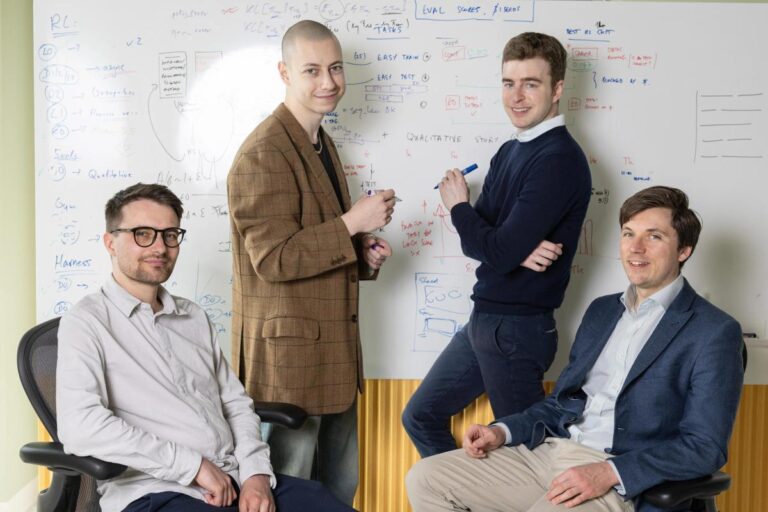
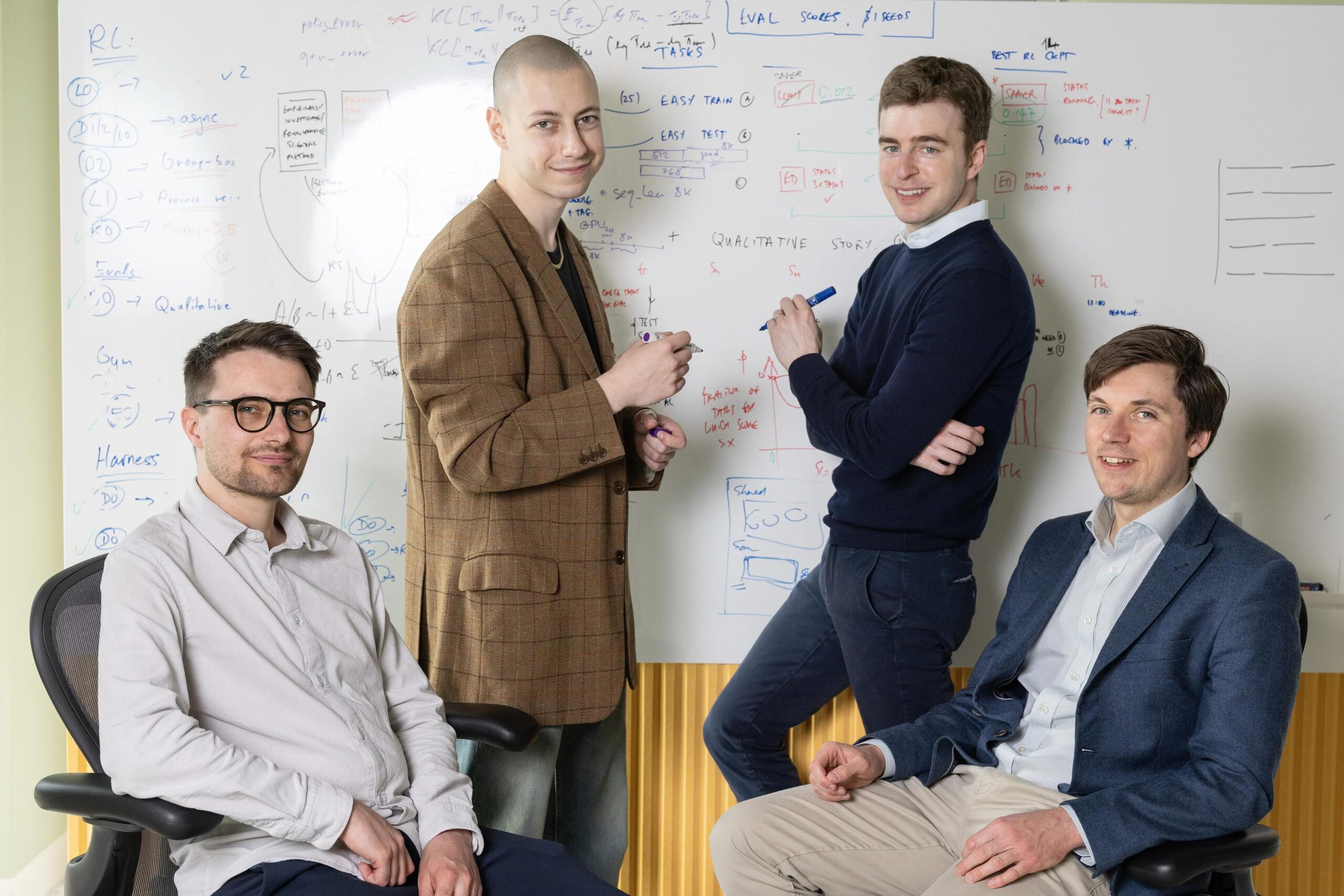
Hughes was personally affected by garden leave arrangements. “This is a personal view rather than a company view, but I was affected by the garden leave problem,” he told TechCrunch. He eventually navigated around the constraint and founded Inherent alongside three other cofounders — Louis Kirsch, Kaloyan Aleksiev, and Tantum Collins — all of them former DeepMind colleagues. But the structural disadvantage remains a drag on London’s startup ecosystem, particularly in talent-intensive fields like AI where the best researchers are always in demand.
Next Steps and Ambitions
Inherent’s trajectory from stealth to public benchmarks to hiring expansion follows a familiar pattern for well-backed AI startups. But the company’s underlying thesis — that smaller, more thoughtfully constructed models trained with novel learning approaches can outperform brute-force scaling — represents a bet against the current consensus in large-scale AI development.
Whether Faraday’s performance on paper replication translates into genuine scientific discovery remains to be seen. The startup has articulated an ambitious goal and shown preliminary evidence that its approach is viable. The next phase will test whether the team can scale this capability across scientific domains and eventually produce findings that advance human knowledge.
Frequently Asked Questions
How did Faraday outperform larger models from OpenAI and Anthropic?
Inherent trained Faraday using reinforcement learning on a 27-billion-parameter Qwen 3.6 model, teaching it to develop research taste — the ability to identify valuable experiments and design them well. This approach prioritized decision-making quality over model size, and the team had Faraday use OpenAI's GPT-5.5 Codex for coding tasks rather than building its own code generation system.
What is the broader goal behind the paper replication achievement?
Reproducing published findings is a training exercise for Inherent's larger objective: building AI agents that can discover new scientific knowledge. Cofounder Edward Hughes compared it to how human PhD students begin their careers by replicating prior work before conducting original research.
How does Inherent plan to compete for talent in a crowded market?
The startup is based in London's King's Cross neighborhood, which has become a global AI hub due to DeepMind's presence. Inherent operates with an all-in-person team and plans to grow to 20-25 employees by year's end. Cofounder Hughes has criticized U.K. garden leave rules — which bar employees from joining rival companies for months after resigning — as disadvantaging London startups against American competitors in recruiting top AI talent.
