
Key takeaways
- Volkswagen's Mission Efficiency prototype achieved 323 miles per gallon equivalent during a 794-mile real-world test from Wolfsburg to Vienna with 104 miles of range remaining.
- The design uses a Kammback roofline with 0.158 drag coefficient achieved through 2+2 seating, tightened wheel wells, and traditional mirrors instead of cameras despite aerodynamic penalties.
- The interior follows Slate Auto's minimalist philosophy, eliminating infotainment and built-in speakers in favor of a portable Bluetooth speaker.
- Volkswagen has not committed to production, though it previously manufactured 250 units of the efficiency-focused XL1 at €110,000 starting price in 2013.
Volkswagen unveiled a new electric vehicle prototype Monday capable of extraordinary efficiency: 323 miles per gallon equivalent under ideal conditions. The Mission Efficiency completed a real-world test covering 794 miles from the company’s headquarters in Wolfsburg, Germany, to Vienna with a single charge and 104 miles of range remaining in the battery. The consumption rate during this journey—7.51 kilowatt-hours per 100 miles—translates to approximately 279 MPGe, placing it among the most efficient vehicles ever built.
The result outpaces the most efficient production vehicle available: the Lucid Air Pure, which is nearly twice less efficient. While Volkswagen describes the Mission Efficiency as “near production” status, using production-grade components including the electric motor and battery pack from its ID. Polo model, the company has not committed to manufacturing the vehicle for consumers. The company framed the prototype as demonstrating what becomes possible when every system, component, and design decision prioritizes efficiency above all other considerations.
Aerodynamic Engineering for Efficiency
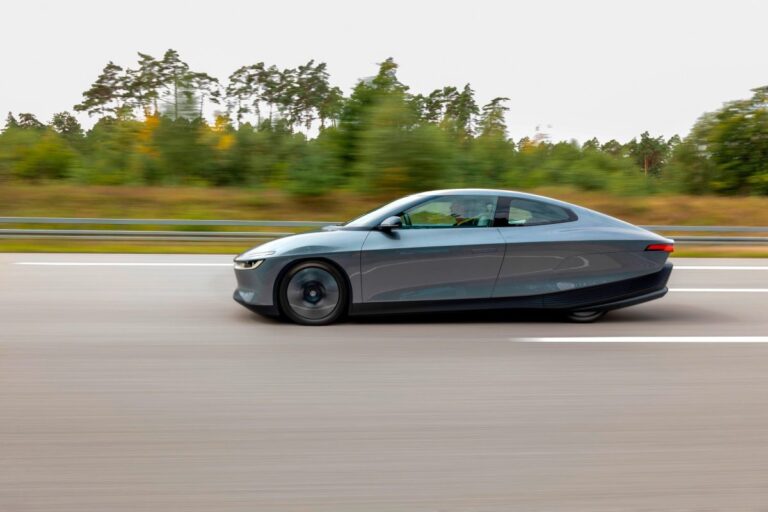
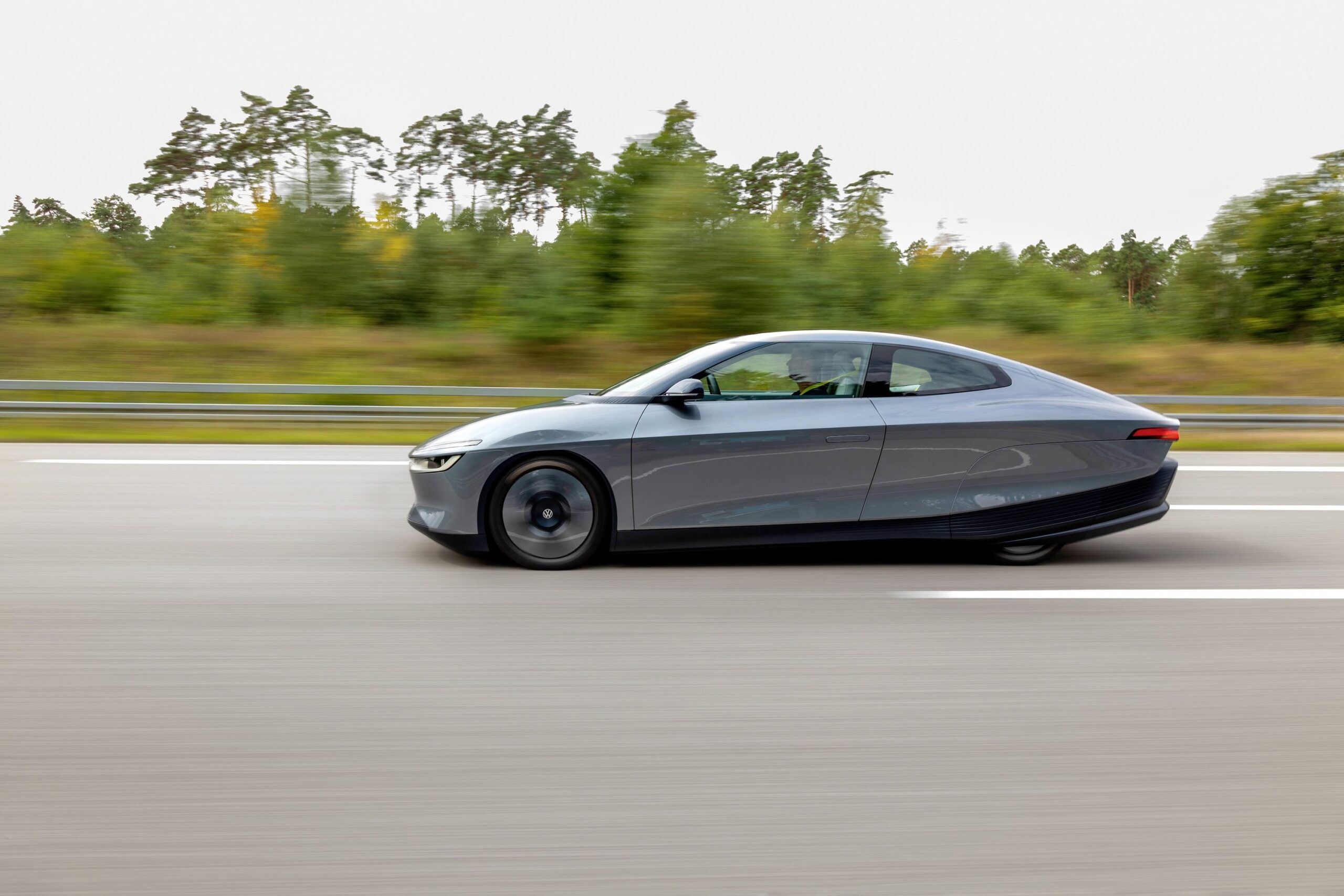
The Mission Efficiency’s shape embodies aerodynamic principles taken to practical limits. The prototype features a Kammback roofline, a design that slopes sharply downward behind the driver’s head, creating the teardrop profile most familiar to efficiency-focused vehicles.
The Kammback Shape
This geometry allowed Volkswagen to achieve a drag coefficient of 0.158 and maintain a frontal area of just 2.08 square meters. Both figures represent substantial improvements over conventional vehicles and directly determine how much energy the powertrain must expend to overcome air resistance at highway speeds. The Kammback design has historical roots in efficiency racing, where drivers and engineers discovered that the shape minimizes turbulence and pressure drag behind the vehicle.
Drag Reduction Strategies
Wheels and tires generate between a quarter and a third of the aerodynamic drag on a vehicle, so Volkswagen tightened the space between wheel wells and tires measurably to reduce this penalty. This compromise directly affects suspension performance: shocks require space to extend and compress as the suspension responds to road irregularities. Reduced wheel well space limits suspension travel, potentially degrading ride quality on rough surfaces where suspension articulation becomes essential.
Sideview mirrors hanging from the sides of a vehicle produce significant aerodynamic drag, and replacing them with cameras would have reduced this penalty substantially. Volkswagen retained the mirrors despite the aerodynamic cost, reasoning that the depth perception and spatial awareness they provide justifies the efficiency penalty. Cameras produce different depth cues than mirrors, and maintaining this familiar visual interface represented a conscious trade-off favoring driver experience over maximum efficiency gain.
Interior Compromises and Design Choices
The pursuit of minimal drag imposed hard constraints on interior space and comfort. The Mission Efficiency is a 2+2 configuration, a technical classification indicating only the front two seats are genuinely usable for adults. The rear seats are designed exclusively for occupants shorter than 5 feet 3 inches, a threshold Volkswagen included in its specifications without attempting to obscure the limitation.
Seating and Space Limitations
Volkswagen suggested the vehicle could theoretically accommodate a young family of four, though this claim depends entirely on the ages and sizes of the children involved. The company acknowledged the constraint by specifying the height requirement for rear passenger comfort. The tighter rear quarters result directly from the vehicle’s tapered roofline that enables such exceptional aerodynamics. Every centimeter of additional headroom behind the driver would have required extending the roof further back, increasing drag and reducing efficiency.
The Slate Auto Influence
The prototype’s interior philosophy directly borrows from Slate Auto’s approach to EV design. Slate Auto’s minimalist pickup truck eliminates unnecessary systems, and the Mission Efficiency follows the same strategy: no infotainment system, no built-in speakers. Instead, the prototype provides a portable Bluetooth speaker and assumes drivers will supply their own mobile devices for navigation and audio. Eliminating these systems reduces physical weight, electrical complexity, and power consumption. An infotainment system adds kilograms to the vehicle while drawing power constantly, both penalties that accumulate across thousands of miles.
The seats themselves contribute to the efficiency calculation. Volkswagen constructed the seats using lightweight materials and specialized designs that reduce mass without sacrificing basic comfort. Every component receives evaluation for its weight contribution and necessity, embodying the approach that any unnecessary pound is a pound that the battery must carry across the Vienna route.
How It Compares to Production Vehicles
The Lucid Air Pure, the most efficient production vehicle currently available, achieves 420 miles of range from an 84-kilowatt-hour battery according to EPA testing. The Mission Efficiency prototype operates with a 54.9-kilowatt-hour battery, substantially smaller than the Lucid’s. Theoretical calculations based on the prototype’s demonstrated consumption suggest it could achieve over 400 miles of range, though this calculation remains unverified by EPA testing and depends entirely on replicating the conditions that produced the Vienna test results.
The Lucid Air Pure is fundamentally a different vehicle category: a full-size sedan with five seats and complete amenities intended for family highway travel. The Mission Efficiency is a proof-of-concept platform exploring how far efficiency engineering can extend while maintaining basic utility. This distinction matters because it explains why direct comparison can mislead: the Lucid sacrifices efficiency for practicality, while Volkswagen sacrificed practicality for efficiency.
The Solar Panel Addition
Volkswagen added solar cells to both the roof and trunk lid, a feature that carries significant appeal for technology enthusiasts despite its limited practical impact. Under conditions that virtually never occur in real driving—perfectly flat terrain, continuous sunshine, constant speed of 42.25 miles per hour—the solar system generates approximately 18 miles of additional range. Any variation from these conditions substantially reduces the contribution. Hills reduce available solar output, clouds reduce sunlight conversion, and varying speeds change the consumption baseline. The solar installation serves primarily as a demonstration of holistic efficiency thinking rather than a practical range extender for most drivers.
Pathways to Production
Volkswagen has not announced whether the Mission Efficiency will transition from prototype to production, though the company’s history suggests it remains possible. More than a decade ago, Volkswagen manufactured 250 units of the XL1, another efficiency-focused halo car built around the same principle of extreme optimization. The XL1 carried a starting price of €110,000 when it entered production in 2013, placing it in a rarefied market segment where production volumes serve brand positioning rather than revenue generation. Customers willing to pay such premiums for extreme efficiency represent a small but dedicated market segment.
The Mission Efficiency’s use of production components from the existing ID. Polo lineup—its motor and battery pack—indicates Volkswagen’s confidence in the engineering direction. Whether that confidence extends to commercial production remains a separate question. Halo vehicles traditionally function as technological demonstrations and brand statements, and the Mission Efficiency appears designed with this role in mind. If Volkswagen does choose to produce examples, expect similar exclusivity and pricing to the XL1.
Frequently Asked Questions
What efficiency did Volkswagen's Mission Efficiency prototype achieve?
The prototype consumed 7.51 kilowatt-hours per 100 miles during a 794-mile test from Wolfsburg to Vienna, achieving 323 miles per gallon equivalent and arriving with 104 miles of range remaining.
How does the Mission Efficiency compare to production vehicles?
It is nearly twice as efficient as the Lucid Air Pure, the most efficient production vehicle available, which achieves 420 miles of range from an 84-kilowatt-hour battery with EPA ratings.
What design choices enabled the prototype's extreme efficiency?
The vehicle uses a Kammback roofline achieving 0.158 drag coefficient, 2+2 seating for occupants under 5 feet 3 inches, tightened wheel wells, traditional mirrors, lightweight seats, and no infotainment system, borrowing interior philosophy from Slate Auto's minimalist approach.
