
Key takeaways
- XREAL's a01 ($300) delivers vivid 1080p visuals on dual OLED panels but requires a USB-C tether to a source device for power.
- Screen mirroring creates redundancy—the a01 displays the same content as a laptop or phone screen mere inches away, undercutting its practical appeal.
- Thermal buildup causes noticeable discomfort during extended use, and the device lacks clear product-market fit for dedicated movie watching.
- XREAL's unreleased Project Aura, powered by Android XR, addresses key limitations through hand tracking, Google Play Store access, and a pocketed compute puck for greater mobility.
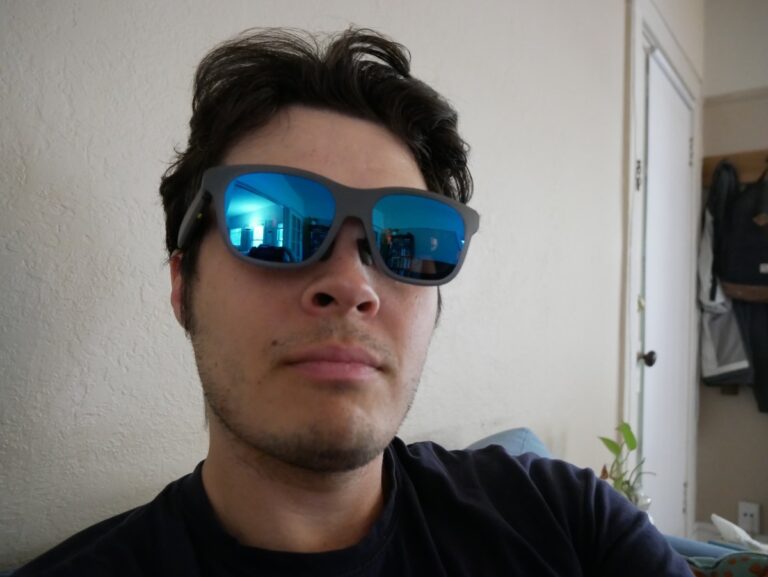
When XREAL released its a01 smart glasses in May, the company positioned them as a device for gaming, productivity, and media consumption. The glasses do not operate like more advanced augmented reality systems such as the Meta Orion or Snap’s Specs, which rely on onboard software and processing. Instead, the a01 functions as an external display: it receives power and content through a USB-C cable connected to a host device—a laptop, smartphone, or handheld gaming console. At approximately $300, the device targets a price point accessible to early adopters curious about wearable displays.
For someone accustomed to consuming films in various formats, testing the a01 as a movie-watching device reveals both the promise and the friction inherent in the current state of wearable display technology.
Display Quality and Technical Specs
The a01 pairs dual mini OLED panels to render its output at 1080p resolution with brightness up to 1,600 nits. Watching David Lynch’s Wild at Heart—specifically a scene featuring Nicolas Cage in a snakeskin jacket—the images appeared vibrant and sharp. Colors popped, and the projection mimicked the experience of viewing content on a high-output home projector or watching a film at a drive-in theater, particularly when used in a dimly lit room.
XREAL markets the viewing area as equivalent to a 147-inch screen, a figure derived from the device’s field of view rather than actual pixel density. This claim shapes expectations but also hints at a core tension: the a01 projects across a wide visual field, immersing the wearer, but the actual resolution remains fixed at 1080p, not the 4K displays common in modern televisions and streaming devices.
The Redundancy Problem
Screen Mirroring Limitations
The most immediate issue emerges from the a01’s reliance on screen mirroring. When connected to a laptop, the device simply replicates what appears on the computer’s monitor. This creates a peculiar scenario: sitting at a desk wearing glasses that project a movie while the same movie plays on a 14-inch laptop screen inches away. The redundancy feels unnecessary, and the practical justification—that the glasses offer greater immersion—does not fully address why a viewer would tolerate the awkwardness of dual screens.
Mobile Connectivity Challenges
Connecting the a01 to a smartphone theoretically solves the desktop problem by enabling viewing during travel—on planes, trains, or anywhere the wearer desires privacy and a large personal display. However, the implementation introduces fresh constraints. The phone’s screen must remain active while the glasses display its mirrored content, meaning the viewer watches a video on a screen strapped to their face while an identical video plays on a device held less than a foot away. Pocketing the phone to reduce visual clutter risks disrupting playback through accidental jostling.
The Beam Pro Alternative
XREAL offers a partial solution through a separate accessory called the Beam Pro, essentially a mini-tablet priced at $200 that functions as an isolated streaming hub. Users download content onto the Beam, connect it to the glasses, and watch without the screen-mirroring constraint. This addition eliminates redundancy but escalates the total investment and introduces another device to carry and manage.
Physical Comfort and Thermal Issues
The a01 distinguishes itself among smart glasses for its lightweight construction and ergonomic design. Compared to Snap’s Specs—tested at CES earlier this year and notably heavier—the a01 feels less cumbersome when worn for extended periods. The glasses sit comfortably on the bridge of the nose and over the eyes without creating pressure points or fatigue.
That comfort erodes once thermal concerns emerge. Extended use causes the device to warm noticeably, generating a tingling sensation across the nose and eye area. This heat production is not unique to XREAL; it reflects a broader challenge in extended reality glasses, where cramming sufficient computing power into a compact plastic housing generates thermal byproducts that transfer to the wearer’s face. The sensation proves disconcerting when the entire appeal of the device is wearability and personal access.
The Product-Market Fit Question
Movie enthusiasts traditionally gravitate toward larger displays. A modern 55-inch television—such as the TCL S-series—delivers a home-viewing experience surpassing what the a01 can provide. The gap between specialized home theater and portable wearable displays remains substantial. For dedicated cinephiles, a big screen remains second only to the theatrical experience itself. Watching a film through tiny OLED panels less than an inch from the eyes offers a distinct sense of immersion but falls short of what most would call optimal for sustained viewing.
As a second monitor, the a01 faces similar challenges. The glasses project almost everything in the wearer’s visual field, making it difficult to reference other screens or work on a nearby laptop while wearing them. The device occupies a confusing middle ground between a specialized gaming accessory and a general-purpose wearable display.
What Comes Next: Project Aura
XREAL’s upcoming Project Aura, glimpsed at Google I/O earlier this year, suggests the company recognizes these limitations and is iterating to address them. The Aura runs on Android XR, an extended reality operating system developed jointly by Google and Samsung. Unlike the a01, the Aura includes native hand tracking—absent from the current model—and grants access to the Google Play Store, expanding its interactive capabilities and augmented reality potential.
The Aura ships with a puck that serves dual purposes: compute node and charging source. Designed to fit in a pocket, this tethered accessory eliminates the need to keep the glasses physically connected to a separate device. The user gains substantially greater mobility without sacrificing functionality, addressing one of the a01’s most significant constraints.
The Current Verdict
The a01 functions as a technical showcase for wearable display technology—bright, sharp, and reasonably comfortable. For movie watching specifically, however, it remains a solution in search of a problem. XREAL’s willingness to iterate and improve its product line, culminating in Project Aura, suggests the company understands the current model’s shortcomings and is pursuing meaningful refinements. Until then, the a01 occupies an interesting but niche position in consumer electronics: a glimpse into hardware innovation that has not yet found its true application.
Frequently Asked Questions
How much does the XREAL a01 cost?
The a01 is priced at approximately $300. A companion device called the Beam Pro, which acts as an isolated streaming hub, costs an additional $200.
What are the display specifications of the a01?
The a01 features dual mini OLED panels with 1080p resolution and brightness up to 1,600 nits. XREAL claims the viewing experience is equivalent to watching on a 147-inch screen.
What improvements does the upcoming Project Aura offer over the a01?
Project Aura, powered by Android XR (developed by Google and Samsung), includes native hand tracking, access to the Google Play Store, and a pocketed compute puck that eliminates the need for physical tethering to a source device, providing greater mobility than the a01.
