

Key takeaways
- Instinct achieved a $10 billion valuation after raising $1 billion in September 2026, but many other text-message AI agents are competing for the market.
- Family-focused agents like Fambot, Ollie, and Ohai offer solutions for household coordination, with pricing from free to $100 per month.
- Specialized agents are emerging for travel (Miso), work (Town), and content creation (Stanley).
- Agent autonomy with independent email accounts and payment methods raises security and privacy questions the industry is still addressing.
The movement toward text-message AI agents reflects a simple premise: instead of installing yet another app and checking another inbox, users should be able to text their AI assistant the same way they message friends. The agent remembers context, connects to the services already running on a user’s phone, and completes tasks without requiring a dedicated interface.
Over the past year, a wave of startups has built agents designed to live in iMessage, WhatsApp, Telegram, SMS, or RCS rather than as standalone applications. Users text requests, and the agent schedules appointments, organizes calendars, researches trips, sends emails, makes reservations, shops online, or sets reminders. The category has attracted serious funding, with valuations climbing rapidly as investors bet on agents becoming a primary way people interact with technology.
General-Purpose Assistants
The highest-profile entrant is Instinct, which raised $350 million at a $2.5 billion valuation before jumping to $10 billion after a September 2026 Series C round of $1 billion. The service lets users communicate by text or voice, connecting to email, calendars, Google Workspace, and similar platforms. According to Instinct, early users have applied it to planning trips, buying groceries, booking tickets, and canceling subscriptions. In September, the company began offering each user’s assistant a dedicated email address, allowing the agent to create accounts and handle tasks requiring an email without filling the user’s personal inbox. Instinct has also begun rolling out the ability for users to have their agent place calls. This level of autonomous action, though appealing to users delegating their workload, has raised privacy and security concerns about an agent operating semi-independently across services.
Martin operates across SMS, phone, WhatsApp, email, Slack, and an iOS app, handling calendars, email, reminders, tasks, notes, and communications. It can also send messages and make phone calls on a user’s behalf while providing daily summaries of what requires attention. The service is priced at $21 per month or higher.
Rene, available on iMessage, Telegram, and WhatsApp, turns natural-language conversations into tasks, reminders, and follow-up actions while maintaining context across interactions. In addition to remembering details, it can browse the web, write code, shop, and create slides and images.
Family-Focused Agents
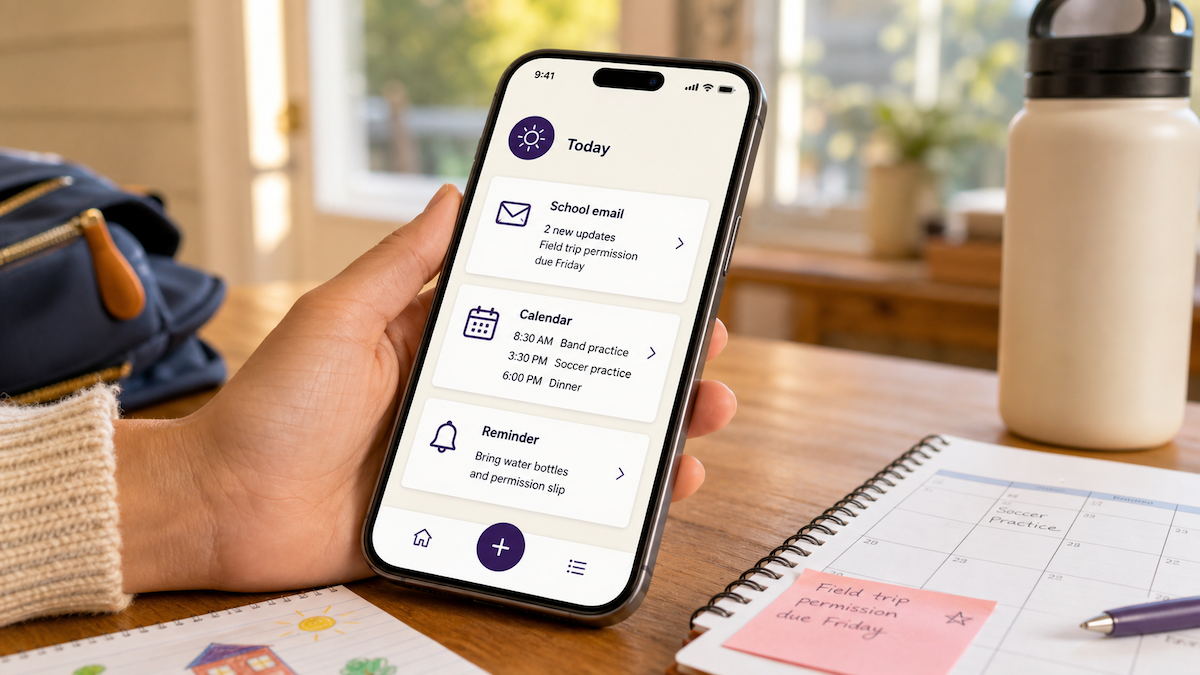
Fambot launched in beta in early September 2026 after raising $3.5 million in pre-seed funding. Positioned as a “chief of staff” for households, it brings together school communications, sports activities, meal planning, calendars, and day-to-day tasks into a single organized view. The service works across iOS, Android, and the web, and families can interact directly over SMS. Each night, Fambot automatically sends a summary of the following day with upcoming events, to-dos, and details like school uniform requirements or what to pack. Parents reply to refine details or make calendar changes. Currently, Fambot connects to Gmail and Google Calendar, with Outlook and Apple Calendar support planned. The company plans to charge roughly what a Netflix subscription costs once the free beta period ends.
Ollie, launched in June 2026, consolidates information scattered across school messages, calendars, task lists, and group chats into a text interface. The service keeps track of household details and delivers relevant information via SMS. A significant differentiator is that Ollie is one of the first mainstream family-focused AI assistants to achieve SOC 2 compliance, a widely used security standard. It offers a free tier and paid plans starting at $25 per month for 150 messages, scaling to $100 per month for 1,000 messages.
Ohai applies the personal-assistant concept to family coordination, allowing households to send messages, forward emails, or make voice requests that the agent transforms into schedules, reminders, and plans. It coordinates calendars, household chores, and meals across family members. A free basic option is available, with subscriptions starting at $9.99 per month depending on family size.
Orbits combines a dedicated app and text messaging to bring together calendars, lists, and conversations. It can search the web, make purchases, book restaurants, change appointments, request household service quotes, and remind family members about chores. The startup is backed by investors including Andreessen Horowitz through its Speedrun fund, N49P, and Garage Capital.
Vertical and Work Applications
Travel Planning
Miso applies the personal-assistant model specifically to travel. Operating through iMessage, it combines AI trip planning with support from a dedicated travel team. Users can arrange flights through messages while the agent factors in their preferences, loyalty points, and other priorities. The service also provides access to trip details, flight updates, and personalized recommendations.
Work and Professional Tasks
Town focuses on professional life rather than personal productivity. The company offers “Townies,” AI assistants designed to learn how individuals work and handle recurring professional tasks. These agents work with email, calendars, documents, Slack, and other platforms. In June 2026, Town raised a $55 million Series A led by Andreessen Horowitz and Forerunner, signaling investor confidence in the work-focused agent space.
Content Creation
Stanley targets content creators rather than general audiences. Available on iMessage, Telegram, and the web, it functions as an AI head of content, helping users brainstorm ideas, develop them into posts, and maintain publishing schedules. It can connect to Instagram accounts to suggest content based on what users have actually been posting. Voice notes become scripts and captions; the platform includes a content calendar and post scheduling.
Pricing and Access Patterns
Pricing varies widely depending on the service’s scope and target audience. Some agents, including Fambot, Folk, Ollie, Ohai, and Pally, offer free tiers or free basic plans. Folk’s Pro subscription costs $8.33 per month for unlimited background tasks. Martin operates at the premium end at $21 per month. Ohai starts at $9.99 per month for families, while Ollie’s paid tier begins at $25 per month for 150 messages. Pally offers 15 minutes of calls monthly on its free plan, with paid plans ranging from $25 for 30 minutes to $100 for 60 minutes per month.
Other Notable Agents
Folk, accessed through iMessage, WhatsApp, and Telegram, distinguishes itself by running on a private cloud computer that can execute code and handle multi-step tasks beyond conversation. Its beta launched in May 2026.
Caddy consolidates scattered information across a phone into actionable items, living in iMessage for iPhone and RCS for Android. It identifies appointments and shopping lists from emails or messages, then connects to calendars and conversations to act on them.
Poke, which launched in March 2026, reached prominence in June when Apple approved it as the first AI agent on the Apple Messages for Business platform. A month later, its parent company, The Interaction Company of California, was acquired by AI coding startup Cognition for a value in the low nine figures.
Iris, powered by the Hermes agent, allows users to delegate tasks directly through iMessage while the agent retains relevant context and proactively follows up.
Tomo distinguishes itself on iMessage by operating as a group chat participant rather than a private assistant. It can handle goals, accountability, scheduling, and organization while sending reminders, searching the web, managing calendars and email, watching videos, and editing photos.
Skye, built by Signull Labs, takes a different approach as an “agentic homescreen” for iPhone that analyzes information from connected services. Raised $3.6 million in seed funding in 2025 and entered private testing in April 2026, Skye surfaces relevant information through contextual cards, suggestions, and daily briefings without requiring users to open an app.
Wajo’s consumer agent, Fo, launched publicly in September 2025 with capabilities to call businesses, send emails, join group chats, make bookings and purchases, and coordinate tasks. A notable feature is that Fo operates with its own email address, phone number, and payment card, allowing it to interact with businesses without users sharing their credentials. When Fo cannot handle something independently, Wajo says it can escalate to a human assistant.
Security and Privacy Considerations
The autonomy granted to these agents, particularly around email accounts, phone calls, and service interactions, has raised questions about privacy and security. As agents gain independent contact information and payment methods, the surface area for misuse or unauthorized actions expands. The security approaches vary: Ollie has pursued SOC 2 compliance as a differentiator, suggesting that compliance will become a competitive factor. However, the broader ecosystem still lacks uniform standards for how agents should request permission, authenticate users, and report what actions they take on behalf of their owners.
Source: TechCrunch
Frequently Asked Questions
What can these AI agents do?
They can schedule appointments, organize calendars, send emails, make reservations, research topics, shop online, and set reminders through text messages without needing a separate app.
How much do these agents typically cost?
Many offer free tiers or beta access. Paid plans range from $8.33 per month for Folk's Pro subscription to $100 per month for premium services like Ollie.
Why is Instinct getting so much attention?
Instinct reached a $10 billion valuation after raising $1 billion in its September 2026 Series C, signaling investor confidence in the text-message agent category.
