
Key takeaways
- U.S. data centers are projected to consume more natural gas than Germany and Japan combined by 2035, nearly double the estimate from nine months earlier, as AI infrastructure demands surge.
- Philadelphia and multiple U.S. cities have mounted organized opposition to data center construction, with residents citing environmental pollution, health impacts, and historical precedent of broken economic promises.
- Governor Kathy Hochul and cities including Denver, Indianapolis, Asheville, Charlotte, and Reno have implemented or approved moratoriums on data center permits pending environmental impact assessments.
- Communities like Philadelphia's Grays Ferry are drawing connections between AI data center pollution and ongoing health effects from past industrial facilities that are now closed.
The explosive growth of AI infrastructure is colliding with American communities already scarred by decades of industrial pollution. As companies race to build data centers to power the next generation of artificial intelligence, residents in cities across the United States are mounting fierce opposition, citing environmental damage and broken promises of economic benefit.
Nowhere is this tension more visible than in Philadelphia, where activists are mobilizing against potential data center construction in neighborhoods that still bear the physical and health consequences of industrial production. The city has identified two potential sites for data centers: one in Northeast Philadelphia and another in Grays Ferry, a Southwest Philadelphia neighborhood that sits in the shadow of industrial history.
The Legacy of Industrial Harm
Shawmar Pitts grew up in Grays Ferry next to what was once the East Coast’s largest oil refinery. The facility operated for decades before an explosion in 2019 forced its closure. For much of his life, Pitts didn’t connect the chronic health conditions plaguing his family and neighbors to the industrial facility looming over their community—until 2018, when he encountered Philly Thrive, an environmental justice organization, tabling in the neighborhood.
A catalog of illness
The information Philly Thrive shared proved revelatory. “I read the information they had on the table about how living near the refinery affects you, and I’m looking at all the sicknesses on this paper, and I’m like, ‘My mother has this, my sister has that, my next-door neighbor suffers from this’ — every house, someone has something on that list,” Pitts told TechCrunch. That moment transformed his understanding of his own family’s medical history. He became deeply involved with Philly Thrive, eventually becoming its managing co-director, and has since emerged as a leading voice opposing new data center development in Philadelphia.
The personal toll extends beyond Pitts’s family. Sonya Sanders, board president of Philly Thrive, lost her husband to a rare bone cancer in 2020. Neither a smoker nor a drinker, her husband’s death mirrors patterns of disease in the community surrounding the Philadelphia Energy Solutions refinery, which processed up to 335,000 barrels of crude oil daily before its closure. “In my eyes, they killed him,” Sanders said at a rally held Monday outside Philadelphia City Hall. “The pollution killed him. I believe he would be here today if he wasn’t silently murdered, because it was the pursuit of profit that killed him.”
The Scale of Future Emissions
Data center energy demands outpacing projections
The environmental argument against new data centers rests on concrete projections about energy consumption and greenhouse gas emissions. According to BloombergNEF, U.S. data centers are projected to consume more natural gas than Germany and Japan combined by 2035. That forecast represents a dramatic acceleration—it’s almost double the firm’s prediction from just nine months earlier, reflecting how rapidly AI infrastructure demands are growing.
The emissions implications are substantial. Burning one cubic foot of natural gas releases approximately 60 grams of carbon dioxide. The additional data center demand expected to come online is projected to generate one million metric tons of greenhouse gas pollution daily—equivalent to roughly 12 percent of all current U.S. greenhouse gas emissions.
The health cost of air pollution
The relationship between fossil fuel emissions and mortality extends globally. Harvard University researchers found in 2021 that fossil fuel air pollution is responsible for one in five deaths worldwide, a figure likely to increase as data center proliferation accelerates emissions.
A typical data center proposed for Pennsylvania contains hundreds of diesel engines designed to operate during emergencies. However, Annie Fox, an attorney with the Clean Air Council, pointed out at the Monday rally that “even if they’re supposedly reserved for emergencies, the government has already said that the data center should use those rather than drawing from an overstressed electrical grid during some heat waves. We can expect that to get more frequent.”
Resistance Across the Country
The pushback against data center construction has moved beyond Philadelphia. Residents across the United States have mobilized to prevent new data center development, particularly in communities with limited resources and histories of industrial harm.
Government restrictions multiply
Official action has begun to catch up with community concerns. In New York, Governor Kathy Hochul signed an executive order that temporarily prevents the state from approving new permits for large projects. “Progress shouldn’t arrive with a higher utility bill, deleted water supply, or noise pollution,” Hochul said at a press conference. “These data centers can only be built, should only be built in places that want them.”
Data center moratoriums have been approved in multiple U.S. cities, including Denver, Indianapolis, Asheville, Charlotte, and Reno. These temporary bans typically give city officials time to assess potential impacts before allowing construction to proceed.
Community Organizing on the Ground
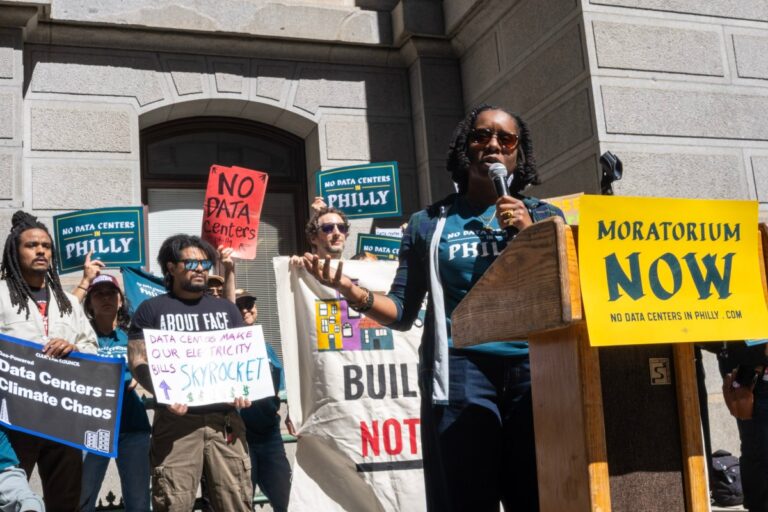
More than 100 people attended the kick-off rally for the No Data Centers in Philly campaign on Monday, gathering outside City Hall to voice opposition to the potential projects. Participants raised concerns spanning environmental contamination, surveillance implications, and resource allocation.
Donna Greenberg, a Philadelphia resident at the rally, expressed a combination of worries reflecting broader community anxieties: “I’m worried about pollution. I’m worried about surveillance and the fact that they’re going to have access to information they have no business knowing, and I’m concerned that they’re going to be using water and electricity that takes away from the people and the neighborhoods who need it.”
Pitts emphasized the significance of the organizing effort: “I just think that our community standing up and fighting back is tremendous. It takes a lot of effort and a lot of people.”
The Promise Versus the Reality
Data center companies and their investors argue that new facilities create jobs and drive economic growth. Yet this narrative has failed to convince a majority of Americans who oppose data center construction in their areas. The disconnect reflects a historical pattern: communities promised economic benefits from industrial development have often experienced pollution, health impacts, and environmental degradation while prosperity flowed elsewhere.
The proposed Philadelphia sites represent a critical test of whether cities will repeat this pattern or learn from it. The fact that municipal officials have already identified specific locations suggests serious consideration of the projects, even as organized opposition mobilizes.
Frequently Asked Questions
Which cities have implemented data center moratoriums?
Denver, Indianapolis, Asheville, Charlotte, and Reno have approved data center moratoriums. New York Governor Kathy Hochul also signed an executive order temporarily preventing the state from approving new permits for large projects.
What are the projected emissions from increased data center demand?
Additional data center demand is expected to generate one million metric tons of greenhouse gas pollution daily, roughly equivalent to 12 percent of all current U.S. greenhouse gas emissions. By 2035, U.S. data centers are projected to consume more natural gas than Germany and Japan combined.
Why are Philadelphia communities particularly opposed to data center construction?
Communities like Grays Ferry are scarred by past industrial pollution, particularly from the Philadelphia Energy Solutions refinery that processed 335,000 barrels of crude oil daily before closing in 2019. Residents report chronic health conditions and deaths they attribute to that facility and worry that data centers would repeat the pattern of pollution and broken economic promises.
