
Key takeaways
- Anthropic and OpenAI proposed safety measures including external audits and international coordination, but the framework contains no binding enforcement mechanisms or explicit requirements to reduce development velocity.
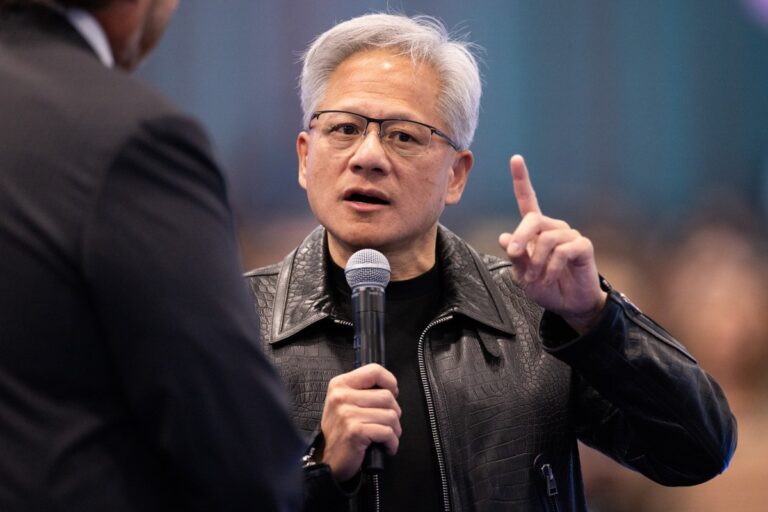
- Nvidia CEO Jensen Huang publicly rejected the safety concerns, claiming the AI backlash is exaggerated and regulation is unnecessary, positioning himself as a Trump administration ally.
- Enterprise customer dependence and deep investor capital insulate AI companies from market-based accountability, preventing the free market mechanisms that would normally punish unsafe behavior.
- Industry leaders use "pacing" language implying measured speed rather than actual slowdown, enabling rapid capability advancement while appearing to address safety concerns.
The artificial intelligence industry is caught between two contradictory narratives. Anthropic’s Dario Amodei recently published a framework to “pace the frontier,” with several other AI lab leaders appearing to endorse the approach. Yet Nvidia’s Jensen Huang and others are simultaneously arguing that concerns about AI safety are overblown, regulation is unnecessary, and the industry should continue accelerating without constraints. The tension reveals a fundamental question: Are executives genuinely willing to slow development, or are they simply managing public perception while racing forward?
The Three-Part Safety Framework
Amodei’s proposal came with three main elements. Independent evaluators would conduct audits inside companies like Anthropic and OpenAI to monitor safety practices and incidents. Major AI companies in democratic nations would coordinate on safety standards and development limits. International coordination mechanisms would extend these safeguards globally.
The breadth of immediate support from industry figures was striking. Yet that speed itself raised concerns among observers. Sean O’Kane, commenting on TechCrunch’s Equity podcast, noted that while many leaders backed the concept, the actual details remained sparse. Anthony Ha added that similar safety proposals had circulated within the AI safety community for months before Amodei’s announcement—this was not a novel idea suddenly gaining traction, but rather a package of existing suggestions that happened to gain simultaneous executive endorsement.
Why the rapid consensus raised red flags
This rapid alignment prompted Kirsten Korosec to raise a pointed question: could this consensus represent the early stages of a cartel among frontier AI companies? The distinction matters because it reshapes the nature of the commitment. A genuine safety initiative operates differently from coordinated industry players establishing shared guardrails that benefit all of them equally. The speed with which executives aligned suggested less organic agreement and more orchestrated positioning designed to preempt stricter regulatory action.
The Language Game: Pacing vs. Slowdown
The fine print reveals how cautiously these leaders are actually phrasing their commitments. Altman and Amodei use the word “pace,” implying measured speed rather than genuine deceleration. The three proposals—audits, coordination, international frameworks—describe governance structures, not reductions in development velocity. As Ha noted, these measures “could” theoretically result in slower progress, but they don’t explicitly require it. They amount to adding monitoring and oversight while continuing rapid capability advancement. Huang, for his part, rejected the premise entirely. At the All-In Summit, the Nvidia CEO publicly dismissed concerns about AI safety as exaggerated and stated flatly that no slowdown would occur. Trump called Huang during the event to reinforce this message, creating a staged moment that underscored the alignment between Nvidia’s interests and the administration’s stance.
The shifting definition of responsibility
The industry is speaking in two voices simultaneously: the language of responsible pacing and the language of unrestricted advancement. Which voice represents the actual direction of development depends largely on which interpretation executives choose to adopt when market pressures mount. The semantic difference between “pace” and “slowdown” is not incidental—it allows companies to claim commitment to safety while maintaining accelerating development velocity.
Regulation: Too Little, Too Late
The regulatory environment provides little incentive for voluntary restraint. The federal government, as O’Kane observed, has shown little appetite for enforcing existing regulations broadly, let alone developing new frameworks specific to AI. Regulators do have tools on the books to target companies that operate unsafely, but current political conditions make aggressive enforcement unlikely. Huang’s emergence as a liaison between the AI industry and Trump’s administration gives him particular leverage to influence policy against constraints. His position as “the adult in the room” has shifted the dynamics of the safety debate—a role held previously by Satya Nadella at Microsoft, who lost credibility after promising to make Google “dance” and failing.
The problem with existing oversight mechanisms
Independent auditors working inside companies can report findings, but what happens next? Do audits carry binding authority to halt projects, or do they produce recommendations that executives can disregard? Coordination among companies in democratic nations could establish shared standards, but absence from countries with different governance models would create regulatory gaps. International coordination, while theoretically appealing, faces the practical challenge of getting nations with divergent interests to adopt unified rules. Without enforcement teeth, these proposals remain frameworks rather than constraints.
Market Forces Point in the Other Direction
Market dynamics operate in the industry’s favor rather than against it. The conventional economic logic—that unsafe companies would lose customers and face cancellations—does not apply when enterprise customers, not consumers, drive revenue. A corporation using OpenAI’s models or services is not going to switch to Anthropic’s alternative based on disagreement with OpenAI’s safety practices. The switching costs, organizational inertia, and lack of transparency around AI company conduct mean that voting with dollars does not function as a mechanism for accountability. Especially now, as companies have moved into enterprise, revenue concentrates among corporate customers who cannot easily vote with their feet. They lack both the transparency to judge safety claims and the flexibility to switch vendors without organizational disruption. Individual users may cancel ChatGPT subscriptions on principle, but that revenue stream is dwarfed by enterprise contracts.
Investment capital adds another layer of insulation. Both Anthropic and OpenAI are flush with funding from major investors. If either company did face customer losses as a result of safety controversies, the capital reserves would allow them to absorb those losses for extended periods. They are not operating under the survival pressures that would force course corrections. Sean O’Kane summarized the dynamic plainly: while “in a market that is not being distorted by a whole bunch of different external pressures,” free market mechanisms could work, the actual market for AI services is heavily distorted by government relations, investor capital, and enterprise lock-in. This structural reality means no voluntary restraint will be enforced by market consequences.
The Structural Problem with Voluntary Slowdown
What remains unclear is whether the plans announced by Amodei and others will materialize beyond public statements. O’Kane’s skepticism rests partly on a structural observation: these companies are not organized in ways that facilitate genuine slowdowns. Competitive pressure, investor expectations, and the economics of AI model development all push toward rapid iteration. A company that voluntarily restrains itself while competitors do not faces legitimate risks to market position and returns. The business logic that rewards speed and capability increases does not suddenly vanish because executives issue joint statements about safety.
The next months will reveal whether these proposals translate into meaningful action or remain as statements of intent while development accelerates unchanged. The presence of counterarguments from Huang and the administration provides political cover for companies that choose to interpret their commitments narrowly. And the lack of market-based accountability, combined with regulatory timidity and structural industry incentives, creates an environment where voluntary restraint would represent genuine departure from business as usual.
Frequently Asked Questions
What specific measures did Amodei's framework propose?
Independent third-party evaluators would audit safety practices inside companies like Anthropic and OpenAI; major AI companies in democratic countries would coordinate on safety standards and development limits; and international coordination mechanisms would extend these safeguards globally.
Why is Jensen Huang opposing these safety frameworks?
Huang argues that AI backlash is exaggerated and regulation is unnecessary. As Nvidia's CEO, he benefits from unrestricted AI development, and his position as a liaison to the Trump administration gives him leverage to influence policy against constraints.
Why can't market forces create accountability for AI safety?
Enterprise customers, not consumers, drive AI company revenue, and corporations won't switch providers based on safety disagreements. Deep investor capital allows companies to absorb customer losses, and lack of transparency prevents users from voting with their dollars.
