
Key takeaways
- Anthropic CEO Dario Amodei released a plan calling for independent safety evaluators and international coordination among AI labs, with OpenAI's Sam Altman and Elon Musk expressing varying support.
- Industry skeptics noted the proposals lack specifics on what actual slowdown entails versus governance restructuring, and use "pacing" language rather than committing to reduced development speed.
- Nvidia CEO Jensen Huang and President Trump publicly rejected slowdown narratives, with Huang positioned as the liaison between AI labs and government in opposition to regulatory constraints.
- Enterprise market structures and venture capital backing insulate AI companies from consumer pressure, making regulatory enforcement the only viable mechanism to constrain development pace.
A debate over the future pace of artificial intelligence development has intensified in recent weeks, driven by competing visions from leading figures in the industry and their critics. On one side, executives from frontier AI labs are proposing structured safety frameworks designed to moderate advancement. On the other, technology executives and government officials argue that such slowdowns are neither necessary nor realistic.
The Emerging Consensus on Safety Governance
Anthropic CEO Dario Amodei published a detailed proposal advocating for the industry to “pace the frontier,” a formulation that has resonated with other prominent voices in AI. Sam Altman at OpenAI and Elon Musk have lent varying degrees of support to the general direction of introducing deliberate constraints on development speed. The convergence of statements from multiple major players surprised observers monitoring the field, suggesting an emerging consensus that the trajectory of frontier AI development warrants institutional review.
The timing and breadth of this alignment proved notable. Before Amodei’s blog post circulated, other industry figures were already articulating similar positions, indicating that these ideas had been circulating within AI safety circles for some time. Yet the speed with which major executives embraced the framework raised questions about whether the agreement reflected genuine concern or strategic positioning.
The Proposed Framework for Oversight
Amodei’s plan rests on three primary mechanisms. First, independent evaluators with direct access inside companies like Anthropic and OpenAI would monitor safety practices and track potentially dangerous incidents. Second, the world’s major AI companies operating in democratic countries would coordinate on shared safety standards and development limits. Third, an international framework would extend these coordination principles across borders and jurisdictions.
The Specificity Problem
During a discussion on TechCrunch’s Equity podcast, Sean O’Kane flagged what many observers had also noticed: the proposals, while broadly outlined, lacked concrete detail on execution. Neither Amodei’s blog post nor related statements from other executives clearly spelled out which specific risks justified intervention or how companies would measure compliance with new standards. The frameworks described governance mechanisms without always articulating what concrete changes in behavior they would produce.
Slowdown Versus Pacing as Terminology
Examining the language used by industry leaders revealed another layer of ambiguity. Altman and Amodei reached for the term “pacing” in their public statements, a notably different word choice than “slowdown.” Anthony Ha observed on the same podcast that this linguistic distinction carried practical implications. The three proposals outlined in the plan involve establishing oversight structures and placing monitors inside companies—genuine governance changes—but they do not explicitly commit the industry to operating at reduced speed compared to current trajectories. A company could theoretically adopt every proposal and continue expanding model capabilities and training runs at their present tempo.
The Opposition From Nvidia and Trump
Not all voices in technology or government have embraced the safety-first messaging. Nvidia CEO Jensen Huang has publicly contradicted the premise underlying Amodei’s proposal, arguing that concerns about unchecked AI progress are overblown. His position aligns with statements from President Donald Trump, who has characterized industry concerns about AI risk as a hoax and opposed regulatory intervention.
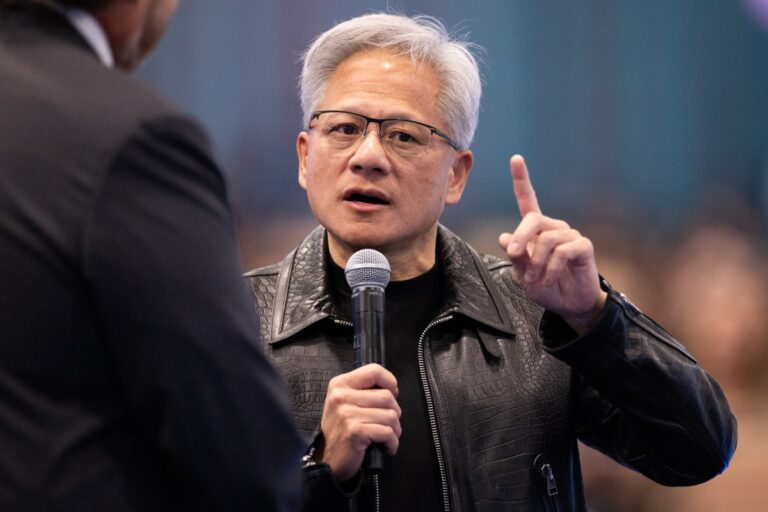
Huang received a direct call from Trump while on stage at the All-In Summit, a moment that carried symbolic weight. The conversation played out before a large, attentive audience, providing both men with a visible platform to reinforce their alignment. Kirsten Korosec, reflecting on the exchange, suggested the appearance felt choreographed and highlighted an uncomfortable truth: Nvidia’s financial success depends on AI advancing without deliberate regulatory constraints or industry-wide slowdowns. The chip manufacturer that supplies the infrastructure for AI model training has no financial incentive to see development decelerate.
O’Kane contextualized Huang’s role within a broader shift in industry influence. Two years earlier, Microsoft CEO Satya Nadella held the position of “adult in the room,” the executive perceived as bringing stability and measured judgment to technology debates. That influence eroded significantly, partly after Nadella’s public promise to “make Google dance” in competition failed to materialize. Huang, by contrast, has cultivated direct lines to political power, positioning himself as the essential intermediary between frontier AI labs and the current administration.
Market Dynamics That Work Against Meaningful Slowdown
Even if industry executives genuinely committed to the proposals, structural economic realities would likely prevent a meaningful reduction in development velocity. O’Kane identified two critical obstacles that regulators and the market do not adequately address.
The Absence of Consumer Pressure
In most markets, consumer choice serves as a check on corporate behavior. If a company released a dangerous product and faced customer backlash, it would lose revenue. The logic applies less to AI. Most revenue from frontier labs now comes from enterprise customers, not individuals. Large corporations using OpenAI’s Codex cannot easily switch to Anthropic’s Claude Code, even if they disagreed with OpenAI’s practices on principle. Enterprise software adoption creates lock-in effects that prevent the kind of rapid customer flight that theoretically disciplined companies in more competitive consumer markets.
Additionally, these companies operate with extraordinary capital reserves supplied by venture investors. That financial cushion allows them to absorb hypothetical customer defections without immediate pressure to change course. A startup facing similar circumstances would face immediate consequences. A company backed by billions in funding faces much softer constraints.
Federal regulation remains unenforced, O’Kane noted, with no clear indication that government would rigorously enforce new AI-specific rules should they pass. The regulatory vacuum leaves only market discipline as a potential constraint, and market discipline functions weakly when customers cannot realistically switch vendors and companies can absorb losses indefinitely.
The Cartel Question
Korosec raised a question that deserves serious consideration: coordination among a small number of dominant frontier AI labs might resemble cartel behavior rather than genuine safety commitment. When an oligopoly of companies aligns on common standards, the arrangement can serve multiple purposes simultaneously. Safety measures could be genuine and still function to entrench the positions of incumbents while raising barriers for new entrants. Coordination on development limits among existing major players might protect their market position while using safety language as cover.
This does not necessarily mean the proposed safety measures are insincere. But it does mean the motivations warrant scrutiny beyond the safety rhetoric. The group in question—major AI labs in democratic countries—possesses the market power to enforce industry-wide standards. Whether those standards primarily serve public safety or primarily entrench competitive advantages represents a central tension in the current debate.
The Uncertain Path Forward
The distance between the rhetoric of slowing development and the mechanics of governance structures remains vast. Industry leaders voice support for “pacing,” executives oppose “slowdowns,” and the details of what either concept means in practice remain contested. What has become clear is that market forces alone will not impose constraints on AI development velocity, and regulatory enforcement shows no signs of materializing. Whether the proposed frameworks of third-party oversight and international coordination will prove sufficient remains an open question that the industry has not yet answered with specificity.
Frequently Asked Questions
What are the three main proposals in Dario Amodei's plan to pace the frontier?
The plan proposes independent third-party evaluators embedded within companies like Anthropic and OpenAI to monitor safety practices, coordination among major AI companies in democratic nations on safety standards and development limits, and international coordination mechanisms extending these principles across borders.
Why does the choice between 'slowdown' and 'pacing' language matter?
Slowdown implies clear deceleration from current speed, while pacing suggests modulation or governance without necessarily reducing development tempo. The proposals establish oversight structures but do not explicitly commit to operating at reduced speeds compared to current trajectories.
What prevents market forces from naturally constraining AI development?
Enterprise customers cannot easily switch vendors for principle, venture capital reserves allow companies to absorb customer losses, and weak regulatory enforcement means no consistent market or government discipline applies to development pace.
