
Key takeaways
- Anduril’s October 2024 combat validation represents a watershed moment for U.S.
- The race to gain “battle-tested in Ukraine” credentials has become a central competitive dynamic in the global autonomous weapons market.
- The deployment of American UGVs represents a new phase in Ukraine’s emergence as the world’s primary laboratory for autonomous ground systems.
- The coming months will reveal whether American UGVs can achieve meaningful deployment alongside Ukrainian and European systems.
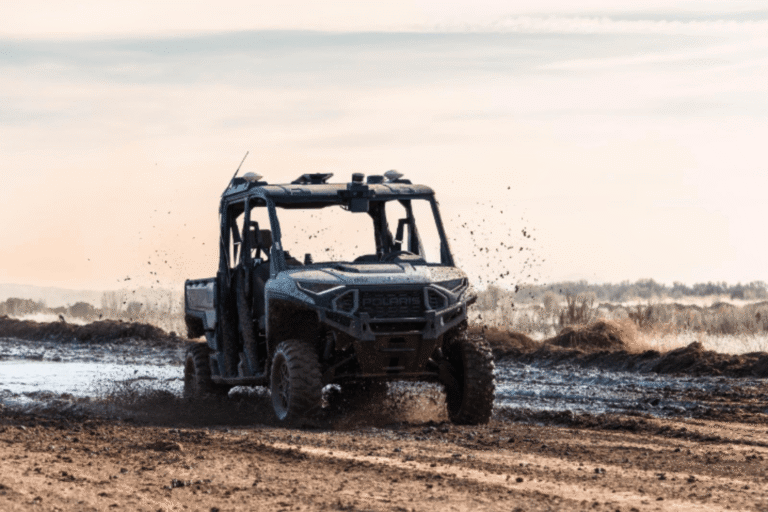
U.S. defense technology company Anduril recently began selling autonomous ground and aerial systems following successful combat tests conducted in Ukraine during October 2024, marking the first validated deployment of American-made unmanned ground vehicles in the Ukrainian theater. The entry of American UGVs into the conflict comes as Ukraine faces surging demand for robotic logistics systems, with the country planning to field 25,000 unmanned ground vehicles in the first half of 2026—more than double the 2025 total—according to Ukrainian Defense Minister Mykhailo Fedorov. This convergence of American technological capability and Ukrainian battlefield demand is reshaping the autonomous weapons market and accelerating a global arms race in robotic warfare.
American Defense Firms Enter the Ukrainian Market
Anduril’s October 2024 combat validation represents a watershed moment for U.S. defense manufacturers seeking to establish credibility in autonomous systems. The company’s successful tests demonstrated that American-designed UGVs could operate effectively in the specific conditions of the Ukrainian front, a credential increasingly valued by defense procurement officials worldwide. This achievement has positioned Anduril among a growing cohort of American firms moving from laboratory development into field deployment.
Beyond Anduril, a Seattle-based company secured a $20 million production contract from the U.S. Marine Corps in June 2026 to manufacture autonomous ground vehicles for potential deployment in contested environments similar to Ukraine. The contract signals serious Pentagon commitment to scaling American UGV production, with the technology explicitly designed for the types of operational challenges posed by the Ukrainian conflict. Separately, Rheinmetall USA and Harbinger announced a partnership in 2026 to develop and field a family of robotic and uncrewed ground vehicles, representing another major push by established defense industrial players to capture the emerging American UGV market.
Ukraine’s Massive Demand Meets American Supply
Ukraine’s appetite for unmanned ground vehicles stems from a critical operational reality: UGVs now conduct 80 percent of logistics operations in the 3rd Assault Brigade of the Ukrainian Armed Forces, and handle 90 percent of logistics in key areas like Pokrovsk and Myrnograd. This data from 2025 reveals that robotic systems have become the backbone of Ukrainian supply chains, replacing soldiers in dangerous frontline logistics roles. The scale of this shift underscores why American manufacturers view Ukraine as both a proving ground and a major market opportunity.
Ukraine’s domestic production capacity, while impressive, cannot meet the 25,000-vehicle target announced by Defense Minister Fedorov for the first half of 2026. Ukrainian manufacturers produced approximately 15,000 UGVs in 2025, leaving a significant gap that American and European suppliers are positioned to fill. The cost advantage of Ukrainian-made systems—ranging from $1,000 to $10,000 per vehicle, with some platoons averaging $700 per unit—means American entrants must either match these prices or offer superior capabilities in AI integration, durability, or autonomous functionality to justify higher costs.
Industry Momentum and Competitive Pressure
The race to gain “battle-tested in Ukraine” credentials has become a central competitive dynamic in the global autonomous weapons market. Companies across Europe and the United States recognize that validation in active combat operations dramatically enhances market credibility and government procurement appeal. Anduril’s October 2024 tests exemplify this strategy, transforming Ukrainian combat conditions into a certification mechanism for emerging defense technologies.
AI integration is emerging as a key differentiator for American UGV systems entering the market. Ukrainian forces are already expecting AI-enabled drone swarms and advanced autonomous ground vehicles to counter Russian forces in 2025 and beyond, creating demand for systems with sophisticated machine learning capabilities. American manufacturers are leveraging their technological advantages in artificial intelligence and software development to position their UGVs as more intelligent and adaptable than lower-cost alternatives, even at higher price points.
The Evolution of Robotic Warfare on the Eastern Front
The deployment of American UGVs represents a new phase in Ukraine’s emergence as the world’s primary laboratory for autonomous ground systems. On March 29, 2024, Russian forces conducted the first-ever direct frontline assault using UGVs equipped with AGS-17 grenade launchers near Berdychi, establishing a precedent for combat-deployed autonomous ground vehicles. What began as Russian experimental deployment has rapidly evolved into a multi-national phenomenon, with American, European, and Ukrainian systems now competing for operational roles across the conflict.
The historical significance of American entry into this space lies not merely in technological capability but in the legitimacy that American participation confers on robotic warfare as a permanent feature of modern combat. The October 2024 Anduril tests and subsequent contracts signal that major Western defense institutions are moving beyond skepticism toward autonomous systems and embracing them as essential operational tools.
Key Developments to Monitor in 2026
The coming months will reveal whether American UGVs can achieve meaningful deployment alongside Ukrainian and European systems. The Seattle-based company’s $20 million Marine Corps contract and the Rheinmetall-Harbinger partnership both have critical milestones in the first half of 2026, precisely when Ukraine aims to deploy its 25,000-vehicle force. These timelines suggest that American manufacturers face both opportunity and pressure to deliver systems at scale and at costs competitive with existing alternatives.
The success or failure of American UGV deployment in Ukraine will reverberate across global defense procurement, AI development, and the broader autonomous weapons industry. As the United States competes with Russian and Chinese approaches to robotic warfare, the Ukrainian theater remains the definitive testing ground for validating next-generation autonomous systems. American firms now entering this market are not simply selling equipment—they are establishing the technological and operational foundations for how the Western world will wage warfare in the autonomous era.
