
Key takeaways
- Benchmark's five partners maintain two to three investments per year per partner, resisting pressure to scale despite raising $2 billion across two funds.
- New partners Jack Altman and Ev Randall joined the firm for its focus on founder relationships and close-knit partnership structure, a rarity in modern venture capital.
- Benchmark partners attribute AI market volatility to misinformation and exaggerated estimates rather than fundamental ecosystem problems, expecting stabilization once OpenAI and Anthropic go public.
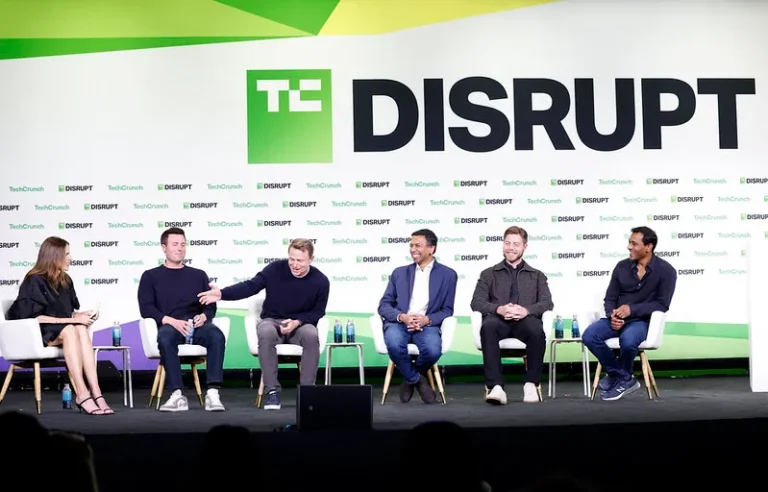
When Benchmark raised $2 billion across two vehicles this summer, it marked only the second time in the venture firm’s 31-year history that it stepped outside its traditional, smaller fund model. But at TechCrunch Disrupt this week, the five general partners made clear they had no intention of swapping their measured approach for the frenzied pace of their competitors.
Peter Fenton, Ev Randall, Jack Altman, Eric Vishria and Chethan Puttagunta sat down to discuss what drives their strategy and how new partners are finding their place in a firm that prizes founder relationships above deal volume. The conversation revealed a venture house that is deliberately staying small even as the world around it accelerates.
The Pressure to Scale (And Why They’re Resisting It)
Benchmark has always been an outlier in venture capital. Where many firms have expanded their partner counts into the dozens and engineered investment processes around high deal flow, Benchmark limits itself to about two or three new bets per partner each year. The partners insisted this hasn’t changed, even with their recent capital raise.
Puttagunta acknowledged the reality that Benchmark will miss successful companies, but framed that as acceptable. His focus is on identifying founders with strengths he can amplify, rather than chasing every opportunity that emerges.
A Philosophy Built on Founder Care
The logic runs counter to conventional wisdom about venture scale. Jack Altman, who joined in February after running his own $275 million fund and hosting a popular podcast, explained that his decision came down to philosophy. He wanted to be part of a group that cared about founders first, not status or money. “In a market this crazy, I don’t know how I’d feel figuring it out on my own,” he said.
Learning From Different Firm Structures
Ev Randall, who arrived late last year after stints at Founders Fund, Bond, and Kleiner Perkins, compared small partnerships to sports teams. Large firms with 50 to 60-person investment teams and federated investment structures felt to him like working through “Byzantine corporate structures.” At Benchmark, decisions happen between five people who genuinely respect each other. “It’s a group that admires each other and learns from each other,” Randall said.
The Two-Fund Model
Benchmark’s $2 billion raise split into two vehicles: a refreshed core fund and a new growth fund. The core fund, which had remained at $500 million for 20 years, has been adjusted upward to account for inflation and economic changes. Fenton called holding it flat for two decades “probably a tactical error on our part.”
Expanding the Mandate
The growth fund, with $1.25 billion to deploy, represents an expansion of the firm’s traditional early-stage mandate. Over the years, Benchmark walked away from opportunities that would have returned somewhere between 10x and 1,000x, according to Fenton, simply because they fell outside the early-stage focus. The new fund removes that constraint.
Portfolio Concentration Strategy
When asked how many bets the growth fund would support, Fenton admitted the five partners have different views. He referenced a J.P. Morgan paper on concentrated portfolios, expressing a preference for the approach where one or two investments generate 90 percent of returns. His estimate: four to six bets, possibly seven or eight, depending on success.
Operating Without Structure
The structure also means there’s no formal voting process or rigid investment criteria. Altman noted that the firm operates without the voting rigor or CRM systems that would be necessary if they were investing in 100 or 200 companies annually. “Because it’s so rare,” he said, “the lack of structure is a huge asset.”
Monday Meetings Without Agendas
One of Benchmark’s most distinctive practices is the absence of an agenda at their weekly partner meetings. Vishria explained this isn’t a quirk but a necessity. The five partners use these sessions to discuss companies they’re meeting, what captures their interest, and patterns they’re seeing in board meetings across their portfolio.
“It’s an ongoing conversation,” Vishria said, describing the effort to understand what’s becoming possible in a landscape of rapid change. The Monday meetings function as a decades-long dialogue, one that Puttagunta stressed requires space to be reactive. If a founder needs help recruiting an executive or closing a strategic partnership, the five partners can mobilize quickly.
This informality extends to deal-making itself. Altman said that many of his investments wouldn’t have been won without his partners’ involvement. He’d joined with a software background but since arriving has invested in chips, robotics, and infrastructure.
The Cerebras Case Study
A case study in how Benchmark thinks emerged from the Cerebras investment. Vishria invested in the AI chip company in spring 2016, during its first round. It was unusual because Benchmark hadn’t made a hardware investment in a decade. The founders presented a simple thesis, though Vishria acknowledged he didn’t fully understand most of the details.
Fenton initially opposed the investment, telling Vishria on the Sunday before the Monday pitch that it went against everything venture had taught him. But the founders persuaded him, and the firm moved forward.
The IPO and Market Volatility
When Cerebras went public earlier this year, it priced at $185, spiked to $350, and retreated back to $185. The volatility sparked a question about whether the IPO process itself is broken. Vishria pointed out that Cerebras raised $6 billion in the process, money the company needed. For capital-intensive AI companies, the traditional IPO still makes sense, he said, even if former colleagues like Bill Gurley have advocated for direct listings instead.
Reading the AI Market Signals
Character.AI and the Misread Narrative
The final portion of the conversation turned to broader market conditions. Character.AI filed for bankruptcy, a token some observers cited as evidence of an AI funding correction beginning. But Randall reframed the narrative. Character.AI was the “leftover corpse” of a company whose founder and team had been acquired by Google roughly 18 months earlier for $2.3 billion, he explained. The bankruptcy filing was being misread in what he called a “hyperactive X echo chamber” as evidence of systemic problems.
Disconnect Between Public Markets and Reality
He pointed to the disconnect between volatile public markets and underlying fundamentals. CoreWeave and Nebius, he said, are trading on estimated annual recurring revenue figures from private companies like OpenAI and Anthropic, firms expected to go public within 12 months. Market swings of 5 to 10 percent come from tweeted estimates and exaggerated data points, not from real changes in company health.
No Inherent Unhealthiness in AI Ecosystem
The reality, according to Randall, is that Benchmark portfolio companies are seeing strong demand. They can’t get enough compute capacity to serve customers willing to pay at healthy gross margins. “There’s nothing inherently unhealthy about the AI ecosystem,” he said. “What’s unhealthy is the volatility from data points that are often untrue or exaggerated for clicks.” He stopped short of predicting a correction, calling macro predictions “always a fool’s errand.” But he did see one outcome that could stabilize the market: OpenAI and Anthropic going public so the speculation driving wild swings would diminish.
Source: TechCrunch
Frequently Asked Questions
What did Benchmark raise this year?
Benchmark raised $2 billion across two funds this summer, marking only the second time in its 31-year history that the firm departed from raising smaller vehicles.
How many investments does each Benchmark partner make per year?
Each partner makes approximately two or three new bets per year, a pace the firm has maintained despite their recent capital raise.
Why did Jack Altman join Benchmark after running his own fund?
Altman joined in February because he wanted to be part of a group that prioritized founder care above money and status, and felt that having smart partners to learn from in a volatile market was valuable.
