
Key takeaways
- Cambridge Heavy Industries operates a tabletop fusion reactor that enables 50 to 80 experiments daily, using a two-laser system that minimizes hardware complexity compared to other inertial confinement approaches.
- The startup raised $6.2 million led by Azolla Ventures to advance laser compression fusion technology developed from materials science research at MIT's Keith Nelson laboratory.
- Cambridge Heavy plans to generate revenue by producing tritium, a rare and expensive isotope in short supply globally, before attempting commercial power generation within a decade.
Cambridge Heavy Industries, a fusion startup operating from a laboratory near MIT, has developed a reactor small enough to fit on a desktop. The company is pursuing a fundamentally different strategy from most fusion ventures, prioritizing compactness and experimental velocity over the massive facilities that characterize the field. It recently completed a $6.2 million seed funding round led by Azolla Ventures, with participation from Overlay, Neta Foundation, P3A, MassCEC, and the Rothrock family.
The tabletop scale offers practical advantages that extend well beyond novelty. “We purposely built a small modular reactor. It’s tiny, it’s benchtop,” said Yun Kai, co-founder and CEO, in an exclusive conversation with TechCrunch. This design choice enables an experimental cadence infeasible for larger systems. Cambridge Heavy conducts 50 to 80 shots per day. Each experiment produces data fed into AI-powered simulations to optimize the reactor’s design, allowing the company to test assumptions quickly and refine the engineering without the long waiting periods required between experiments at larger facilities.
The compact approach reflects a shift in fusion development philosophy. For decades, larger was assumed to be better. Cambridge Heavy suggests that intermediate scale, combined with smart engineering and AI optimization, might unlock solutions faster than traditional megaproject approaches.
How the Laser Compression Works
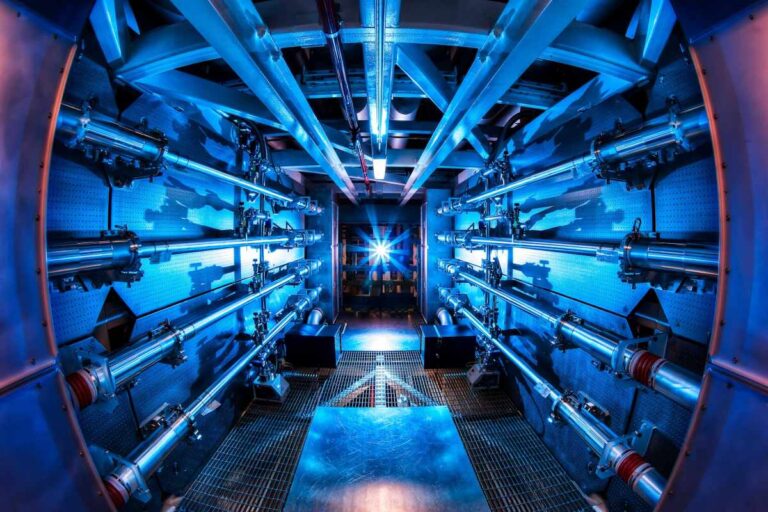
Cambridge Heavy’s fusion device uses laser-driven inertial confinement, the same principle demonstrated by the National Ignition Laboratory’s historic net energy gain. However, most inertial confinement systems require extensive laser arrays to achieve ignition. Cambridge Heavy’s design accomplishes fusion with fewer lasers.
Concentric Rings and Shockwave Choreography
The reactor employs two primary lasers. One splits into multiple beam lines that project light in concentric rings onto a flat, round fuel target. Each laser ring is timed to strike the target in precise sequence, beginning with the outermost ring and proceeding inward.
The first laser ring initiates a compression wave that travels toward the fuel’s center. Subsequent rings are precisely timed to meet and accelerate this shockwave, forcing the fuel to extreme densities. When the shockwave converges at the core, a final laser pulse generates the heat and magnetic field required for fusion ignition. The orchestration of these pressure waves and timing is the engineering heart of the design.
Minimal Laser Power, Maximum Pressure
The core innovation is generating high pressure with comparatively low laser power. This efficiency simplifies operation and maintenance while enabling the rapid testing cycle that makes the compact design valuable. By reducing hardware complexity, the company gains flexibility to test physics assumptions and iterate on the engineering.
The Scientific Foundation
The technology did not originate in fusion research. Keith Nelson, a chemist at MIT, developed it while studying materials under extreme pressure using laser pulses. As his experiments progressively increased pressure, his team recognized they were approaching the conditions necessary for fusion reactions. That observation became the seed for Cambridge Heavy’s engineering program.
The Tritium Supply Opportunity
Cambridge Heavy does not pursue electricity generation immediately. Instead, the company plans to use its smaller reactor systems to produce tritium, a rare isotope of hydrogen. This choice reflects a genuine market gap in the fusion industry, one that could generate significant revenue before the company attempts grid-scale power generation.
Global Scarcity and Market Value
Tritium is one of the rarest materials in industrial supply. The global stockpile totals roughly 40 kilograms. The substance trades for approximately $30,000 per gram on the open market. Nearly all fusion power plants under development require tritium for their fuel cycles, creating consistent demand for a severely constrained supply.
The Forecast Shortage and Revenue Window
Research predicts that the fusion industry will face a significant supply gap. Without new production sources, the industry will be short approximately 28 kilograms of tritium by 2054. At current market rates, that unmet demand represents roughly $840 million in value.
Most fusion developers are engineering reactors that breed their own tritium through nuclear reactions, reducing dependence on external supply. However, this technology remains unproven and development timelines extend as far as a decade. During this window, Cambridge Heavy can generate revenue by supplying tritium to other fusion companies, turning the reactor into a cash-generating asset before attempting the far more capital-intensive transition to commercial power generation.
Demonstration and Commercial Timeline
Cambridge Heavy targets a commercial power plant demonstration within approximately a decade. The facility will be substantially larger than the current benchtop prototype, though smaller than other fusion plants globally. Kai described it as roughly the size of two basketball courts. This intermediate scale is designed to determine whether the laser compression approach can produce net energy sufficient for commercial deployment.
The two-basketball-court scale represents a meaningful decision in fusion engineering. It is large enough to test economics and physics at a credible scale, yet small enough to be built without the multibillion-dollar budgets that characterize megaprojects.
Source: TechCrunch
Frequently Asked Questions
What makes Cambridge Heavy's reactor different from other fusion devices?
The reactor uses two main lasers split into concentric laser rings to achieve fusion with lower laser power than other inertial confinement approaches. Its compact, benchtop size enables 50 to 80 experiments per day, allowing rapid iteration and optimization through AI-powered simulations.
Why is Cambridge Heavy focusing on tritium production before power generation?
Tritium, a rare isotope essential to all fusion power plants, sells for approximately $30,000 per gram with only 40 kilograms in global supply. Research predicts a shortage of 28 kilograms by 2054 worth roughly $840 million. This creates a revenue opportunity for Cambridge Heavy while other developers work on self-sufficient tritium production, which may take up to a decade.
When does Cambridge Heavy plan to build a commercial power plant?
The startup targets completion of a commercial demonstration facility within approximately a decade. The plant will be roughly the size of two basketball courts, larger than the current benchtop prototype but smaller than other fusion facilities globally, and is intended to prove whether the laser compression approach can generate sufficient net energy for commercial deployment.
