
Key takeaways
- CIA officer David J. Rush pleaded guilty to wire fraud after stealing nearly $200 million through a fake special access program masquerading as a continuity of government operation.
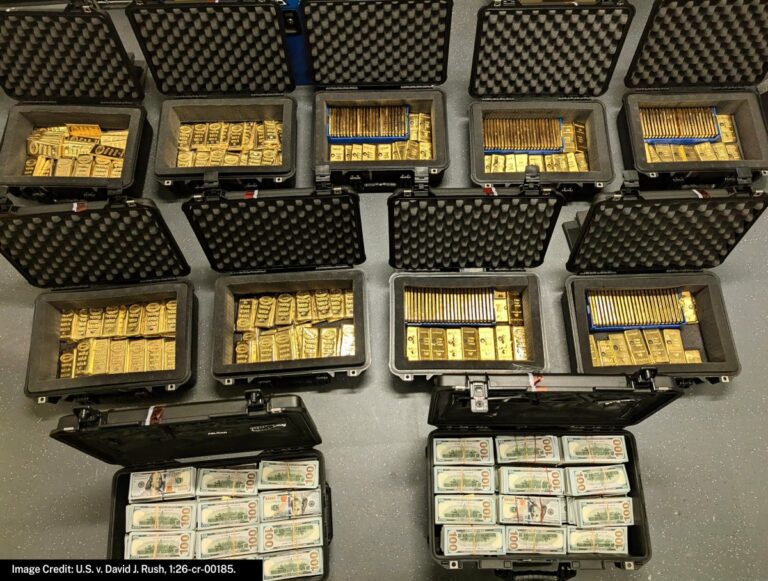
- Law enforcement discovered $46 million in gold bars, over $2 million in cash, luxury watches, and high-value vehicles in Rush's residence.
- Rush was able to operate as his own spending approving official, authorizing millions in government expenditures without meaningful oversight despite his access to sensitive intelligence programs.
- He faces up to 20 years in prison, with sentencing scheduled for late January 2027.
A senior CIA officer with more than a decade of service has admitted to orchestrating one of the agency’s most brazen internal thefts: a scheme that diverted nearly $200 million in government funds into his personal possession through the creation of a fictitious intelligence operation.
The U.S. Department of Justice announced Tuesday that David J. Rush, a Virginia resident, pleaded guilty to wire fraud for his role in the fraud. According to prosecutors, Rush exploited his position to design an elaborate false program, leveraging his access to classified spending authority to move federal money without meaningful review.
Building the Scheme
A Fabricated Intelligence Program
The elaborate nature of Rush’s deception centered on a carefully constructed lie. Operating throughout 2025, he created what appeared to be a legitimate special access program, known as a SAP in intelligence circles. These compartmentalized surveillance and intelligence-gathering operations rank among the government’s most sensitive undertakings, requiring security clearance so restricted that even highly cleared officials lack access.
Rush structured his false operation under the pretense of a “continuity of government” plan. Such plans, standard across federal agencies, designate operational protocols to maintain government function during war, natural disaster, or other catastrophic scenarios. By masking his theft as part of this framework, Rush embedded his scheme within bureaucratic structures designed to handle extremely sensitive matters with limited oversight.
Exploiting Position and Authority
Court filings reveal the depth of Rush’s access to the system. He worked for a CIA division focused on developing espionage tools and hacking techniques since 2010, giving him more than a decade of agency familiarity and established credibility. Within this specialized unit, Rush held significant authority over government intelligence programs and spending decisions.
His position, critically, allowed him to operate as his own approving official. This structural vulnerability meant Rush could authorize government expenditures without the scrutiny typically applied to spending of this magnitude. The system, designed to protect genuinely classified operations from exposure, instead became the mechanism through which Rush moved millions in federal funds.
The Gold Conspiracy
The financial centerpiece of the scheme involved precious metals. Rush leveraged his fabricated SAP and corresponding false government contract to manipulate an unnamed defense contractor. He convinced the contractor to purchase large quantities of gold under the pretense of government need. Once acquired, the gold entered Rush’s possession rather than any legitimate government inventory.
This arrangement required deception at multiple levels. The contractor had to believe the purchases served a genuine national security purpose. The internal CIA structures had to accept the special access program as authentic. Meanwhile, the gold itself disappeared into Rush’s private holdings, becoming tangible proof of the theft.
The Discovery and Assets
When law enforcement executed the arrest, they uncovered physical evidence spanning multiple asset categories. Police located and seized more than $46 million worth of gold bars stored in Rush’s residence. Beyond the precious metals, investigators recovered over $2 million in cash, a collection of luxury watches, and multiple high-value vehicles.
These holdings provided concrete proof of the fraud’s scope and duration. The sheer volume of gold bars, the stash of unreported cash, and the luxury acquisitions painted a picture of extended criminal activity. The assets suggested Rush had been systematically converting stolen government funds into tangible wealth over an extended period.
Questions About Vetting and Detection
The discovery raised immediate questions about internal security. Rush had lied about his educational credentials and military experience when initially applying to the CIA. These fabrications, significant enough to disqualify an applicant, somehow escaped detection during the hiring process.
More troubling for the intelligence community: once inside, Rush’s activities went undetected for over a year. An officer with access to some of the government’s most sensitive intelligence-gathering programs was able to construct an elaborate fraud involving hundreds of millions of dollars without raising alarm. The scheme persisted long enough for him to accumulate $46 million in gold and millions more in cash before arrest.
The plea agreement provides a window into the government’s concerns. Rather than proceed to trial, prosecutors and the defendant agreed to the guilty plea. This arrangement spared the government from having to explain in open court exactly how its vetting procedures failed to catch these initial falsehoods, or how the theft remained hidden for so long despite his sensitive position.
Legal Consequences and Sentencing
Rush pleaded guilty to one count of wire fraud, admitting his role in using electronic communications to facilitate the scheme. His sentencing hearing is scheduled for late January 2027. Federal sentencing guidelines allow prosecutors to recommend up to 20 years in prison for this conviction.
The single wire fraud charge, while serious, represents only the primary charge in what investigators viewed as a sprawling fraud. Court documents indicate that Rush’s ability to authorize spending without scrutiny enabled him to “expend substantial amounts of United States government money,” suggesting a breach of operational security that extends beyond simple theft.
Intelligence Implications
The case raised immediate concerns within the intelligence establishment. According to reporting, Rush’s work involved one of the government’s most sensitive intelligence-gathering programs, details so closely held that only a handful of senior officials and select lawmakers possess knowledge of its full scope. The nature of these operations, and the fact that one trusted official could exploit them for personal gain, prompted the need for operational secrecy even in legal proceedings.
The Washington Post, first to report details of the investigation, withheld specifics about the particular intelligence program involved. The publication stated that disclosing such details could jeopardize ongoing intelligence-gathering operations currently underway.
This decision reflects the tension within the case: how to prosecute a major crime without exposing the very secrets the defendant exploited. The plea agreement may have provided a solution, allowing conviction without requiring full disclosure of Rush’s specific duties or the programs he had access to during his tenure with the agency.
Source: TechCrunch
Frequently Asked Questions
How did David J. Rush manage to steal nearly $200 million from the CIA?
Rush created a fake special access program under the guise of a "continuity of government" plan that would maintain government operations during catastrophic events. He then used his position to convince an unnamed defense contractor to purchase large quantities of gold under the false premise of government need, pocketing the proceeds.
What assets were recovered when Rush was arrested?
Investigators discovered more than $46 million worth of gold bars in Rush's residence, along with over $2 million in cash, luxury watches, and multiple high-value vehicles.
How long did Rush's fraud go undetected?
The scheme went undetected for over a year before his arrest, despite Rush having access to one of the government's most sensitive intelligence-gathering programs and significant authority over government spending.
