
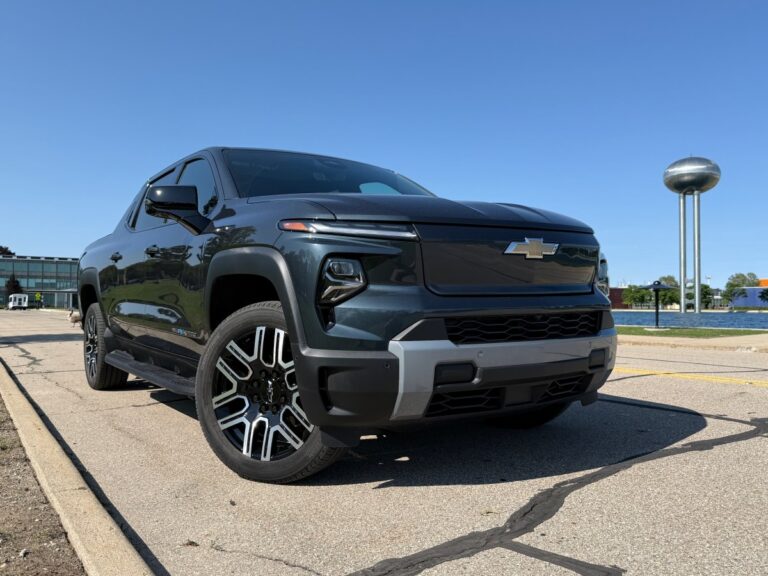
Key takeaways
- The 2026 Chevrolet Silverado EV starts at $55,395 for the Work Truck trim and reaches $98,695 for the RST Max Range version, positioning it as one of the market’s priciest electric pickups.
- Chevrolet markets the 2026 Silverada EV with up to 493 miles of EPA-estimated range and claims of 100 miles of range in 10 minutes via 350 kW DC fast charging.
- In Q3 2025, the Silverado EV recorded 3,940 deliveries in the U.S., nearly double the prior year’s volume but still a fraction of competitor volumes.
- In early 2026, GM announced the cancellation of EV production plans in Michigan and will retool facilities to build V8 Inter nal combustion engine vehicles including the Silverado, Sierra, and Escalade.
General Motors recorded a $1.6 billion charge in 2026 due to slowing EV demand and fading federal incentives, signaling a strategic retreat from electrification that has left the Chevrolet Silverado EV stranded in the market despite its premium positioning and “all-American” branding. The financial setback—with $1.2 billion tied to non-cash asset impairments from EV production capacity changes—reflects GM’s reduced confidence in electric truck profitability and raises questions about whether the company’s flagship electric pickup can survive in an increasingly price-sensitive market.
A Premium Truck Nobody Can Afford
The 2026 Chevrolet Silverado EV starts at $55,395 for the Work Truck trim and reaches $98,695 for the RST Max Range version, positioning it as one of the market’s priciest electric pickups. The RST Launch Edition, which debuted in May 2024, carried a sticker price of $96,495—comparable to the GMC Hummer EV but above the Rivian R1T and Ford F-150 Lightning, both of which offer comparable or superior capability at lower price points.
Introduced in January 2022 and launched for the 2024 model year, the Silverado EV entered a market where truck buyers increasingly prioritize affordability over premium features. The pricing strategy has proven catastrophic for dealer profitability: dealers report selling Silverado EVs $16,000 to $20,000 under MSRP, with some citing low run-rate profitability and the need to move 80,000 units monthly just to break even. Used 2024 Silverado EV prices now range from $46,100 for the Work Truck to $61,700 for the RST—down from original MSRPs of $74,900 and $96,495 respectively—revealing depreciation of approximately 38% in just two years.
Real-World Performance Falls Short of Claims
Chevrolet markets the 2026 Silverada EV with up to 493 miles of EPA-estimated range and claims of 100 miles of range in 10 minutes via 350 kW DC fast charging. However, real-world highway testing at 75 mph revealed significant gaps between advertised and actual performance: the RST managed only 400 miles versus its EPA rating, while the LT achieved 310 miles against a 390-mile estimate.
These inefficiencies under tow or highway load conditions erode consumer confidence in the vehicle’s capabilities and reliability. The gap between marketing claims and real-world performance matters because truck buyers depend on range estimates for long-haul work and leisure use—a critical factor in purchasing decisions where trust directly influences adoption rates.
Sales Data Exposes Market Rejection
In Q3 2025, the Silverado EV recorded 3,940 deliveries in the U.S., nearly double the prior year’s volume but still a fraction of competitor volumes. The Ford F-150 Lightning, by contrast, sold approximately 40,000 full-size EV trucks in 2024, demonstrating the vast gap between GM’s electric truck and established rivals in the segment where brand loyalty and proven capability dominate buyer decisions.
Full-year 2025 data further highlights the Silverado EV’s weakness: GM sold only 11,275 units of the electric pickup while the Chevrolet Equinox EV—priced around $35,000—sold 57,945 units, making it the best-selling non-Tesla EV in America. This disparity reveals a critical market truth: GM’s budget EVs outperform its premium electric trucks by a factor of five, suggesting price sensitivity, not patriotic branding, drives EV adoption decisions among American consumers.
GM’s Strategic Retreat From Electric Trucks
In early 2026, GM announced the cancellation of EV production plans in Michigan and will retool facilities to build V8 Internal combustion engine vehicles including the Silverado, Sierra, and Escalade. This reversal came after EV sales dropped 43% in Q4 2024, partly due to expiring federal tax credits that had artificially supported demand.
The decision underscores that high-margin gas trucks remain GM’s “lifeblood” and signals sharply reduced corporate commitment to electric truck development. The strategic shift dampens consumer enthusiasm for the Silverado EV, as potential buyers recognize that the manufacturer itself has lost faith in the product’s long-term viability and market potential.
The Bolt’s Decline Foreshadowed Silverado EV’s Struggles
Chevrolet’s EV sales challenges predate the Silverado EV’s collapse. The Chevrolet Bolt EV, discontinued in December 2023 after 11 years as the best-selling non-Tesla EV, sold 62,044 units in its final full year (2023). From January through March 2026, the revived Bolt EV—returning as a 2027 model priced under $30,000—sold only 791 units in the U.S., illustrating the dramatic market shift away from premium EV pricing.
The Bolt’s revival at a sub-$30,000 price point contrasts sharply with the Silverado EV’s $55,000-plus positioning, suggesting GM recognizes that affordability, not premium positioning, drives volume in the current EV market. The company’s inability to apply these lessons to the Silverado EV has left the electric truck stranded in an increasingly crowded and price-conscious segment.
What Comes Next for GM’s Electric Truck Ambitions
Investors and analysts should monitor whether GM’s 2026 production capacity retooling accelerates the Silverado EV’s exit from the market or whether the company commits additional resources to price reductions and product improvements. The 2027 model year refresh cycle will signal whether GM intends to compete seriously in the electric truck segment or gradually phase out the Silverado EV in favor of higher-margin gas-powered alternatives.
The Silverado EV’s struggle represents a broader reckoning in the electric vehicle market: premium pricing, unmet range claims, and fading federal incentives have exposed the gap between manufacturer ambitions and consumer willingness to pay. For GM, the question is no longer whether the Silverada EV can compete with Tesla and Ford—it is whether the company can afford to keep building it at all.
