
Key takeaways
- Tesla’s decision to discontinue the Model S and Model X represents far more than a product line rationalization—it reflects the company’s explicit pivot away from traditional vehicle manufacturing.
- Tesla’s announcement coincided with a cascade of discontinuations from traditional automakers that had invested billions in electrification strategies.
- U.S. tariff policy emerged as a decisive factor in multiple discontinuation announcements, particularly affecting vehicles produced internationally or utilizing Chinese-connected technology.
- Beyond tariff pressures, fundamental weakening in EV consumer demand accelerated discontinuation timelines across the industry.
Tesla CEO Elon Musk confirmed in January 2026 that the company will end production of the Model S sedan and Model X SUV by April 1, 2026, marking a historic shift as the electric vehicle industry experiences a dramatic contraction across North America. The discontinuation of these flagship models, combined with at least nine other major EV cancellations announced throughout 2025 and early 2026, signals a fundamental retreat from electrification that has reshaped the automotive landscape in ways few industry observers predicted just two years ago. The wave of cancellations stems from a combination of tariff pressures, weakening consumer demand, and strategic pivots by major automakers toward hybrid technologies and alternative business models.
Tesla’s Historic Exit from Traditional Automaking
Tesla’s decision to discontinue the Model S and Model X represents far more than a product line rationalization—it reflects the company’s explicit pivot away from traditional vehicle manufacturing. Musk framed the move as necessary to “make way for what the company views is the future,” specifically shifting Tesla’s focus toward building a humanoid robot factory and transitioning from a carmaker to a “physical-AI provider.” This strategic reorientation marks a dramatic departure from the company’s core business model and signals confidence in alternative revenue streams that Tesla believes will supersede automotive manufacturing.
The Model S and Model X, which were among Tesla’s most profitable vehicles, had anchored the company’s premium segment since their respective launches in 2012 and 2015. By discontinuing both models simultaneously on April 1, 2026, Tesla eliminated two of the three core vehicles in its lineup, leaving only the Model 3 and Model Y to carry the company’s traditional automotive operations forward. The decision underscores how dramatically the competitive and regulatory environment has shifted, forcing even the world’s most valuable automaker to recalculate its priorities.
A Broader Industry Collapse in EV Production
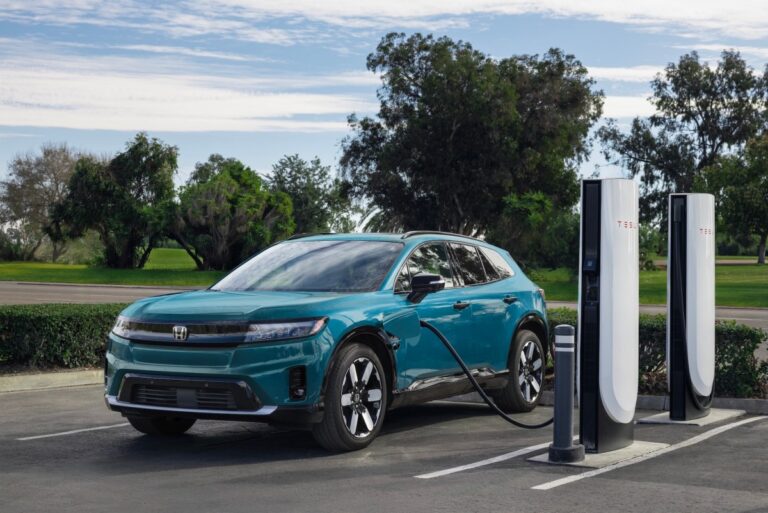
Tesla’s announcement coincided with a cascade of discontinuations from traditional automakers that had invested billions in electrification strategies. Honda confirmed in July 2026 that the Prologue, the company’s only all-electric vehicle for the U.S. market, is “officially dead,” ending a product line that launched just three years earlier in 2024. This decision followed Honda’s March 2026 announcement that it would cancel planned production of three additional EVs for the American market: the Acura RSX, the Honda 0 Series Sedan, and the Honda 0 Series SUV, citing U.S. tariffs and Chinese competition as primary drivers.
The automotive industry’s retreat extended across multiple manufacturers and price segments. Ford halted production of the F-150 Lightning electric pickup in December 2025 after reporting over $27 billion in recent write-downs due to its EV retreat. General Motors discontinued the BrightDrop electric vans in October 2025 after initially launching them under their own brand before integrating them into Chevrolet. BMW confirmed that both the refreshed iX and the i4 would be discontinued in the U.S., with 2026 marking the i4’s final model year after just five years on the market. Acura discontinued the ZDX, its first EV built on the Ultium platform, in September 2025 after failing to sustain buyer Interest despite significant marketing investment.
Tariffs and International Competition Drive Decisions
U.S. tariff policy emerged as a decisive factor in multiple discontinuation announcements, particularly affecting vehicles produced internationally or utilizing Chinese-connected technology. Swedish EV maker Polestar, owned by Chinese giant Geely, was forced to withdraw the Polestar 2 from the U.S. market entirely due to the American ban on vehicles with Chinese-connected technology, making the model economically unviable after tariffs increased costs substantially. Hyundai stopped selling the standard Ioniq 6 in March 2026 and declined to ship the 2026 Kona Electric from Korean plants to U.S. dealerships in February 2026, with only the high-performance Ioniq 6N version remaining in limited quantities.
These tariff-driven decisions reveal how trade policy has become as consequential as consumer demand in determining which vehicles reach American dealerships. The tariff environment made manufacturing and importation economics prohibitive for several models that might otherwise have remained viable. Nissan decided against producing a 2026 model year of the Ariya SUV for the U.S. market, with sales having collapsed to just 36 units in the second quarter of 2026, making it what analysts called the “number one flop of the quarter.”
Market Demand and Consumer Behavior Shifts
Beyond tariff pressures, fundamental weakening in EV consumer demand accelerated discontinuation timelines across the industry. BMW’s decision to discontinue the iX and i4 reflected declining sales over the two-year period preceding the end of the federal EV tax credit, which exacerbated demand erosion for premium electric vehicles. Nissan’s Ariya faced such weak U.S. sales that the company concluded continued production made no economic sense, with the possibility that the model may never return to American shores. Acura’s ZDX cancellation demonstrated that even ambitious new platforms could not overcome market headwinds created by shifting consumer preferences and broader economic uncertainty.
The pattern across these discontinuations reveals that automakers had overestimated both the speed of electrification adoption and consumer willingness to pay premium prices for electric vehicles in a competitive market. Production halts and model cancellations accelerated as inventory levels rose and dealer networks reported softer demand, forcing manufacturers to acknowledge that their EV expansion timelines had been unrealistic.
A Historic Inflection Point for the Industry
The 2025-2026 period represents a historic inflection point for the global automotive industry, comparable to previous technological transitions but compressed into an unusually short timeframe. Just five years earlier, nearly every major automaker had announced ambitious electrification targets with specific production volumes and market share projections that now appear wildly optimistic. The cascade of cancellations and write-downs suggests that the industry’s collective miscalculation about EV demand and the pace of consumer adoption has triggered a strategic reset affecting investment priorities, manufacturing capacity, and long-term product planning.
These discontinuations have eliminated options for consumers seeking electric vehicles across multiple price segments and vehicle categories. The disappearance of the F-150 Lightning removed the most prominent electric truck option, while cancellations of models like the Ioniq 6 and Kona Electric eliminated affordable electrified transportation at a moment when policy makers had emphasized the importance of bringing EV prices down to increase adoption.
What Comes Next for the EV Market
The immediate focus for automotive investors and analysts will be determining whether remaining EV models can sustain profitability and market share in an environment characterized by intense competition, tariff uncertainty, and shifting consumer preferences. Ford, General Motors, and Tesla will face intense scrutiny regarding production volumes and pricing strategies for their remaining electric vehicle lineups, particularly as these companies balance EV commitments against investor pressure to return to profitability. The success or failure of models like the Tesla Model 3 and Model Y, the Ford Mustang Mach-E, and the Chevrolet Blazer EV will largely determine whether the industry’s electrification narrative can recover credibility.
The wave of 2025-2026 discontinuations has fundamentally altered the competitive landscape for electric vehicles in North America and raised critical questions about whether the transition to electrification will proceed as rapidly as previously projected or whether hybrid technologies will capture a larger market share than anticipated.
