
Key takeaways
- A router failure during routine copper-to-fiber upgrade work at a remote FAA facility by contractor L3Harris caused a network overload that triggered a complete nationwide flight shutdown.
- The FAA is investigating whether L3Harris installed the equipment incorrectly or provided faulty hardware; the distinction carries significant legal and operational implications.
- Duffy used the incident to push Congress for increased FAA infrastructure funding, while acknowledging that scheduling critical maintenance for Friday afternoon rather than late evening will be reevaluated.
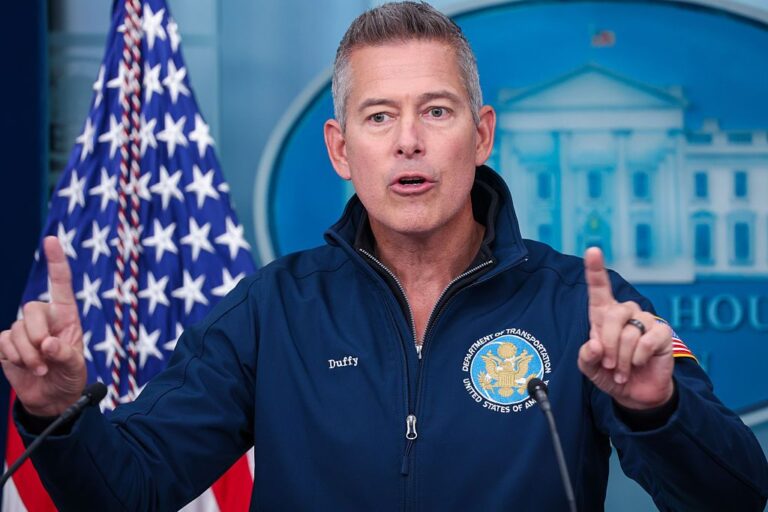
A nationwide flight ground stop Friday halted aviation across the United States, marking only the third complete shutdown of the 21st century. Transportation Secretary Sean Duffy announced the cause Saturday: routine maintenance at a remote Federal Aviation Administration facility by contractor L3Harris had triggered the failure. The company was upgrading copper wire infrastructure to fiber optic cable when a router malfunctioned and overloaded a critical communication system supporting air traffic control. More than 8,200 flights were canceled Friday evening according to aviation data firm Cirium, with at least 3,000 additional cancellations on Saturday after the ground stop was lifted. Duffy’s Saturday press conference announcing the cause experienced technical difficulties of its own, an unintended counterpoint to an announcement about infrastructure failures.
How the Network Overload Cascaded
Rebecca Guy, acting CTO of the FAA, detailed how the maintenance work unfolded into a system failure. Engineers detected instability in the network and investigated its source. “When we started to see the occurrence where our network was having instability, we started to look at what was the cause,” Guy said. “And as such, we saw two places that were actually pinging our network at a very high rate—a thousand connections over every four to five seconds.” The FAA immediately disabled both sources and stabilized the network, preventing further cascade effects through the interconnected system.
Equipment Failure or Installation Error
What triggered the overload remained unclear. Duffy raised the critical accountability question: “What we’re working to determine was whether we had incompetence—meaning, was it user error or installator error from L3Harris? Or did they install a faulty router?” The distinction mattered legally and operationally. Installation error pointed to contractor accountability, while faulty equipment indicated potential quality control or supply chain problems. Guy announced that the FAA would conduct a root cause analysis to determine which scenario had occurred.
The Timing That Maximized Disruption
Duffy faced immediate criticism over scheduling critical FAA maintenance for 3 p.m. on a Friday, the week’s busiest period for air traffic. The timing maximized both disruption and public visibility. Duffy explained that remote FAA facilities undergo maintenance during daytime hours while larger airports schedule work late at night to minimize flight impact. He acknowledged the timing created avoidable disruption and committed to reevaluation. “There will be reevaluation of when we do this work,” he said. The choice of Friday afternoon suggested either insufficient planning or acceptance of operational risk during peak traffic.
Congressional Funding as Central Message
Throughout multiple Saturday press conferences, Duffy repeatedly used the incident to argue that Congress must increase funding for FAA equipment upgrades. He characterized the work as “pretty straightforward work that we were doing yesterday at, again, a very remote location”—the kind of routine modernization that a well-funded agency handles without catastrophic failure. The copper-to-fiber conversion at the center of the outage became his central argument: aging infrastructure requires replacement with modern systems, and delaying such upgrades invites exactly this type of operational collapse. Duffy framed the incident not as evidence of poor planning but as proof that Congress must fund necessary FAA infrastructure work.
The AI Speculation
Timing Created Questions
The ground stop’s timing created immediate distraction. The FAA had announced the rollout of an artificial intelligence tool for air traffic controllers just one day earlier. The air traffic controllers union said it had not been consulted during the AI system’s design. Speculation erupted about whether the new AI system and the ground stop were connected.
Official Denials
FAA administrator Bryan Bedford moved quickly to extinguish this theory. “We have zero evidence of anything nefarious and zero evidence of anything AI-related,” he stated. He reframed the incident as purely an equipment problem: “We want to be clear that we have an equipment issue, and we’re working through what this defective piece of equipment was.” Homeland Security Secretary Markwayne Mullin offered a lighter response when asked about AI involvement, joking that his department calls it “SI” around headquarters—a play on stupidity rather than artificial intelligence.
Investigation and Future Operations
Guy’s root cause analysis will determine whether the router itself was defective or whether installation procedures by L3Harris failed. The incident raises broader questions about contingency planning for remote FAA facilities and whether critical infrastructure upgrades require additional safeguards to prevent single points of failure. Future maintenance on critical systems will likely shift away from high-traffic periods and busy days of the week.
Source: TechCrunch
Frequently Asked Questions
What caused the nationwide flight ground stop?
Contractor L3Harris was upgrading copper wire to fiber optic cable at a remote FAA facility when a router malfunctioned and overloaded a critical communication system. The FAA is investigating whether the installation was faulty or the router itself was defective.
How many flights were canceled?
More than 8,200 flights were canceled Friday evening, according to aviation data firm Cirium, with at least 3,000 additional cancellations on Saturday after the ground stop was lifted.
Was the AI tool announced the day before involved?
No. FAA administrator Bryan Bedford stated the agency has "zero evidence of anything nefarious and zero evidence of anything AI-related." The incident was caused by equipment failure during routine maintenance work.
