

Key takeaways
- Google released Gemini 4 Hydrogen, a faster AI model that completes multi-step tasks 2.5x quicker than its previous fast model while beating more powerful models on reasoning benchmarks.
- Hydrogen improves Google Search by better understanding multi-part questions, handling typos more effectively, and breaking queries into subqueries to surface more relevant websites.
- The model offers four thinking levels including a new xhigh tier for complex analysis, and ranks No. 5 on Agent Arena's benchmarks for multi-step tasks.
- Gemini 4 Hydrogen is available in Google AI Studio, the Gemini API, Gemini App, and to paid AI Pro and Ultra subscribers, with rollout underway globally in Google Search.
Google has released Gemini 4 Hydrogen, a new model the company describes as its “biggest model improvement to Search yet.” The release reflects a strategic shift in how Google allocates AI capability, recognizing that not every task requires its most powerful model.
Hydrogen is built for agentic workflows, in which an AI system completes multiple steps independently. Google designed it to prioritize speed and efficiency without sacrificing reasoning ability. This approach acknowledges a practical reality in AI deployment: faster, cheaper models often serve specific use cases better than heavyweight alternatives.
What Hydrogen Represents
Google’s frontier models, Gemini 4 Carbon and Gemini 4 Argon, optimize for deep reasoning on complex problems. Hydrogen takes a different approach. The company describes it as a faster, cheaper model for tasks that don’t require the full reasoning power of its largest systems.
The distinction has practical weight. Frontier models excel when problems demand extensive analysis and multi-step reasoning. Hydrogen targets the middle ground where speed and reasonable intelligence outperform raw power. This positioning lets Google optimize infrastructure and costs while serving a broader range of applications.
Speed and Performance Gains
Faster execution across workflows
Hydrogen completes tasks 2.5 times faster than Gemini 3.8 Flash, Google’s previous fast model. This improvement applies across agentic workflows, reducing latency for users and computational costs for Google.
What makes the speed gain significant is that Hydrogen doesn’t simply trade intelligence for velocity. On the Artificial Analysis Intelligence Index, Hydrogen beats the more powerful Gemini 4 Argon when Argon runs at its default high thinking level. The result indicates Hydrogen achieves meaningful efficiency rather than a simple performance compromise.
Reasoning and benchmarking
Hydrogen handles independent work on coding, testing, and code verification. Google also designed it to work alongside Carbon and Argon in workflows requiring multiple models. This flexibility allows developers to select the right model for each step.
On multi-step tasks including deep research, data analysis, and broad codebase navigation, Hydrogen ranks No. 5 on Agent Arena’s benchmarks. The ranking positions it competitively among agentic AI systems while prioritizing speed over maximum reasoning depth.
Transforming Google Search
Better understanding of user intent
Hydrogen improves how Google Search interprets what users actually want. The model handles nuanced and complicated questions faster, allowing users to ask in natural language, including multi-part questions and specific requests. Hydrogen also navigates confusing typos more effectively than previous models.
These improvements mean Search addresses each part of a query more precisely. A multi-component question gets parsed into distinct elements rather than treated as a monolithic request.
Visual and structured responses
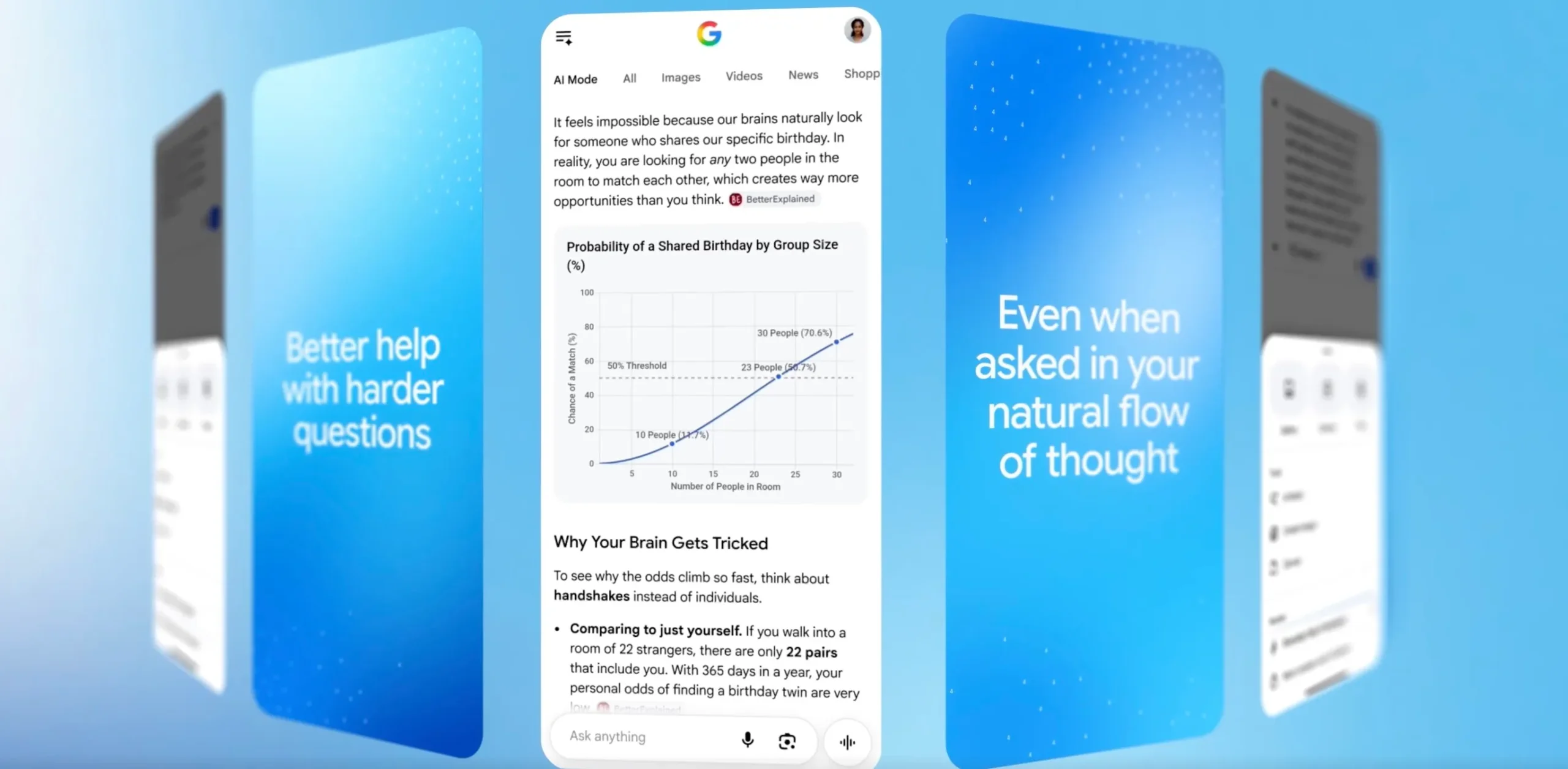
Google Search now displays more images, structured responses, comparison tables, and custom tools in AI Mode when using Hydrogen. These elements help users absorb complex information faster. Comparison tables make trade-offs immediately apparent, and structured responses break information into digestible sections.
Discovery through query decomposition
Hydrogen improves Search’s fan-out technique, which breaks a single user prompt into multiple subqueries. By decomposing queries, Search surfaces related websites and content users might otherwise miss. The technique proves particularly effective for exploratory searches involving multiple related angles.
Thinking Levels and Flexibility
Hydrogen offers four thinking levels: low, medium, high (default), and a new extra-high tier called “xhigh.” Each level balances reasoning depth with speed and token efficiency. The xhigh level provides maximum reasoning for complex analysis, while lower levels enable rapid responses for straightforward queries.
This graduated approach lets developers and users select reasoning depth for specific tasks. A factual lookup might use low or medium thinking, while complex analysis might require high or xhigh. The model adjusts its reasoning process and output token count based on the selected level.
Availability and Distribution
Gemini 4 Hydrogen is rolling out to all Google Search users globally. Beyond Search, the model is available in Google AI Studio, the Gemini API, the Gemini App, and to paid subscribers in Google’s Antigravity development platform. Users can access Hydrogen through the AI Pro and Ultra subscription tiers.
This broad distribution means developers can integrate Hydrogen into applications via the Gemini API, while consumers encounter it through Google’s products. Tiered availability ensures capabilities reach power users and paying customers first, with broader access expanding over time.
Model Strategy Shift
The release reflects Google’s evolving approach to AI capability distribution. Rather than deploying a single frontier model across all use cases, Google segments its portfolio by speed, reasoning depth, and cost. Carbon and Argon handle tasks requiring maximum reasoning, while Hydrogen addresses the broader category where speed and reasonable intelligence suffice.
This segmentation lets Google optimize performance and costs simultaneously. Developers gain control over trade-offs: they can prioritize speed over reasoning, or reasoning over speed, depending on their specific requirements. As AI integrates into more products and workflows, this flexibility becomes increasingly valuable.
Source: TechCrunch
Frequently Asked Questions
What is Gemini 4 Hydrogen and why did Google release it?
Hydrogen is Google's new model designed for agentic workflows where an AI completes multiple steps independently. Google released it because not all tasks need its most powerful models; a faster, cheaper option works better for many use cases. Hydrogen completes tasks 2.5x faster than Gemini 3.8 Flash while still outperforming the more powerful Gemini 4 Argon on reasoning benchmarks at Argon's default high thinking level.
How does Hydrogen improve Google Search?
Hydrogen helps Search better understand complex multi-part questions, handle confusing typos, and break single queries into multiple subqueries to surface more relevant results. It also enhances visual responses by showing more images, comparison tables, structured responses, and custom tools in AI Mode.
Where can I use Gemini 4 Hydrogen?
Hydrogen is rolling out to all Google Search users globally. Developers can access it through Google AI Studio, the Gemini API, and the Gemini App. Paid subscribers to Google's AI Pro and Ultra tiers in the Antigravity development platform can also use it directly.
