
Key takeaways
- The $50 million Series B round represents Manna’s largest single capital injection to date and signals accelerating investor confidence in autonomous last-mile delivery.
- Manna’s expansion ambitions rest on seven years of operational mastery across Europe and Texas, where the company has completed over 250,000 regulated commercial unmanned aerial vehicle flights.
- Manna plans to create 400 new jobs across Ireland and the United States in robotics, software engineering, aviation, and operations, bringing total headcount to over 570 employees.
- Industry observers have dubbed Manna the “Ryanair of drone delivery” for its focus on low-cost, high-volume logistics that prioritizes operational efficiency over premium service positioning.
Manna Air Delivery has raised $50 million in Series B funding to launch up to 40 new operational drone bases across the United States, marking the Irish autonomous delivery company’s most aggressive push into American markets. The funding round, announced in April 2026 and led by ARK Invest—the venture firm behind OpenAI, Tesla, and SpaceX—values the company at over $150 million and brings total capital raised to $110 million. Founder and CEO Bobby Healy has set an ambitious target of two million deliveries by the end of 2026 as Manna scales operations across Oklahoma, Texas, and additional U.S. locations.
Record Funding Fuels American Expansion
The $50 million Series B round represents Manna’s largest single capital injection to date and signals accelerating investor confidence in autonomous last-mile delivery. ARK Invest led the round alongside Schooner Capital and Ireland’s Strategic Investment Fund (ISIF), with support from existing backers including Coca-Cola HBC, Molten Ventures, and Enterprise Ireland. The timing follows Manna’s $30 million Series A round in March 2025, which valued the company at over $150 million and brought total funding to $60 million at that point.
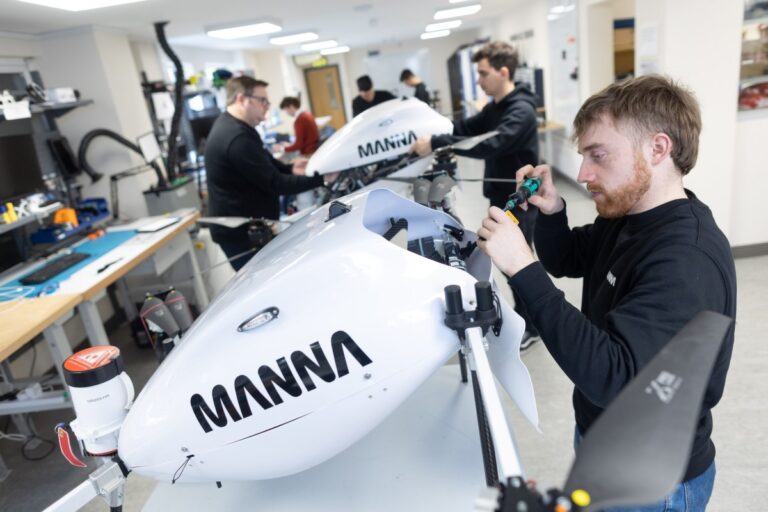
Bobby Healy’s stated ambition to achieve two million deliveries by year-end reflects Manna’s confidence in its proven operational playbook. The company plans to deploy its custom-built eight-motor electric aircraft across the first U.S. bases in Tulsa, Oklahoma and Dallas-Fort Worth, Texas, leveraging regulatory relationships with the Federal Aviation Administration (FAA) that have recently accelerated. Manna secured four new U.S. locations approved within 30 days, a pace the company attributes to new FAA leadership and executive orders streamlining drone commerce authorization.
Seven Years of European Dominance Precedes U.S. Entry
Manna’s expansion ambitions rest on seven years of operational mastery across Europe and Texas, where the company has completed over 250,000 regulated commercial unmanned aerial vehicle flights. Founded in 2019 by Bobby Healy, Manna operates one of the world’s most active consumer drone delivery networks, delivering food, medical supplies, books, and clothing to suburban neighborhoods. The company currently serves 150,000 residents in Dublin and aims to expand that footprint to one million by the end of 2026.
The company’s regulatory certifications under the European Union Aviation Safety Agency (EASA) provide a foundation for FAA negotiations, demonstrating that Manna’s aircraft, operations, and safety protocols can function at scale in heavily regulated airspace. Partnerships with Uber, Deliveroo, Just Eat, and DoorDash have established Manna as a trusted logistics provider for major food delivery platforms, creating existing demand channels for U.S. expansion. The company’s fivefold year-over-year growth from 2023 to 2024—when flights surged from 165,000 to over 250,000—demonstrates market traction and operational readiness.
Employment and Talent Signal Long-Term Commitment
Manna plans to create 400 new jobs across Ireland and the United States in robotics, software engineering, aviation, and operations, bringing total headcount to over 570 employees. The hiring announcement, made by Enterprise Ireland on April 1, 2026, underscores the company’s intent to build permanent infrastructure rather than pursue a quick exit or limited pilot program. This staffing expansion positions Manna to manage 40 operational bases across multiple U.S. markets simultaneously.
The investment in technical talent reflects the complexity of scaling autonomous flight operations across diverse geographies and regulatory jurisdictions. Manna’s need for software engineers, robotics specialists, and aviation experts signals that the company is building proprietary capabilities in autonomous navigation, traffic management, and logistics optimization. The jobs announcement also carries political significance in Ireland, where Enterprise Ireland has positioned drone delivery as a strategic technology sector aligned with the nation’s aerospace and software engineering strengths.
The Ryanair Model Takes Flight
Industry observers have dubbed Manna the “Ryanair of drone delivery” for its focus on low-cost, high-volume logistics that prioritizes operational efficiency over premium service positioning. Bobby Healy has emphasized that Manna completed 300,000 deliveries while competitors remained in early marketing phases, a metric that reflects the company’s execution-first culture. This operational philosophy mirrors Ryanair’s disruptive low-cost airline model applied to autonomous urban air mobility, suggesting Manna may reshape drone delivery economics rather than simply participate in an emerging market.
The comparison carries strategic weight because Ryanair’s model—high volume, tight margins, relentless cost reduction—fundamentally altered European aviation and created trillions in passenger value. If Manna achieves similar dominance in suburban drone logistics, the company could establish a defensible moat around last-mile delivery in North America. Competitors like Wing (Alphabet’s subsidiary) and Zipline have pursued different strategies emphasizing rural delivery and medical supply chains, leaving Manna positioned to capture suburban food and parcel delivery at scale.
Regulatory Environment Shifts in Manna’s Favor
Manna’s rapid approval of four U.S. locations within 30 days reflects a marked shift in FAA openness to commercial drone operations, driven by new leadership and executive orders prioritizing drone commerce. The company’s existing EASA certification provides a regulatory template that FAA officials can reference when evaluating Manna’s U.S. safety protocols and operational procedures. This regulatory tailwind differs sharply from the drone industry’s earlier years, when FAA approval timelines extended across months or years.
The timing of Manna’s U.S. expansion coincides with broader shifts in American policy toward autonomous systems and advanced air mobility. Venture Capital investors backing Manna—including ARK Invest—have signaled confidence that U.S. regulatory pathways for drone delivery will remain open and accelerate. If Manna successfully deploys 40 bases and achieves two million deliveries in 2026, the company will establish precedent that FAA approval is achievable at scale, potentially opening pathways for other autonomous delivery operators.
What Lies Ahead for Manna
Manna’s execution against its 2026 targets will determine whether the company can establish dominant market position in U.S. suburban drone delivery before well-capitalized competitors scale aggressively. The company must navigate local zoning regulations, noise concerns, and airspace coordination challenges across 40 separate markets while maintaining the operational excellence that generated fivefold growth in 2024. Success would validate ARK Invest’s thesis that autonomous delivery represents a multi-billion-dollar market opportunity comparable to early-stage ride-sharing or food delivery platforms.
The coming 18 months will clarify whether Manna’s European playbook translates seamlessly to American suburbs or whether regional differences in infrastructure, regulation, and consumer behavior require adaptation. If Manna achieves two million deliveries by year-end 2026 and secures additional funding to support further expansion, the company could emerge as the clear market leader in autonomous last-mile logistics. The drone delivery market remains nascent, but Manna’s capital, operational track record, and regulatory momentum position the company to define how autonomous aircraft reshape American commerce.
