
Key takeaways
- Nvidia projects 70% revenue growth for next year to approximately $680 billion, driven by deep integration with every major AI lab and cloud provider.
- A single modern Nvidia GPU system now costs $8.5 million and requires specialized logistics, vastly different from the $399 consumer GPUs the company once sold.
- Huang defended Nvidia's practice of investing in customers that then buy billions in hardware, citing $100 billion in signed contracts as evidence the strategy is not circular.
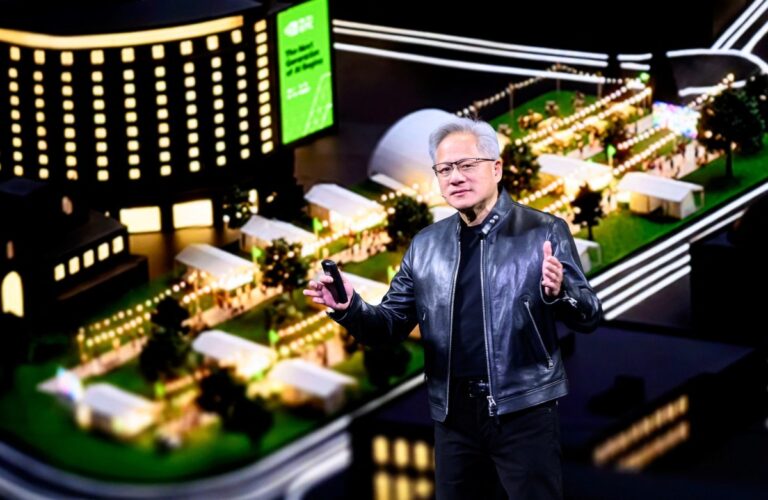
Jensen Huang laid out his confidence in Nvidia’s expansion at the Goldman Sachs Communacopia + Technology conference on Thursday, reiterating a revenue forecast that would represent a dramatic acceleration even by the company’s recent standards. Nvidia will grow 70% year-over-year, Huang said, building on a current fiscal year expected to end near $400 billion in revenue—a projection that would push annual revenue close to $680 billion if realized.
The scale of Nvidia’s AI chip business has fundamentally shifted how the company describes itself. Where Nvidia once sold graphics processors to PC gamers at $399 per unit, Huang emphasized that the typical GPU sold today exists within a far larger system. A single unit now costs $8.5 million, comprises 2 million components, consumes 250,000 kilowatts of power, and connects to dozens of additional processors through NVLink connections. Nvidia ships thousands of these systems annually.
One specific product line—a system combining 36 Grace CPUs with 72 Blackwell GPUs—is seeing 27% month-to-month sales growth. The scale underscores why Huang believes traditional comparisons of Nvidia to consumer GPU makers no longer apply. “You need airplanes to ship what we build,” he said, a reference both to the literal logistics of moving multi-ton systems and to the perception problem that still dogs Nvidia despite its commanding position.
Embedded Across Every Major AI Initiative
Huang attributed his confidence in the 70% growth forecast to Nvidia’s position as infrastructure provider to every significant actor in AI development. The company’s processors power models from Anthropic and OpenAI, as well as Google’s systems and open-weight models distributed more broadly. “Nvidia runs every model. Every single lab can use us,” Huang said. “We are a foundational platform of the AI ecosystem, foundational platform of the AI industry.”
Visibility Into Demand Signals
This structural position gives Nvidia visibility into demand that extends far beyond its direct customer relationships. Huang described a monitoring system tracking “every single gigawatt of land, power, shell around the world.” The term “shell” refers to empty data center buildings before they are equipped with computing hardware. Suppliers, original equipment manufacturers, cloud providers, and AI-native startups all report capacity and utilization data back to Nvidia through various partnerships. “We’re working with everybody, and so we kind of know where everything is,” Huang said, describing an informational advantage that feeds into Nvidia’s quarterly planning.
Market Saturation Claims
Despite this optimism, Huang acknowledged that much of AI’s current spending originates from startups in the field that raise capital and deploy most of it directly into compute and model training. As the industry matures and becomes more efficient in infrastructure use, spending patterns could shift. The CEO did not elaborate on how Nvidia might navigate such a transition or whether the 70% forecast accounts for potential efficiency gains.
Competition From Multiple Fronts
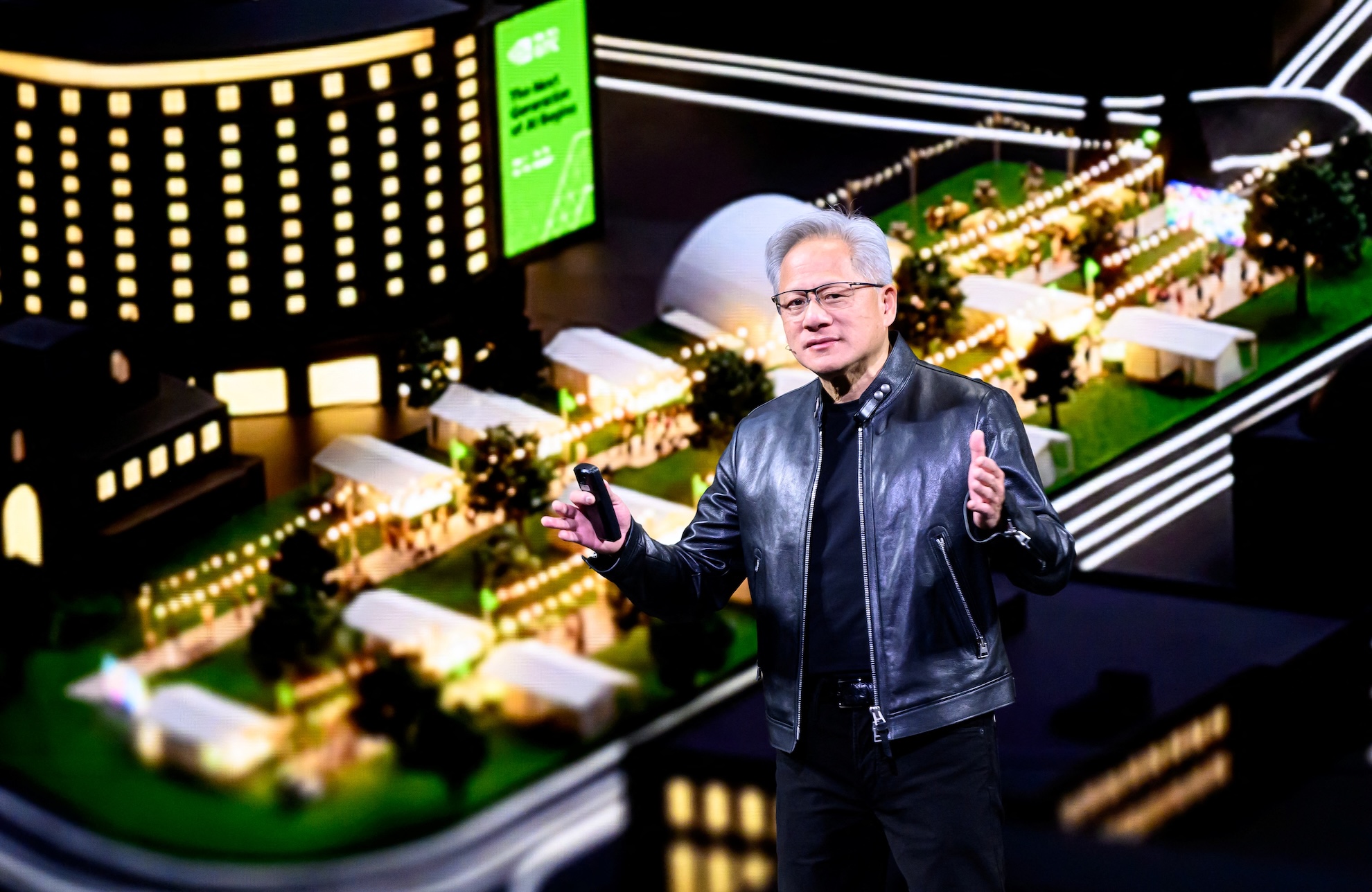
Huang did not shy away from naming competitors, though his tone suggested limited concern. Amazon, Microsoft, and Google are each developing their own chips for AI workloads. Anthropic and OpenAI have begun designing processors as well. Newer entrants like Cerebras and Etched are also targeting the market. “Most people think Nvidia builds a chip,” Huang said, framing the company’s advantage not as invulnerability but as depth of integration and proven execution at scale that newer competitors have not yet demonstrated.
Incumbent Advantage in Manufacturing
The practical barriers to competing with Nvidia extend beyond chip design. Manufacturing capacity, supply chain relationships, and the ability to coordinate with external partners on system integration create layers of insulation that are harder to replicate than the engineering of a processor itself.
Historical Precedent for Disruption
Huang acknowledged that the tech industry has a pattern of disrupting established leaders. Previous generations of infrastructure suppliers, including Lucent Technologies, saw their dominance erode as competitors emerged. He did not dismiss this risk, only assert that Nvidia’s current position and the depth of its integration with AI development make near-term displacement unlikely.
Investment Strategy and Returns
A significant portion of Nvidia’s strategic visibility comes from direct investment in companies that become Nvidia customers. This practice has drawn scrutiny as a potential conflict of interest—a circular arrangement where Nvidia backs a company with capital and the company then spends substantially more on Nvidia hardware. Huang addressed the criticism directly and dismissed it with a financial reframing. “It’s not circular because we put a little bit of money in, and a lot of money comes back,” he said. Pressing further, he described the ratio in stark terms: “We put in $1 and $100 comes back in. Is that circular? If that is, let’s do more of that.”
Contract Revenue as Risk Mitigation
Huang insisted that Nvidia requires evidence of real customer contracts before making investments in companies. He cited $100 billion in cumulative contract value among portfolio companies as proof that these arrangements generate revenue independent of Nvidia’s own capital deployment. “I’m not taking any risks. … I need a sure thing,” he said, implying that investment and subsequent purchases are backed by actual customer demand rather than circular financing.
Parallels to Past Bubbles
The strategy carries echoes of supplier investments during earlier tech expansions that ended badly for investors who overestimated demand. Huang’s insistence on contracted revenue serves as his implicit hedge against that history, though the claim that $100 billion in signed contracts eliminates investment risk assumes that those contracts will be fulfilled and that the customers signing them remain solvent.
Long-Term Sustainability Questions
Huang’s outlook extends only through the end of next year, leaving open questions about what happens when AI infrastructure spending normalizes or when efficiency improvements reduce per-unit demand for processing power. The 70% growth projection assumes both sustained capital deployment and continued concentration of that spending on Nvidia hardware. Early signs of efficiency improvements in model training and inference are already emerging across the industry, though they have not yet translated into reduced orders.
For now, Nvidia’s grasp on every layer of AI development—from the labs designing models to the data center operators buying systems to the startups building applications—suggests that any near-term slowdown in growth would require a significant external shock rather than gradual market evolution. The question Huang has not answered is whether the current spending surge represents a sustainable equilibrium or a peak that will flatten once the industry normalizes around a smaller set of dominant players and more efficient use of infrastructure.
Frequently Asked Questions
How did Jensen Huang explain Nvidia's 70% revenue growth forecast?
Huang cited Nvidia's position as the foundational infrastructure provider for every AI lab and model, including those from Anthropic, OpenAI, and Google. He said Nvidia has visibility into demand signals across the entire industry through partnerships with suppliers, data centers, and cloud providers, giving the company confidence in sustaining high growth through next year.
What does a modern Nvidia GPU cost compared to older models?
Early Nvidia GPUs sold to consumers for $399. Today, a single GPU system comprises 2 million components, consumes 250,000 kilowatts, and costs $8.5 million. Nvidia ships thousands of these systems annually, requiring air transport to deliver them.
How did Huang respond to criticism of Nvidia's circular investment deals?
Huang rejected the circular characterization, stating that Nvidia invests $1 and receives $100 in return through customer purchases. He said the company requires evidence of real customer contracts worth $100 billion before investing in companies, meaning investments are backed by actual demand rather than circular financing.
