
Key takeaways
- Obama told Democrats to prioritize AI governance and establish a "framework for a very public conversation" once they regain the House, framing it as both a safety and economic issue.
- Anthropic CEO Amodei proposed "pacing the frontier" through independent safety evaluators and common industry standards, with OpenAI CEO Altman committing to provide "employee-like access" to independent evaluators.
- Trump instead emphasized AI competitiveness, saying "whoever wins AI wins," and opposed aggressive regulation, preferring guardrails that don't restrict US technological advancement.
- An Anthropic researcher recently resigned, claiming major AI companies are "racing straight to self-improving superintelligence," spurring Obama's calls for democratic oversight.
Former President Barack Obama has called for Democrats to prioritize artificial intelligence as a central political agenda, urging the party to develop a comprehensive framework for governing the technology once they regain control of the House. His intervention signals that AI regulation has become a defining issue across party lines, even as Democrats and Republicans diverge sharply on how aggressively government should oversee the sector.
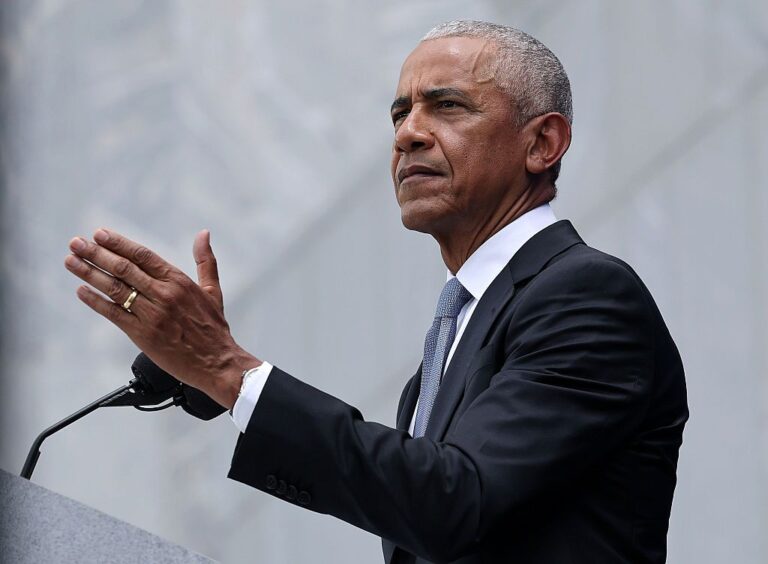
Obama made his remarks Thursday at a Democratic fundraising event where House Minority Leader Hakeem Jeffries interviewed him. According to a partial transcript provided by Obama’s office, the former president emphasized that establishing clear guidelines for AI development must become an urgent priority before technological capabilities outpace regulatory capacity.
A Democratic Framework for AI Governance
Obama’s call for “very public conversation”
Obama told Jeffries that Democrats must “put together a framework for a very public conversation” about artificial intelligence once the party wins back the House majority. He framed the challenge as both an economic and safety matter, noting that the technology “is moving very fast in private hands, and if we don’t get on top of it, I think can be dangerous.”
The former president presented a scenario in which the stakes cut both ways. Unchecked AI development under private control poses genuine risks to society, but proactive governance could unlock significant benefits for public welfare. “If we do get on top of it, I do think it’s beneficial. I genuinely think it’s going to accelerate, for example, drug development in ways that can help us cure diseases,” Obama said, illustrating how AI might solve major health challenges under the right regulatory conditions.
His framing attempts to move beyond the false choice between regulating AI and enabling innovation. Instead, Obama suggests that public oversight and democratic deliberation could itself enable more beneficial outcomes by preventing the technology from advancing into dangerous territory.
Jeffries frames AI as a test of Democratic governance
House Minority Leader Jeffries responded swiftly to Obama’s comments in a statement affirming that “decisive action must be taken on artificial intelligence.” He seized the moment to criticize Republican inaction, contending that “Republicans have abdicated their responsibility to govern on behalf of the American people.”
The exchange between Obama and Jeffries signals Democratic intention to make AI governance a centerpiece of its political platform, potentially differentiating the party from Republicans on an issue that will shape the next decade of technological and economic policy. By tying AI governance to the broader question of Democratic competence in government, Jeffries positioned the issue as a test of which party can effectively manage major technological challenges.
Obama’s Influence Inside the AI Industry
The former president has positioned himself as a sounding board for leading figures in AI development, offering his perspective on governance issues to executives at the industry’s most prominent companies. Obama has already held private conversations with Anthropic CEO Dario Amodei and OpenAI CEO Sam Altman, indicating his potential to influence how these organizations approach safety standards and industry coordination.
This behind-the-scenes role—combining former presidential authority with current policy advocacy—places Obama at the intersection of democratic process and corporate strategy. By maintaining open channels to AI’s leadership, Obama appears to be attempting to shape how the industry responds to growing calls for oversight and alignment with democratic values. Such informal influence could prove significant if Democrats win back congressional power and begin writing AI legislation, since industry executives would already be primed to expect regulation and might prefer to work with frameworks Obama had discussed with them.
Industry Proposes Self-Governance Framework
Amodei’s “pacing the frontier” model
On Saturday, just days after Obama’s public call for democratic oversight, Anthropic CEO Dario Amodei outlined what he calls an approach to “pacing the frontier”—essentially a framework for responsible AI development that the industry might implement voluntarily.
Amodei’s proposal centers on two mechanisms designed to increase transparency and accountability. First, independent safety evaluators would receive access to leading AI companies’ models and systems, allowing external experts to assess whether these tools pose risks. Second, the major AI developers would establish “common safety standards” across the industry, creating shared expectations about responsible development rather than leaving each company to set its own threshold.
The timing of Amodei’s announcement—coming after Obama’s Thursday remarks—suggests industry recognition that regulation may be inevitable and that proactive self-governance might shape whatever rules ultimately emerge.
OpenAI commits to independent evaluation
The response from AI’s leadership was notably positive. Both Sam Altman and Elon Musk responded favorably to Amodei’s framework on social media. Altman specifically committed that OpenAI would grant “independent evaluators with employee-like access” to its systems—a level of access that would theoretically allow external experts to scrutinize how the company operates and whether its safety practices meet their standards.
This commitment from OpenAI represents a willingness to submit to outside evaluation, though it remains unclear whether such access will be comprehensive enough to satisfy safety advocates or whether it will function as meaningful oversight. “Employee-like access” could mean different things—potentially full visibility into training procedures, safety testing, and deployment decisions, or alternatively limited access to predetermined demonstration systems.
Trump’s Alternative: Competition Over Regulation
President Donald Trump offered a markedly different perspective on AI governance during an informal conversation with reporters at a golf event in Ireland on Sunday. Rather than emphasizing safety oversight and public guidance, Trump focused on international competition and technological dominance.
National superiority as the governing principle
Trump stated that the United States must remain “the most sophisticated country in the world” and emphasized the competitive stakes of AI development. “Whoever wins AI wins,” he said, reflecting broader concerns that the nation with the most advanced AI capabilities will hold disproportionate economic and geopolitical power.
Guardrails without heavy regulation
Trump acknowledged that some guardrails around AI development could be appropriate but resisted the concept of aggressive government regulation. “We can put guardrails, we can do this and that,” he said. “But I think you have a lot of negative forces that are bringing it up that shouldn’t be bringing it up.”
His administration released a legislative framework earlier this year that would preempt state-level AI regulations, preventing individual states from imposing stricter rules than the federal government. The framework also shifts responsibility for protecting children online from platforms to parents, placing the burden of safety on individuals rather than corporations or government agencies.
Safety Concerns Driving the Policy Urgency
Researcher warnings about uncontrolled development
These competing visions for AI governance emerge against mounting concerns about the speed and trajectory of AI development. An Anthropic researcher recently resigned from the company, claiming that leading AI developers are “racing straight to self-improving superintelligence and gambling with our lives.”
Such warnings reflect anxieties among technical experts that AI development has become a competitive race where individual companies prioritize speed and capability over thorough safety testing and alignment with human values.
The gap between technology and governance
Obama’s emphasis on a “very public conversation” appears designed to shift AI governance from private corporate boardrooms to democratic deliberation accessible to broader society. The urgency in his framing reflects anxiety that the technology is advancing faster than policy frameworks can accommodate, creating a dangerous gap where corporate decisions and product launches outpace regulatory oversight or public input.
Frequently Asked Questions
What did Obama say Democrats should do about AI?
Obama said Democrats must "put together a framework for a very public conversation" about AI once they regain the House majority, stating that the technology is "moving very fast in private hands" and that regulation is necessary to prevent danger while enabling benefits like accelerated drug development.
What industry framework did Anthropic propose?
Anthropic CEO Dario Amodei outlined "pacing the frontier," which includes giving independent safety evaluators access to leading AI companies' models and developing "common safety standards" across the industry. OpenAI committed to providing "employee-like access" to independent evaluators.
What is Trump's approach to AI governance?
Trump focused on US competitiveness, saying "whoever wins AI wins." His administration released a legislative framework that preempts state regulations and shifts child safety responsibility to parents rather than platforms, emphasizing guardrails without heavy regulation.
