
Key takeaways
- Aurora Innovation and Kodiak AI received permits to test autonomous trucks on California roads following the DMV's April 28 approval of updated regulations.
- Both companies had previously conducted testing in Texas; Aurora launched commercial operations there in May 2025 on the Dallas-Houston route and has since expanded to four additional corridors.
- Teamsters California filed suit against the DMV, arguing the agency failed to study economic impacts on truck drivers and did not adequately evaluate safety risks before approving the permits.
- The permits require human safety operators in every vehicle and prohibit operation on roads with speed limits below 25 miles per hour except on direct routes between destinations.
California Lifts Ban on Heavy-Duty Autonomous Trucks
On April 28, the California Department of Motor Vehicles approved updated regulations that fundamentally changed the state’s stance on autonomous heavy-duty vehicles. For the first time, driverless trucks weighing more than 10,000 pounds can legally test on California’s public roads—a watershed moment for an industry that has operated largely in Texas while waiting for their home state to catch up.
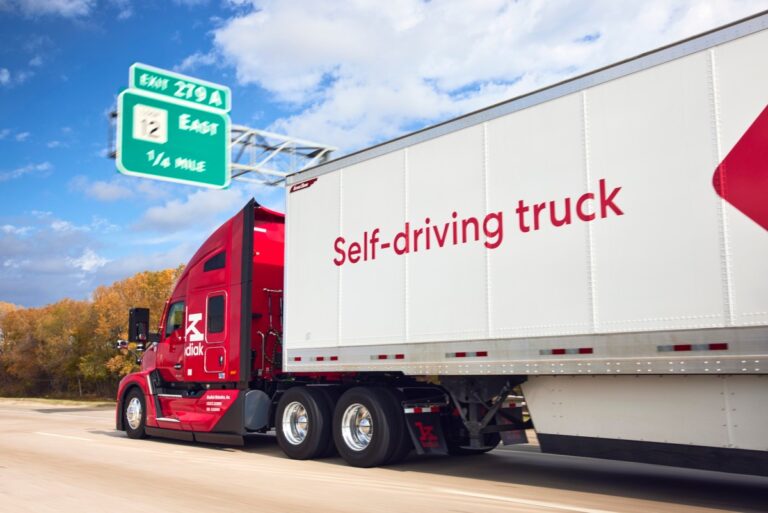
Two companies have already seized the opportunity. Aurora Innovation and Kodiak AI, both headquartered in California, received testing permits from the DMV. Kodiak has already deployed a handful of test trucks, concentrating its initial operations around its Mountain View office.
What the rules allow
The updated framework establishes the permitting criteria that companies must meet to gain approval. Aurora and Kodiak satisfied all requirements, including:
- Demonstrated safety protocols
- Proof of insurance
- Vehicle registration
- Evidence of qualified safety drivers
- Additional compliance measures
A critical restriction remains in place: every vehicle must have a human safety operator seated at the wheel. The rules also prohibit operation on roads where the posted speed limit is 25 miles per hour or lower, except when traveling directly between two destinations.
This regulatory compromise balances innovation against safety concerns from labor and community stakeholders.
Aurora’s Texas Head Start
Aurora Innovation had already established significant commercial operations before the California permit arrived. The company launched its autonomous truck service in Texas in May 2025, beginning with runs between Dallas and Houston. Since that initial route, Aurora has expanded its network to cover additional corridors:
- Fort Worth to El Paso
- El Paso to Phoenix
- Fort Worth to Phoenix
- Laredo to Dallas
By focusing on Texas while California maintained its ban, Aurora positioned itself to be among the first companies with real-world heavy-duty autonomous driving data. Now, with California’s regulatory shift, the company can bring that operational experience back to its home state and test on its own roads.
Why Texas became the testing ground
Both Aurora and Kodiak are California-based, yet neither could test their truck technology in the state until this spring. Texas offered a regulatory environment where innovation could proceed. Aurora’s deployment there was not merely an experiment—it became a functioning service hauling freight on public highways, producing genuine operational metrics that inform next steps.
Kodiak’s Permian Basin Launch and Expansion
Kodiak AI took a different path into autonomous truck operations. The company began commercial driverless operations in January 2025, but started in an off-road environment: the Permian Basin in remote West Texas. That setup allowed Kodiak to operate without highway speed limits and the full suite of traffic interaction challenges.
Since that beginning, Kodiak has moved toward on-highway operations. The company now runs a route between Dallas and Houston—the same corridor where Aurora operates—indicating that both companies are converging on high-traffic, economically significant lanes.
From controlled to highway environments
The transition from off-road to on-highway testing represents a major step in validating autonomous truck technology. Off-road operations in sparsely populated areas allowed Kodiak to perfect systems without constant interaction with other vehicles, vulnerable road users, and the full complexity of highway traffic. Moving to the Dallas-Houston corridor requires the trucks to handle merge operations, interact with human drivers, and perform in real conditions where failures carry genuine consequences.
Legal Challenge and Labor Opposition
The regulatory approval has not gone unchallenged. Last week, Teamsters California—the labor union representing truck drivers—filed suit against the state’s DMV. The lawsuit, lodged in Superior Court in Alameda County, makes two central arguments: first, that the DMV circumvented legal requirements to study and publicly disclose the economic impacts of autonomous trucks on the state’s workforce; and second, that the agency failed to adequately evaluate safety risks to other motorists.
The lawsuit reflects legitimate concerns about displacement. If autonomous trucks prove viable at scale, the impact on professional drivers would be substantial. The legal strategy centers on procedural grounds—claiming the regulator did not follow required processes—rather than claiming the technology is unsafe outright.
Regulatory procedure versus innovation
The Teamsters’ argument highlights a recurring tension in autonomous vehicle regulation: the speed at which agencies update rules versus the thoroughness of impact assessments. The DMV may have satisfied the technical criteria for safety and vehicle performance, but the suit raises whether it satisfied the requirement to study economic and social consequences before opening California’s roads to driverless trucks.
What Gets Tested, and Why It Matters
Both companies will be operating on some of California’s most important freight corridors. The state’s trucking industry moves goods across the nation’s most populous region and connects to cross-border trade. If autonomous trucks function reliably at scale here, the implications extend far beyond California. Federal regulators watching these tests will factor the data into national policy decisions.
The testing phase is not a final deployment. Human safety operators will monitor every run. Speed restrictions apply. The permits do not grant unlimited operational freedom. However, they represent a shift from “this technology cannot operate in California” to “this technology can operate under these conditions.” That shift opens the door to gathering the long-term performance data that regulators will eventually use to decide whether and how to allow full deployment.
The path from testing to deployment
Neither company has announced when it expects to move from supervised testing to unsupervised autonomous operation. The permits are the first step. Each additional expansion of operational parameters—removing the safety driver, operating on lower-speed roads, expanding routes—will likely require additional regulatory approval. The process will generate more data, more real-world evidence, and likely more resistance from unions and safety advocates.
For now, Aurora and Kodiak have won the right to test on California’s highways under structured conditions. What happens next depends on how those tests perform and what economic and political pressure emerges as the companies demonstrate progress.
Frequently Asked Questions
When did California lift its ban on driverless trucks?
On April 28, when the California DMV approved updated regulations allowing driverless vehicles weighing over 10,000 pounds to test on public roads.
Which companies received testing permits from California's DMV?
Aurora Innovation and Kodiak AI, both California-based autonomous truck developers. Kodiak has already started deploying test trucks around its Mountain View office.
Why did Aurora and Kodiak focus testing in Texas before California approved autonomous trucks?
California maintained a ban on driverless trucks weighing over 10,000 pounds until April 28, forcing both companies to conduct their commercial operations in Texas where regulations permitted autonomous heavy-duty trucking.
