
Key takeaways
- Uber and Pony.ai plan to deploy 2,000 robotaxis across four European cities under an expanded partnership where Pony.ai supplies autonomous technology and Uber provides the ride-hailing platform.
- Pony.ai, a Guangzhou-based autonomous vehicle maker that launched in four Chinese cities, is executing a rapid international expansion through partnerships in the Middle East and Europe.
- Uber has partnered with more than 30 autonomous vehicle companies, using a multi-provider strategy that avoids dependence on any single technology provider and allows regional customization.
- The companies will reveal city names and launch timelines in phases, suggesting ongoing regulatory approval processes and negotiations with local partners in each market.
Uber and Chinese autonomous vehicle maker Pony.ai are bringing 2,000 robotaxis to four cities across Europe, marking a major expansion of their partnership and signaling accelerating commercial ambitions in the rapidly developing robotaxi market. The companies announced the deployment as part of a broader agreement that establishes clearer pathways for scaling autonomous ride-hailing services across multiple regions and market conditions.
The announcement underscores how the autonomous vehicle space is consolidating around platform operators like Uber and specialized technology providers like Pony.ai. Rather than individual companies building complete end-to-end solutions, the industry is increasingly organized around partnerships where different players contribute distinct capabilities to reach commercial scale faster.
How the Partnership Model Works
The expanded Uber-Pony.ai agreement establishes a clear division of labor designed to accelerate deployment while allowing regional flexibility. Pony.ai, based in Guangzhou, China, will supply the core autonomous vehicle technology powering the robotaxis. Uber contributes its established ride-hailing platform, bringing rider-facing interfaces, pricing systems, customer support, and demand aggregation—infrastructure the company has refined over more than a decade of traditional ride-sharing operations.
Modular Fleet Management
Neither company needs to operate the physical fleet itself. Fleet management responsibilities—including vehicle maintenance, cleaning, and charging infrastructure—can be delegated to local providers who understand regional infrastructure and labor markets. This modular approach lets each market find the most cost-effective and operationally sound fleet partner rather than forcing a one-size-fits-all global operations model.
Flexible Ownership Structures
The robotaxi fleet may be owned by different entities depending on the specific market. Uber might own vehicles in one city while a local transportation authority or private company owns them in another. This flexibility addresses regulatory variation across Europe, where some jurisdictions may prefer public ownership of transportation assets or have tax and licensing structures that favor local ownership.
Phased Commercial Deployment
Uber and Pony.ai have not yet disclosed the four European cities where the robotaxis will operate, or provided a timeline for deployment. Instead, the companies stated that details would be revealed in phases. This staged announcement approach—disclosing the scale (2,000 vehicles across four cities) before revealing locations or launch dates—suggests the companies are still finalizing regulatory approvals and local partnerships city by city.
Pony.ai’s Path From China to Global Markets
Pony.ai’s European plans represent a rapid internationalization of a company that only recently achieved substantial autonomous vehicle deployment in its home market. The Guangzhou-based company has launched robotaxi services in four Chinese cities, building operational expertise and regulatory relationships in what remains one of the most advanced autonomous vehicle markets globally.
Middle East as Strategic Stepping Stone
Pony.ai and Uber first partnered in May 2025 with a focus on Middle Eastern deployment. That initial partnership established the basic framework of the relationship before expanding to Europe. The Middle East move, which includes targeting Qatar, suggests Pony.ai and Uber identified favorable regulatory conditions and strong demand for autonomous mobility services in that region, using it as a testing ground for international operations before scaling to Europe’s more fragmented regulatory landscape.
Croatia as Entry Point
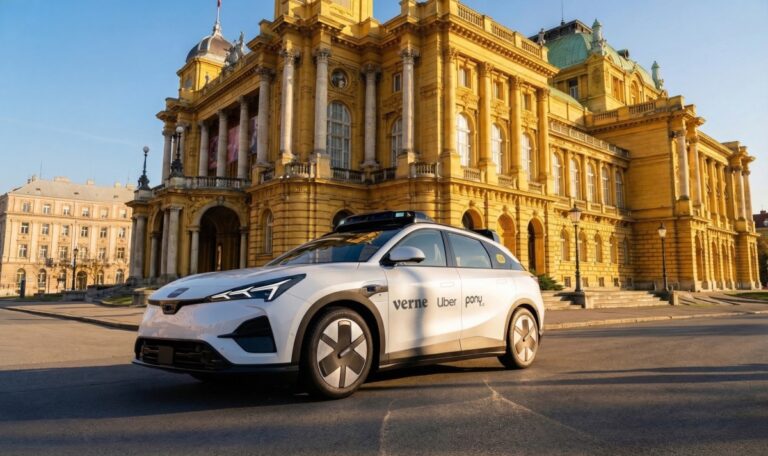
Earlier in 2026, Uber and Pony.ai announced a planned commercial robotaxi service in Zagreb, Croatia, in partnership with local company Verne. Zagreb represents the first explicitly named European deployment and may serve as a model for rolling out to the other three undisclosed cities. The partnership with Verne indicates Pony.ai’s willingness to collaborate with established European mobility companies rather than attempting to operate independently in unfamiliar markets.

Uber’s Multi-Partner Robotaxi Strategy
This Pony.ai expansion is part of a broader Uber strategy of partnering with multiple autonomous vehicle providers. Uber has established partnerships with more than 30 autonomous vehicle companies over the past several years, creating optionality rather than betting on a single technology provider.
This approach allows Uber to offer ride-hailing services with different autonomous vehicle technologies depending on regional technology maturity, regulatory approval timelines, and cost structures. Where one AV company faces delays, another might be ready for deployment. Where one technology suits highway driving but another excels in urban environments, Uber can deploy the appropriate provider for each use case.
Pony.ai becomes one of Uber’s most significant partners by vehicle count under this new agreement. The 2,000-vehicle commitment across four European cities dwarfs most other autonomous vehicle deployments announced to date and signals that Pony.ai’s technology has cleared Uber’s performance and reliability thresholds for major investment.
Market Timing and Competitive Position
The announcement comes as autonomous robotaxi services are transitioning from limited pilot operations to commercial deployments in multiple geographies. Waymo, Cruise, and other autonomous vehicle companies have faced regulatory scrutiny and operational challenges, but successful operations in San Francisco and other U.S. cities have demonstrated technical feasibility.
Europe presents distinct opportunities and challenges. Regulatory frameworks differ sharply across individual countries, labor laws may constrain fleet operations, and infrastructure for autonomous vehicles (particularly regarding charging and fleet maintenance depots) remains underdeveloped in most cities. The phased deployment approach Uber and Pony.ai are taking suggests they’re proceeding methodically rather than rushing toward aggressive timelines.
What the Deployment Model Reveals
The expanded partnership structure reveals how autonomous mobility services are likely to be built globally. Complete vertical integration—one company building technology, owning vehicles, and operating services—has proven capital-intensive and operationally complex. The Uber-Pony.ai model distributes risk and capital requirements across multiple players, each contributing what they do best.
Pony.ai supplies autonomous driving software and vehicle integration. Uber supplies demand aggregation, pricing algorithms, and customer interface. Verne and other local partners supply operational expertise and regional knowledge. This distribution of responsibility potentially accelerates the timeline to commercial operation compared to any single company building everything internally.
The 2,000-vehicle commitment represents meaningful scale in the context of global autonomous vehicle deployments as of mid-2026. It signals that Pony.ai has achieved sufficient technical maturity and that Uber’s confidence in the partnership extends beyond pilot testing to real commercial deployment. The focus on Europe, where regulations remain fragmented and infrastructure requires investment, suggests both companies view the market as having reached maturity sufficient to justify substantial capital deployment despite regulatory complexity.
Frequently Asked Questions
How many robotaxis will Uber and Pony.ai deploy in Europe and across how many cities?
The companies plan to deploy 2,000 robotaxis across four European cities. Specific city names and deployment timelines have not yet been disclosed and will be revealed in phases.
What role does each company play in the partnership?
Pony.ai, based in Guangzhou, China, supplies the autonomous vehicle technology. Uber provides its ride-hailing platform including pricing, customer interfaces, and demand aggregation. Fleet management and ownership can vary by market and may involve local partners.
Where has Pony.ai previously deployed robotaxis?
Pony.ai has launched robotaxi services in four Chinese cities. The company first partnered with Uber in May 2025 with a focus on the Middle East, including Qatar. In 2026, Uber and Pony.ai announced plans for Zagreb, Croatia, in partnership with local company Verne.
