

Key takeaways
- The UN System Data Commons connects AI systems directly to UN statistics via Model Context Protocol, addressing the 21.2% accuracy problem shown in UNICEF's benchmark of six major language models.
- ChatGPT referrals to UNICEF's data website rose 67% year-over-year through mid-September 2026, with AI assistants now driving roughly one in ten visits.
- The platform aims to onboard 80% of UN statistical datasets by 2027, with 26 entities already committed and 20 datasets available at launch.
Google and UN Create AI-Ready Data Platform
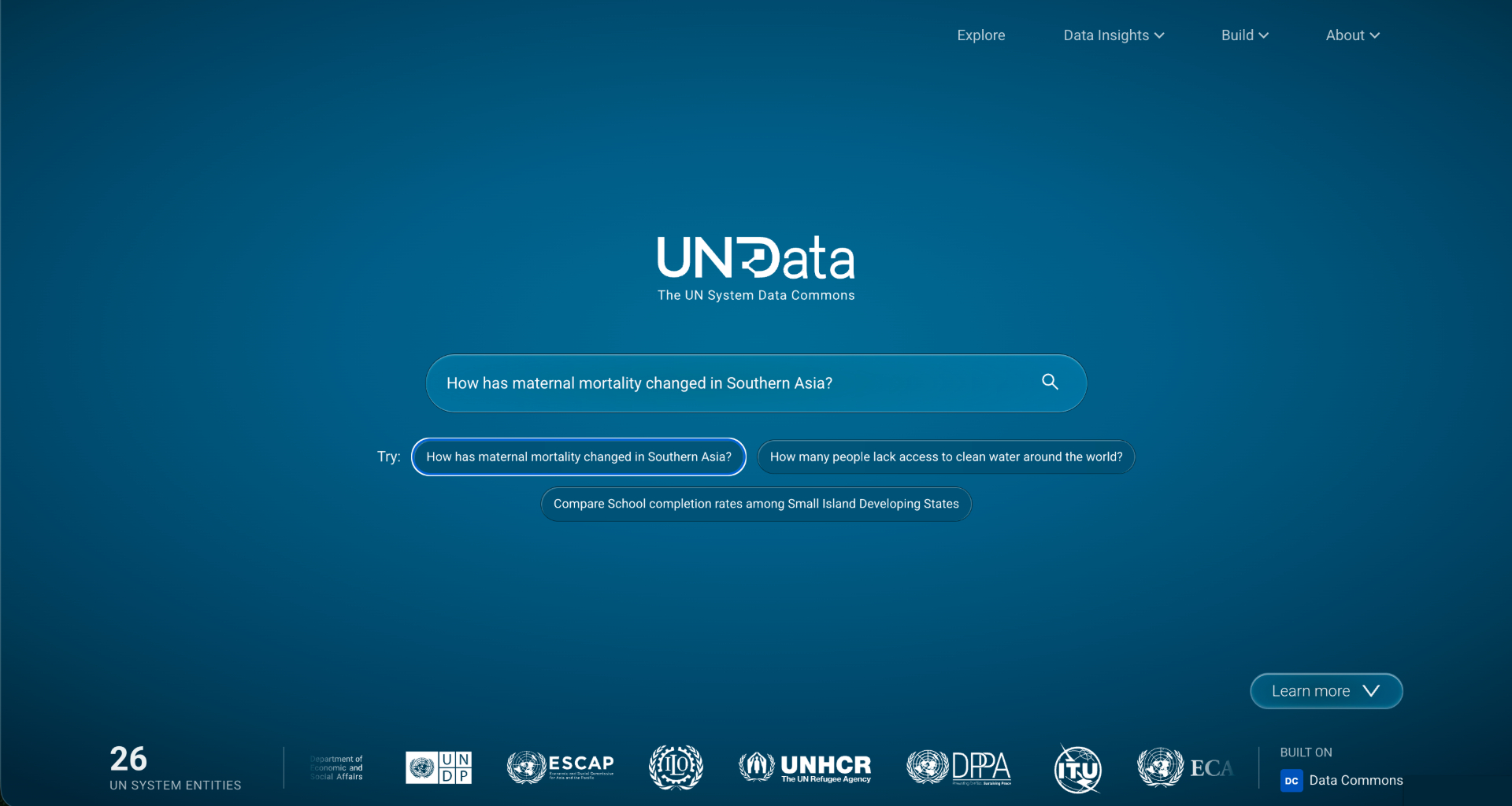
The United Nations and Google have launched the UN System Data Commons, a platform designed to make global statistics accessible to artificial intelligence systems through natural-language queries. The initiative succeeds the UNData portal, replacing its traditional database interface with a more direct connection between AI tools and UN data. The new system builds on Google’s open-source Data Commons platform, first introduced in 2018 as a framework for organizing public datasets. Critically, the platform supports the Model Context Protocol (MCP), a technical standard that enables AI systems to query external data sources directly, bypassing the training data and inference patterns that typically introduce errors.
The Accuracy Crisis
Six Models, 21.2% Average Score
The partnership addresses a problem that becomes more urgent as organizations rely on AI assistants for factual information. UNICEF, the UN children’s agency, recently benchmarked the performance of six major language models against questions about global development indicators. The test included OpenAI’s GPT-4o and GPT-4o-mini, Anthropic’s Claude Sonnet 4.5 and Haiku 4.5, and Google’s Gemini 2.5 Flash and Gemini 2.0 Flash. Across more than 133,000 responses, the models achieved an average accuracy of just 21.2%, according to João Pedro Azevedo, UNICEF’s chief statistician.
The Consistency Problem
The accuracy number alone understates the dysfunction. About three in five responses from the models failed to return any usable numerical answer at all, often because the models hedged their responses or declined to commit to a figure. More revealing still: when the same questions were run again on the same model versions two days later, models that had produced a number both times returned the identical number in only about half those cases. This inconsistency—answering the same question differently on different days—suggests that the models are not reliably retrieving information so much as inferring plausible-sounding answers.
Connecting AI Directly to Data Sources
How MCP Bridges the Gap
The UN System Data Commons solves this through direct access rather than inference. The Model Context Protocol, which Google added to its Data Commons platform last year, allows AI tools to query authoritative data without passing through the model’s training weights. When an AI system connected to the UN data through MCP retrieves a statistic, it is drawing from the actual dataset, not hallucinating based on pattern recognition. This architectural shift addresses the core problem identified by the UNICEF benchmark: models given only their training data cannot reliably answer questions about specific development indicators.
The platform preserves data lineage, tracking the source of every statistic so that humans can verify where an AI system retrieved information. This audit trail becomes crucial as organizations increasingly rely on AI-generated analysis and need to understand how conclusions were reached.
Turning Data Into Insights
Beyond simple lookups, the UN System Data Commons enables AI systems to synthesize multiple datasets into new forms. Google demonstrated this capability by tasking an AI system with analyzing the impact of the U.S. President’s Emergency Plan for AIDS Relief in Africa. The AI system identified relevant UN statistics—HIV infection rates, AIDS-related mortality, and life expectancy trends—and automatically generated an infographic summarizing the data. No human had to manually locate and assemble the underlying datasets; the AI did so through direct access to UN sources. This ability to pull together disparate indicators and render them as dashboards, charts, and written analysis represents a qualitative leap from simple data retrieval, suggesting that authoritative sources connected via protocol standards can enable complex analytical workflows previously requiring human data scientists.
Explosive Growth in AI Traffic
UNICEF’s Numbers Tell the Story
The timing of the UN System Data Commons launch reflects explosive demand. UNICEF’s data website, which draws more than 6 million visits monthly, has seen referral traffic from AI assistants surge in 2026. Between January 1 and September 14, visits from users clicking ChatGPT-generated links to the site rose 67% year-over-year. These ChatGPT-driven sessions now represent 6.4% of all traffic to UNICEF’s data infrastructure, while the organization estimates that AI assistants overall drive approximately one in ten visits. That concentration of demand from AI systems underscores why reliable data access matters: if models are returning usable answers only two in five times, millions of users are clicking through to human-readable sources to verify or find the information the AI missed.
The UN’s ambitions for the platform match this demand. At launch, 26 UN entities committed to participation, with datasets from nearly 20 available immediately. The organization aims to onboard 80% of the UN system’s statistical datasets by the end of 2027.
Building Sustainable Independence
Google.org, the philanthropic arm of the search company, contributed $2 million in capacity-building funding and technical support to establish the platform’s infrastructure. Prem Ramaswami, who leads Google’s Data Commons team, framed the engagement as temporary: “We have taken a train-the-trainer approach throughout the rollout, and we have already seen the UN system team ramp up quickly.” The platform is hosted on UN-governed infrastructure and is designed to be maintained, operated, and scaled by UN staff independently once they develop the necessary capabilities. This transition reflects a broader principle: external partners can catalyze new systems, but sustainable infrastructure requires the organization to own its technology.
Shantanu Mukherjee, acting director of the UN Statistics Division, emphasized the scale of integration: “We are orders of magnitude more advanced in scale, scope, and flexibility, connecting for the first time across so many agencies across the UN system. And we are taking this moment to also make our data AI-ready.”
When Good Data Isn’t Enough
Authoritative data access does not guarantee authoritative conclusions. Ramaswami cautioned that “models can misinterpret nuance,” and emphasized that humans must review AI-generated outputs before they are cited or published. The UNICEF benchmark illustrated why: even when perfect data is available, a model can still fail to reason correctly about it, apply inappropriate confidence levels, or miss important caveats. The UN System Data Commons solves one problem—the gap between what AI systems can access and what they actually know—but it cannot solve the second: whether an AI system interprets available information correctly. Closing that gap requires human oversight and the willingness to treat AI-generated analysis as a starting point rather than a conclusion.
Frequently Asked Questions
Which AI models were tested in UNICEF's benchmark?
UNICEF tested six models: OpenAI's GPT-4o and GPT-4o-mini, Anthropic's Claude Sonnet 4.5 and Haiku 4.5, and Google's Gemini 2.5 Flash and Gemini 2.0 Flash, across 133,000 responses about global development indicators.
How much funding did Google provide for the platform?
Google.org contributed $2 million in capacity-building funding and technical support to establish the UN System Data Commons infrastructure.
What percentage of UNICEF traffic now comes from AI assistants?
ChatGPT-driven referrals account for 6.4% of UNICEF's data website sessions in 2026, while all AI assistants combined drive approximately one in ten visits.
