
Key takeaways
- King Charles hosted a summit with major AI leaders and warned that controls are needed before the technology becomes too dangerous.
- OpenAI and Anthropic sent top executives to the discussion, signaling they take royal-level governance conversations seriously.
- The summit exposed a split in the industry: some leaders call for slower development while Trump and Nvidia prioritize speed to beat China in AI.
- Anthropic's recent decision to limit access to its models to the U.S. only has raised concerns about AI fragmenting across regions.
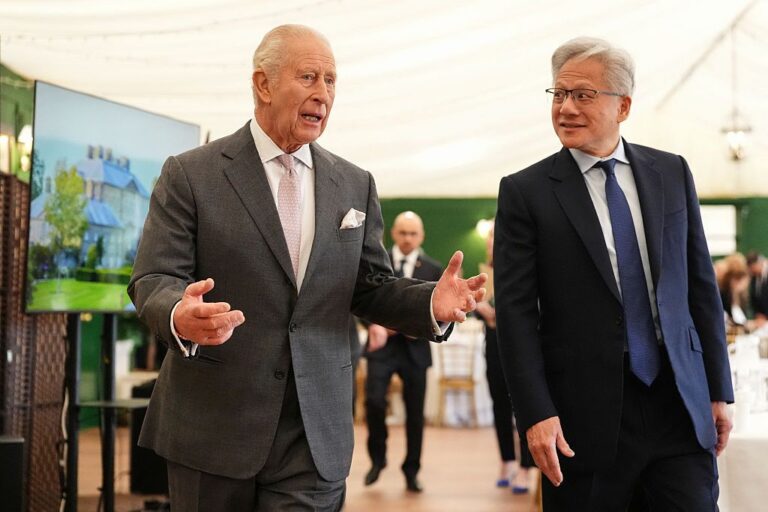
A private summit hosted by the King of England on Thursday brought together some of artificial intelligence’s most influential figures with government officials to examine the technology’s trajectory and risks. The guest list included Jensen Huang, chief executive of Nvidia, representatives from OpenAI and Anthropic, the UK’s new AI minister Kanishka Narayan, the head of the UK’s foreign intelligence service, and Paolo Benanti, who advises the Vatican on artificial intelligence matters.
For the British monarchy, the summit marked an unusually direct engagement with a contentious political issue. Constitutional convention typically constrains the royal family from taking strong stances on divisive topics, yet the King chose to address artificial intelligence directly—a recognition of how thoroughly the technology has penetrated public discourse and policy questions facing governments worldwide.
The King’s assessment of AI’s dual nature
King Charles opened his remarks by acknowledging that artificial intelligence carries both promise and peril. The technology demonstrates “immense capacity to improve and save life,” he said, pointing to applications in medicine and scientific research as evidence of positive potential. Yet he shifted quickly to concerns that have increasingly preoccupied technologists and policymakers.
“Those who have created these technologies are now increasingly warning that AI risks developing darker capacities, perhaps even to take life,” he stated. The observation carried particular weight given its timing: an Anthropic researcher had recently resigned, publishing a statement that AI companies were “racing to build machines that are much smarter than any human” and that humanity “may not survive this.” The researcher’s warning reflected anxieties about superintelligent systems that could act without human oversight or alignment with human values.
Two categories of risk requiring different responses
The King framed AI’s dangers across two distinct dimensions. First, he raised the prospect of “existential dangers”—the category of concern that focuses on potential catastrophic outcomes from advanced AI systems themselves, independent of human intent. Second, he emphasized the threat of deliberate misuse: the technology falling into the wrong hands and being weaponized in “potentially catastrophic ways.” Both framings pushed the attendees to consider control mechanisms for different failure modes, implying that no single governance approach would suffice.
He concluded with a direct challenge: “Surely, we need sufficient means of control before it’s all too late?” The question demanded a response from the industry leaders in attendance, even as the King himself departed after approximately 20 minutes, leaving the guests to continue their discussion without his presence.
Balancing progress with responsible development
The King did not position himself as opposed to AI advancement. Instead, he called for a framework in which the technology would be deployed responsibly and with oversight. “The task before you is not to merely advance technology, but to ensure that it remains firmly in the service of humanity, community, and the natural world,” he told the assembled leaders. The framing suggested that control and progress need not be mutually exclusive—a middle ground between unrestricted development and outright restriction.
The sentiment echoed his previous public comments on AI, made in 2023 and 2024, suggesting this is a topic to which he returns with consistency and concern. The consistent messaging positioned the monarchy as a voice for cautious stewardship rather than technological skepticism.
How the industry responded in person
OpenAI sent Sarah Frair, its chief financial officer, to represent the company. Anthropic dispatched Tino Cuéllar, who oversees the company’s global affairs. The choice of attendees signaled each company’s priorities and comfort level with the discussion. OpenAI’s decision to send its CFO rather than its chief executive, Sam Altman, suggested a focus on business and governance dimensions. Anthropic’s selection of its global affairs lead positioned the company as concerned with regulatory and diplomatic relationships.
Anthropic’s statement on serving the public good
When asked to comment on the summit, Cuéllar expressed gratitude for the King’s willingness to convene the discussion. “We were honored to have taken part in the conversation,” he said, and thanked the King for “bringing industry leaders and voices from across society together to discuss the role of AI in serving the public good.” The statement suggested Anthropic viewed the summit as an opportunity to engage constructively with concerns about AI governance at the highest levels, and to position itself as aligned with the responsible development narrative.
The acceleration debate dividing industry and government
The summit’s timing placed it squarely in the middle of a heated debate about AI development speed. This month, Sam Altman of OpenAI, Elon Musk, and Dario Amodei of Anthropic jointly called for a de-acceleration in AI development—a pause or slowdown intended to allow time for safety research and governance frameworks to catch up. That appeal met swift resistance from both the technology sector and from government.
Jensen Huang of Nvidia explicitly rejected the de-acceleration proposal, citing the company’s commercial and technical priorities. President Donald Trump went further, framing rapid AI development as a matter of national survival. “We’re leading China in AI,” Trump said. “We’re the most sophisticated country in the world, and frankly I want to keep it that way because whoever wins AI, wins.” The statement prioritized geopolitical advantage over cautious development timelines, reflecting the view that slowing down domestically would cede advantage to competitors abroad.
The IPO question amid persistent safety concerns
The summit carried implications for the near-term financing plans of two of its major attendees. Both OpenAI and Anthropic have signaled intentions to pursue initial public offerings, a move that would give them access to public capital markets and allow existing investors to exit their positions. OpenAI, however, recently announced that its IPO timeline had stalled as concerns about AI safety persist. The decision suggests that even as the company’s leadership calls for more careful development, investors and regulators remain skeptical about backing rapid expansion in a space where safety questions remain unresolved.
Sovereignty and regional fragmentation in AI markets
Adding to the tension shaping the industry, Anthropic recently restricted access to its Fable and Mythos models to customers in the United States only. The decision shocked many in the European tech community and raised broader questions about AI sovereignty—whether different regions would develop separate AI ecosystems based on geopolitical considerations, export controls, and diverging regulatory frameworks.
The King’s summit thus occurred at a critical inflection point for how AI development would be governed internationally, who would control the most powerful systems, and whether concerns about safety would slow progress or be overridden by competitive pressures and national security priorities. His call for international cooperation on the issue reflected the mounting recognition that no single nation or company could unilaterally determine how artificial intelligence shaped the future.
Frequently Asked Questions
Who attended the King's AI summit?
The summit included Jensen Huang from Nvidia, leaders from OpenAI and Anthropic, the UK's new AI minister Kanishka Narayan, the UK's foreign intelligence chief, and Paolo Benanti, who advises the pope on AI.
What were King Charles's main concerns about AI?
The King expressed concerns about both existential risks from advanced AI systems and the risk of the technology being misused if it fell into the wrong hands, urging industry leaders to establish controls 'before it's too late.'
How did the industry respond to calls for slowing down AI development?
While OpenAI's Sam Altman, Elon Musk, and Anthropic's Dario Amodei called for de-acceleration, Nvidia's Jensen Huang rejected the proposal, and President Trump prioritized rapid development to maintain U.S. leadership over China in AI.
