
Key takeaways
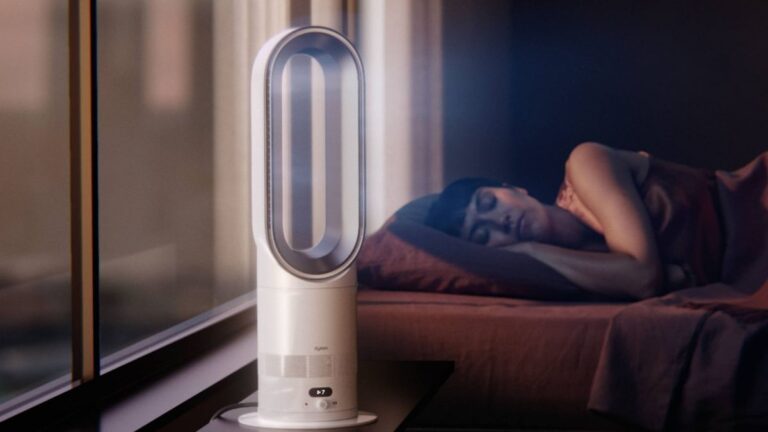
- The Dyson AM09 Hot + Cool uses proprietary “airmultiplier technology” to project air in a concentrated flow or diffuse it across an entire room, eliminating the need for separate heating and cooling appliances.
- Dyson’s ability to command premium pricing for consolidated appliances faces headwinds from deteriorating financial performance.
- Despite near-term financial headwinds, Dyson has doubled down on research and development as a path toward margin recovery and portfolio diversification.
- Dyson has systematically expanded its portfolio beyond vacuums and fans into higher-margin personal care and home technologies.
The Dyson AM09 Hot + Cool represents a premium consolidation strategy that has become emblematic of the British appliance maker’s high-margin, innovation-first positioning—even as the company navigates its first revenue decline in 22 years. This bladeless fan, priced at £400, combines heating and cooling functionality into a single unit, exemplifying Dyson’s engineering philosophy of precise temperature control and energy efficiency. The device’s market positioning underscores a broader shift within Dyson’s portfolio toward premium home and personal care technologies.
Premium Consolidation Meets Engineering Precision
The Dyson AM09 Hot + Cool uses proprietary “airmultiplier technology” to project air in a concentrated flow or diffuse it across an entire room, eliminating the need for separate heating and cooling appliances. The device draws up to 2,000 Watts at peak heating capacity and can be set to pump air between 0°C and 37°C, delivering whole-room temperature control from a single footprint. Despite commanding a price point over ten times higher than comparable oscillating fan heaters, the AM09 has attracted consumers seeking to consolidate their climate control infrastructure.
The newer Dyson Hot+Cool HF1 model, an evolution of the AM09, heats a whole room 20% faster and operates up to 25% quieter than previous versions. Critically, the HF1 features an intelligent thermostat that switches the machine on and off automatically, making it up to 30% more energy efficient than non-thermostat controlled heaters. Users can pre-heat rooms via the MyDyson™ app before arriving home, integrating climate control into broader smart-home ecosystems and justifying the premium price point through convenience and energy savings.
Financial Pressure Reshapes Strategic Focus
Dyson’s ability to command premium pricing for consolidated appliances faces headwinds from deteriorating financial performance. In 2024, the company sold over 20 million products globally—a record volume—yet pre-tax profit collapsed 47% to £561 million, down from £1.1 billion in 2023. Revenue simultaneously fell 7.04% to £6.6 billion from £7.1 billion, marking the company’s first revenue decline in 22 years since 2002.
CEO Hanno Kirner described 2024 as “a difficult but necessary year of transformation,” attributing the profit decline to reduced consumer confidence, global business restructuring including layoffs, and currency fluctuations stemming from a strengthening British pound. The paradox of record unit sales coupled with shrinking profits underscores the pressure Dyson faces from sluggish global economic growth dampening consumer spending on premium appliances. This dynamic has intensified the company’s focus on high-margin, innovation-driven products like the AM09 rather than low-cost alternatives.
R&D Investment Signals Long-Term Confidence
Despite near-term financial headwinds, Dyson has doubled down on research and development as a path toward margin recovery and portfolio diversification. The company invested approximately £2 billion into R&D since 2021, equating to roughly £9 million per week, and announced a new £2.75 billion investment plan over five years to double its product portfolio and enter new fields beyond the home by 2025. These investments concentrate in Singapore, the UK, and the Philippines, with plans to hire engineers in software, machine learning, and robotics.
Dyson’s heat control technology exemplifies the precision engineering driving this R&D strategy. The company’s Corrale straightener measures temperature 100 times per second to ensure plates remain at optimal levels, allowing styling at 20–40 degrees lower than conventional tools and reducing hair damage by 50%. This same intelligent heat control philosophy underpins the AM09’s ability to warm a room efficiently without overheating, demonstrating how Dyson’s core engineering competency translates across product categories from personal care to home climate control.
Portfolio Expansion Beyond Traditional Appliances
Dyson has systematically expanded its portfolio beyond vacuums and fans into higher-margin personal care and home technologies. The company now offers hair care products including the Supersonic and Airwrap hair dryers, the Corrale straightener, and the Airstrait styling tool, alongside lighting and hand dryer offerings. This diversification strategy reflects management’s recognition that premium appliance markets reward innovation and brand positioning over volume-driven competition.
The company’s abandoned electric vehicle project illustrates the boundaries of this diversification strategy. Dyson launched the EV in 2020 but discontinued the initiative citing high costs and low profitability, signaling a deliberate pivot away from capital-intensive manufacturing toward high-margin, premium home and personal care technologies. This strategic focus reinforces why products like the AM09 Hot + Cool—commanding premium pricing through engineering sophistication and energy efficiency—represent Dyson’s core growth vector moving forward.
Two Decades of Growth Interrupted
The 2024 revenue decline represents a watershed moment for Dyson, ending a 22-year streak of consistent annual growth. The last revenue drop occurred in 2002, making the current downturn a rare inflection point in the company’s modern history. However, the sale of 20 million units in 2024 demonstrates that the brand retains substantial consumer demand despite financial compression.
Hanno Kirner’s characterization of 2024 as “a difficult but necessary year of transformation” suggests management views the current period as a strategic recalibration rather than a fundamental market rejection of Dyson’s premium positioning. The company’s commitment to £2.75 billion in new R&D investment over five years signals confidence that innovation-driven product consolidation—exemplified by devices like the AM09—will restore margin expansion once global economic conditions stabilize.
What Investors Should Monitor
Market observers should track Dyson’s ability to convert record unit sales into profit recovery as the company deploys its £2.75 billion R&D investment plan through 2025. The successful commercialization of new product categories in software, machine learning, and robotics will signal whether management’s transformation narrative translates into financial results. Currency headwinds and consumer spending patterns in key markets will also determine whether premium appliance consolidation strategies like the AM09 can sustain pricing power.
The AM09 Hot + Cool and its HF1 successor exemplify Dyson’s strategic bet that premium consumers will pay substantial premiums for engineering sophistication, energy efficiency, and smart-home integration. As the company navigates its first revenue decline in two decades, the success of these consolidated, high-margin devices in restoring profitability will define whether Dyson’s transformation strategy succeeds or whether further restructuring becomes necessary.
