

Key takeaways
- HackerRank's Chakra combines three traditional hiring rounds into one AI-conducted interview and ran 500,000 interview sessions during its six-month beta with companies like Snowflake and Capgemini.
- Chakra evaluates 'AI fluency' — how well candidates frame problems for AI, judge its output, and adapt solutions — rather than just whether they produce correct code.
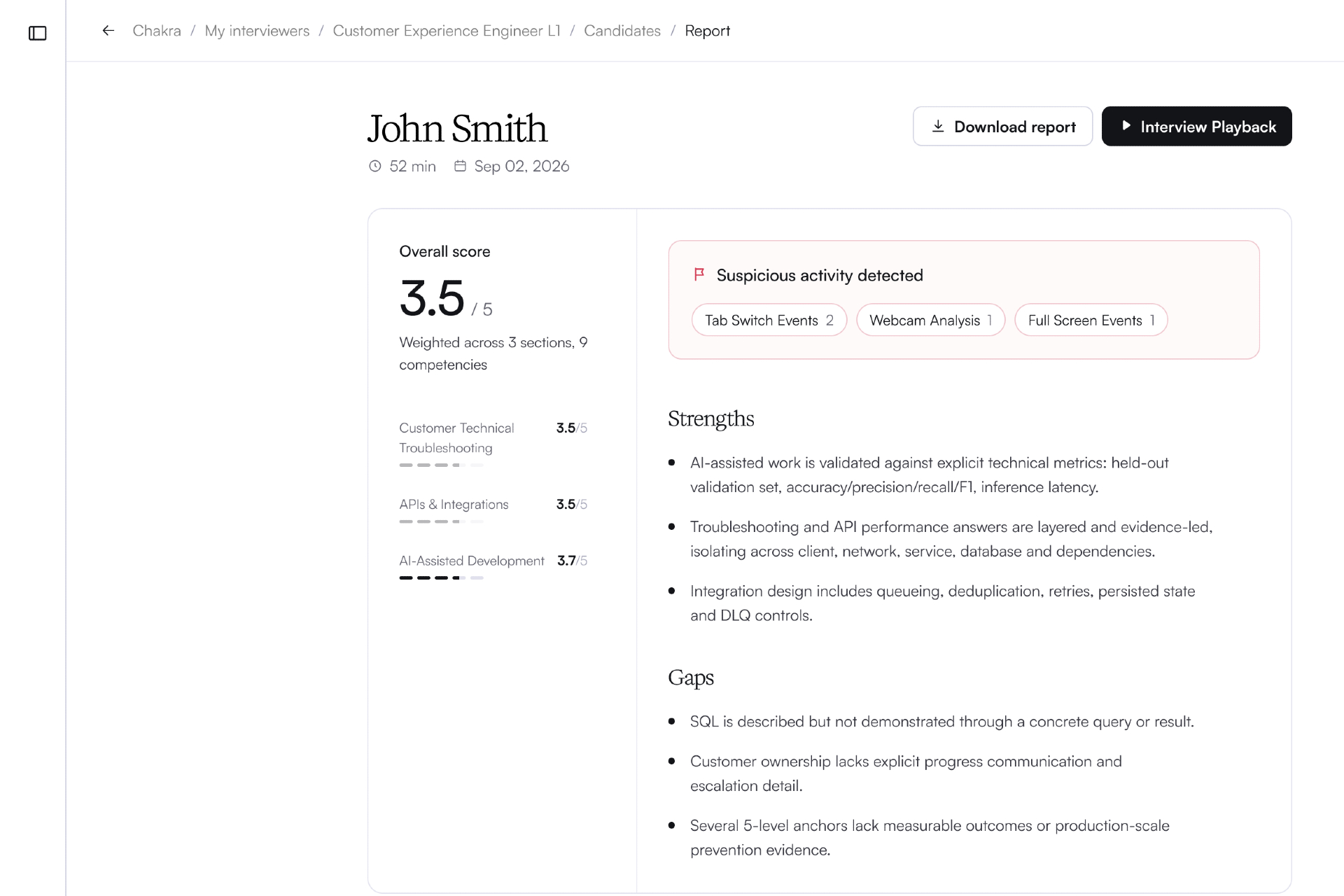
- Counterintuitively, Chakra interviews showed 70-80% fewer suspicious activity flags than traditional assessments, suggesting transparent AI access reduces candidates' incentive to cheat.
- HackerRank is pivoting from testing coding ability to evaluating thinking processes, even as regulators increase scrutiny of automated hiring tools for potential bias.
HackerRank, a platform used by thousands of companies to assess and hire software developers, is moving beyond traditional coding tests with Chakra, an AI agent that conducts interviews, observes candidates as they work, and evaluates their thinking process alongside their solutions. The startup is making Chakra generally available to customers on Monday after approximately six months in beta testing.
During the beta period, Chakra conducted more than 500,000 interviews. Early users included Snowflake, Snorkel, and Capgemini, with HackerRank also testing the product internally. The scale of beta usage suggests the industry is ready to explore how AI can reshape hiring itself, not merely automate its administrative components.
Measuring Thinking, Not Just Output
The launch reflects a fundamental shift in what hiring managers can evaluate. Before AI tools became ubiquitous, assessing a developer meant checking whether they produced correct output. HackerRank co-founder and CEO Vivek Ravisankar articulated the change directly: with generative AI now accessible to everyone, employers need to evaluate how candidates think through problems, judge AI’s responses, and steer tools toward solutions.
AI fluency as the new signal
HackerRank calls this new dimension “AI fluency” — a candidate’s ability to frame problems for AI, evaluate its output, and adapt solutions. This measures something harder to fake than traditional coding tests, where memorization or internet searches could yield correct answers without genuine understanding. The concept also aligns with how developers actually work in modern software shops, where using AI as a collaborating tool is increasingly standard practice.
The interview as simulation
In practice, a Chakra interview resembles actual work more closely than conventional assessments. Candidates receive tasks involving real code repositories and complete them in a canvas with an integrated AI assistant. As they work, Chakra observes their decisions and asks follow-up questions about their reasoning, such as why they chose one approach over another or how they would adapt their solution if a new constraint appeared mid-project.
Process becomes observable
This design makes the candidate’s thinking visible to evaluators. Rather than seeing only the final answer, hiring managers can assess judgment calls, problem-solving strategies, and how effectively candidates collaborate with AI — dimensions that traditional multiple-choice coding challenges never exposed.
Compressing Three Rounds Into One
Ravisankar told TechCrunch that Chakra reshapes the basic hiring workflow. Traditional hiring required three separate rounds: a recruiter screen, a take-home assessment, and a technical follow-up interview with an engineer. Chakra combines all of this into a single conversation. The AI conducts initial screening, observes live coding work, and poses clarifying questions, eliminating scheduling delays and coordination overhead that multi-round hiring processes create.
Faster feedback and signal gathering
Candidates also benefit from immediate feedback within the same interview rather than waiting days between rounds to learn what comes next. This compressed timeline could speed hiring decisions while gathering more comprehensive data about how candidates approach problems under observation. For companies managing high volumes of developer applications, the efficiency gain represents significant operational savings.
Cheating Actually Declined
One assumption might suggest that giving candidates access to AI during an interview would make cheating easier. Ravisankar reported the opposite pattern emerged during testing, contradicting conventional intuition about tool availability and rule-breaking.
Suspicious activity dropped 70-80 percent
Suspicious-activity flags in Chakra interviews ran 70 to 80 percent lower compared to traditional HackerRank assessments, though rates varied by geography and seniority level. The reduction was consistent enough to suggest a real behavioral shift rather than statistical noise, though Ravisankar noted that the exact percentage depended on several contextual factors.
Transparency as deterrent
By making the AI a transparent, visible part of the interview, HackerRank removed the motivation for candidates to secretly deploy unauthorized tools. Since evaluators explicitly assess how candidates work with the integrated AI assistant, covert external tools offer little advantage and significant risk. Ravisankar said the legitimate access itself reduced incentives for deception, as candidates had no reason to resort to hidden workarounds when the official tool was already available.
A Strategic Reversal for HackerRank
The move represents a calculated bet against the business HackerRank spent over a decade building. The company, which launched at TechCrunch Disrupt in 2012 with Y Combinator backing, now serves over 3,000 business customers including Amazon, Nvidia, Clay, and Replit. Its developer community exceeds 30 million users worldwide. The company’s core value proposition centered on measuring whether developers could solve algorithmic problems correctly.
Accepting the old product’s decline
Ravisankar acknowledged that the traditional product still has value but no longer measures engineering ability adequately in an AI-first world. He compared HackerRank’s transition to Apple moving from the iPod to the iPhone: the older device did not disappear overnight, but Apple correctly identified where its future lay. “Chakra is going to be the headline,” he said. “It’s going to be the way that we’re going to move forward.”
AI Scoring, Humans Decide
Integrating AI into hiring decisions inevitably raises questions about delegation and algorithmic bias. HackerRank emphasizes that Chakra scores and ranks candidates but does not make final hiring decisions, which remain with humans. This division allows AI to apply consistent rubrics to structured assessment while human interviewers evaluate cultural fit and answer questions about team, role, and company culture.
Consistency versus embedded bias
Ravisankar argued that properly tuned AI can apply the same criteria to every candidate without unconscious influences based on background or education. However, consistent rule application does not guarantee freedom from bias. Automated hiring tools inherit biases from training data, models, and decision criteria, as regulators and researchers increasingly document.
Regulatory frameworks tightening
New York City now requires employers using certain automated employment decision tools to conduct independent bias audits and notify candidates before deployment. Ravisankar acknowledged that hiring is a regulated sector and said HackerRank built compliance into Chakra from the start. The regulatory environment will likely shape how broadly such tools can be adopted across industries and geographies.
Source: TechCrunch
Frequently Asked Questions
What is Chakra and when did HackerRank make it available?
Chakra is an AI interviewer that conducts interviews, observes candidates solving real-world coding tasks, and evaluates their thinking process. HackerRank made it generally available on Monday after six months of beta testing, during which it conducted over 500,000 interviews with companies including Snowflake, Snorkel, and Capgemini.
How does Chakra reduce cheating compared to traditional interviews?
Chakra interviews had 70-80% fewer suspicious-activity flags than comparable traditional HackerRank assessments. CEO Vivek Ravisankar attributed this to candidates having legitimate access to AI during the interview, which reduces the incentive to secretly use unauthorized tools to receive answers.
What does HackerRank mean by 'AI fluency'?
AI fluency refers to how well a candidate frames a problem for AI, judges the AI's output, and steers it toward a solution. This represents a shift from traditional interviews that evaluated whether developers could produce correct code, toward assessing their judgment and thinking process.
