
Key takeaways
- Trump announced a new Super Intelligence Force chaired by national intelligence director Jay Clayton, with vice chairs from the FTC, military research, and federal personnel management, to coordinate federal AI policy.
- The task force has 120 days to report on AI's risks and opportunities and must develop plans for addressing AI-enabled threats while preventing overregulation that could slow American competitiveness.
- Trump rebranded artificial intelligence as "super intelligence" across federal usage, a terminology shift that tech executives began adopting after signing a non-binding safety pledge at the White House.
- The task force formalizes a September promise to establish an AI Force and appoint an AI czar, consolidating AI strategy at the highest government levels while distributing implementation across existing agencies.
President Donald Trump announced the formation of a Super Intelligence Force on Sunday, establishing a new federal task force designed to coordinate government strategy around what he now calls “super intelligence” rather than artificial intelligence. Posted on Trump’s social network Truth Social, the announcement formalizes what Trump had previously promised: an AI Force with an appointed czar overseeing the nation’s approach to the technology. Trump characterized the effort as potentially more significant than the Industrial Revolution or the Internet itself, framing it as essential to protecting American interests and improving citizens’ lives.
Who Leads the Super Intelligence Force
Jay Clayton, the national intelligence director, will chair the Super Intelligence Force, establishing him as the administration’s top official for overseeing artificial intelligence and related strategic matters. According to the Wall Street Journal, the task force includes Clayton as chair with three vice chairs: FTC Chair Andrew Ferguson, Undersecretary of War for Research and Engineering Emil Michael, and Office of Personnel Management Director Scott Kupor.
This structure distributes AI policy authority across multiple federal agencies, signaling that the administration views AI governance as extending beyond technical or research domains into trade regulation, military strategy, and federal workforce management. Each vice chair brings distinct jurisdictional authority: Ferguson oversees consumer protection and competition, Michael manages research partnerships with the military and defense contractors, and Kupor controls federal hiring and personnel policy.
Rebranding AI as Super Intelligence
The Terminology Shift
Trump’s decision to rebrand artificial intelligence as “super intelligence” across federal usage represents a deliberate attempt to reshape how the government discusses the technology. The shift emerged even as Trump had previously dismissed AI safety concerns as a hoax promoted by what he called “Radical Left Dumocrats.” Despite his skepticism toward some AI critiques, he proceeded to establish formal governmental structures to oversee the field, suggesting an acknowledgment of the technology’s significance regardless of his views on specific safety debates.
Industry Adoption and Early Stumbles
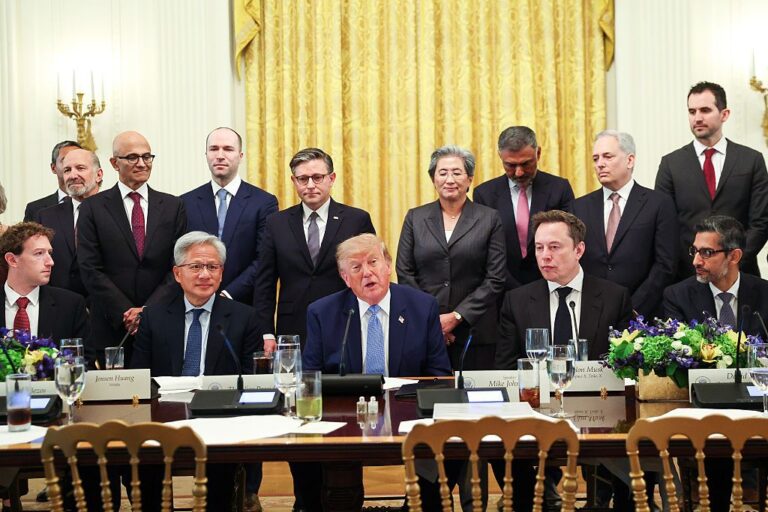
Tech executives gathering at the White House this week to sign a non-binding AI safety pledge began adopting the “super intelligence” terminology in their statements, though adoption has been uneven. The pledge document itself contained a typo, highlighting the sometimes rushed coordination of messaging across multiple parties as the new framing rolls out. These early inconsistencies suggest ongoing confusion about how the rebranding should apply across different contexts.
Historical Precedent and Implications
Direct attempts to reshape how an entire sector discusses its work are unusual for presidential administrations. The “super intelligence” rebranding differs from typical policy approaches, which tend to work within existing terminology rather than attempting to modify it across government and industry simultaneously. How durable this terminology becomes in government usage, industry communications, and public discourse will likely depend on whether it gains traction beyond the immediate policy context and executive branch communications.
The Task Force Mission and Timeline
The Super Intelligence Force has been explicitly tasked with coordinating federal efforts to keep America leading globally in what Trump now calls super intelligence. Trump’s framing emphasized protecting American interests and improving citizens’ lives through this leadership position, positioning AI development as a matter of national welfare alongside national security.
The task force operates under a 120-day deadline to produce a comprehensive report assessing both the risks and opportunities presented by AI development. According to its charter, the force will “develop plans for responding to SI-enabled threats to our society, while preventing overregulation and regulatory capture that would stifle innovation and competition.” This language reveals the core tension in the task force’s mandate: it must address potential harms from advanced AI while ensuring that regulatory responses do not handicap American companies or slow development relative to international competitors.
Competitive Positioning and Global Context
Avoiding Technological Retreat
Jay Clayton has previously argued that permitting the United States to “back away” from AI development while countries like China continue advancing would be irresponsible. This position reflects a conviction, shared across the task force, that being “not first” in AI represents one of the paramount risks to American interests. The framing prioritizes technological and competitive leadership as the primary metric of success.
The Regulation Question
The task force charter’s emphasis on preventing overregulation and regulatory capture suggests that the administration expects AI companies will lobby against restrictions, and the task force intends to resist such pressure while remaining open to necessary safeguards. The balance between these competing demands will determine whether the task force ultimately produces restrictions or recommendations that favor continued innovation with minimal constraint.
Formalizing Earlier Promises
The Super Intelligence Force announcement implements a commitment Trump made in September, when he promised to establish an AI Force and appoint an AI czar, specifying that “Only High I.Q. individuals need apply.” The new task force structure represents that formal implementation, with terminology adjusted to match Trump’s preference for “super intelligence” across federal usage.
With Clayton as chair and vice chairs drawn from the FTC, military research, and personnel management, the administration has created a structure that consolidates AI strategy at the highest levels of government while distributing implementation authority across multiple existing agencies. The 120-day reporting deadline will likely produce the administration’s most detailed public position on how it intends to balance AI innovation with any perceived risks or threats.
Source: TechCrunch
Frequently Asked Questions
Who leads Trump's new Super Intelligence Force?
Jay Clayton, the national intelligence director, chairs the task force. Vice chairs include FTC Chair Andrew Ferguson, Undersecretary of War for Research and Engineering Emil Michael, and Office of Personnel Management Director Scott Kupor.
What is the Super Intelligence Force required to do?
The task force has 120 days to produce a report assessing the risks and opportunities of AI development. According to its charter, it will develop plans for addressing AI-enabled threats while preventing overregulation that could stifle innovation and competition.
Why did Trump rebrand AI as 'super intelligence'?
Trump issued an executive order to rebrand artificial intelligence as "super intelligence" across federal usage. Tech executives gathering at the White House to sign a non-binding safety pledge began adopting the new terminology, though the pledge document itself contained a typo that highlighted inconsistencies in the rollout.
