
Key takeaways
- Intero Biosystems manufactures lab-grown human intestinal organoids called GastroScreen to help pharmaceutical companies test drugs without animal models.
- The Denver startup has raised $2.3 million in pre-seed funding and generated over $400,000 in revenue since its 2024 founding.
- Recent FDA guidance on non-animal testing methods has opened regulatory pathways that are driving pharmaceutical companies to explore organoid technology.
- The company is working to scale from producing thousands to hundreds of thousands of organoids per batch while planning to license biological data to AI companies.
Drug development has a fundamental problem: what works in mice or rats often fails when tested in humans. Most drug candidates never make it to market, in part because animal models don’t reliably predict human biology. Intero Biosystems, a Denver startup founded in 2024, is pursuing a different approach. The company grows human intestinal tissue in a lab, creating organoids that the pharmaceutical industry can use to test drugs before they reach clinical trials.
The startup spun out of the University of Michigan and has raised $2.3 million in pre-seed funding. With seven employees and just under 10 customers, Intero has already generated more than $400,000 in revenue between the fourth quarter of last year and the third quarter of this year, a sign that pharmaceutical and biotech companies are willing to pay for alternatives to animal testing.
Why Animal Testing Falls Short
The gap between animal models and human outcomes is not theoretical. Most drugs fail clinical trials, a problem that regulatory bodies have begun to address directly. The U.S. Food and Drug Administration laid out plans in April of last year to reduce its reliance on animal testing. In March of this year, the FDA issued draft guidance on how companies should validate new approach methodologies, or NAMs, the term for any non-animal testing approach, when using them in regulatory submissions. That guidance does not endorse specific methods, but it creates a framework that pharmaceutical companies can use to justify moving away from animal models.
Intero’s Solution: Mini Human Intestines
The GastroScreen Product
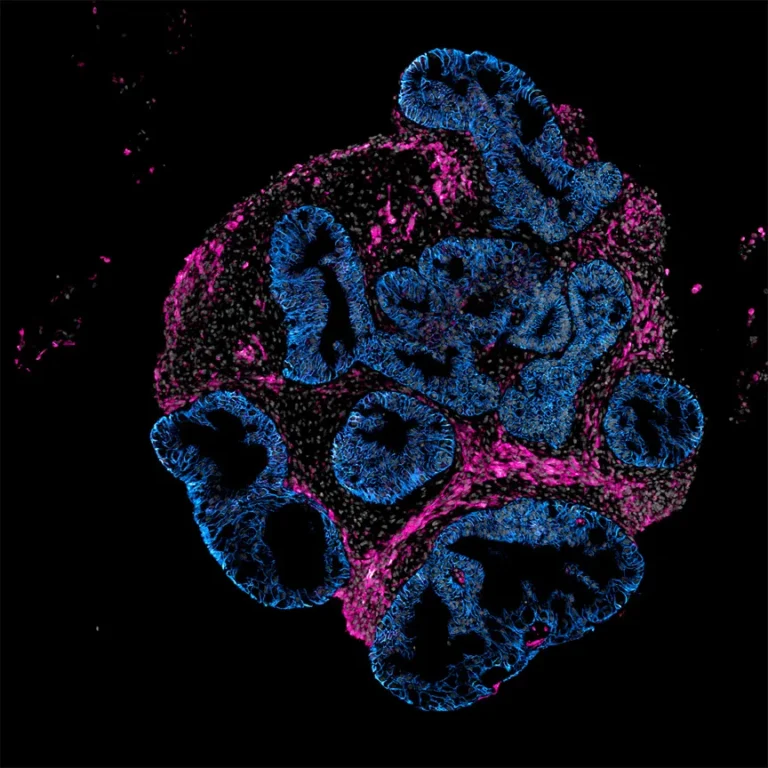
Intero’s flagship offering is GastroScreen, a human intestinal organoid roughly one millimeter across. The company manufactures these organoids in batches of about 100 and ships them in tubes to pharmaceutical, biotech, food, and chemical companies. Unlike simpler cell models that capture only part of the gut, GastroScreen contains multiple cell and tissue types found in a real human intestine.
Technology and Applications
The organoids are derived from induced pluripotent stem cells, adult cells reprogrammed to become nearly any cell type and generated from a blood sample. Co-founder and CTO Madeline Eiken described the approach in an interview with TechCrunch: “Most drugs fail clinical trials, and I think it’s pretty easy to appreciate that we are neither mice nor flat layers of cells.”
Beyond the organoids themselves, Intero sells the nutrient mixes and chemicals needed to run experiments, as well as custom testing services. Customers can expose the organoids to drug candidates to assess safety, or they can induce disease-like conditions to understand how tissue responds to different compounds. “We’re literally shipping mini living organs in the mail to people,” co-founder and CEO Charlie Childs said.
The Validation Challenge
Intero is currently in the second stage of a three-stage process to validate GastroScreen’s accuracy. The company first demonstrated that the organoids contain the key tissues of the human gut. It has since tested well-known drugs with documented effects on humans, and GastroScreen has shown the expected responses to anti-inflammatory compounds and to substances known to damage the gut. The final stage will involve direct comparison with existing animal and clinical data from pharmaceutical partners. Several companies are already running studies with both existing compounds and new drug candidates, Childs said.
Building a Market in an Era of Regulatory Change
FDA-Driven Momentum
Regulatory pressure is accelerating industry interest in alternatives to animal testing. Changes in U.S. law now allow drug developers to use non-animal methods in some cases, a shift that has made pharmaceutical companies more willing to explore technologies like organoids, according to Eiken. Companies that were once hesitant about the approach are now considering bringing organoids in-house.
Competition and Differentiation
Intero faces competition from several established players. Altis Biosystems develops stem cell-derived intestinal models, while InSphero offers patient-derived intestinal organoids for toxicity testing. MIMETAS takes a different approach with organ-on-chip technology, using microfluidic devices to recreate the human tissue environment.
Intero differentiates itself through the complexity and scalability of its model. Because GastroScreen is derived from induced pluripotent stem cells rather than tissue collected through procedures like colonoscopies, the company can potentially personalize models to different patients and scale production more easily.
Scaling Production and Future Vision
Currently, Intero can manufacture a few thousand organoids per batch. The company is working to automate its manufacturing process with a goal of producing hundreds of thousands of organoids at a time.
Childs sees organoid data as a resource for artificial intelligence. Rather than using AI to build organoids, Intero plans to license biological datasets to pharmaceutical and AI companies, a business model that could generate revenue beyond selling the organoids themselves.
The company’s longer-term ambitions include personalized medicine, where a patient’s own cells would be used to create organoids that test different drugs before treatment begins. Childs described an even more distant goal: an artificial intestine built on the manufacturing scale and patient-specific data developed through the organoid platform. Intero is competing in TechCrunch’s Startup Battlefield at Disrupt, the conference running October 13 to 15 in San Francisco.
Source: TechCrunch
Frequently Asked Questions
How are Intero's organoids different from other intestinal models?
GastroScreen contains multiple cell and tissue types found in a real human intestine, unlike simpler models that replicate only part of the gut. The organoids are derived from induced pluripotent stem cells, which can be generated from a blood sample, allowing for personalization and easier scaling than models grown from tissue collected through procedures like colonoscopies.
What stage is Intero at in proving that GastroScreen works?
The company is in the second stage of a three-stage validation process. It has shown that the organoids contain key human intestinal tissues and has tested well-known drugs with documented human effects, confirming expected responses to anti-inflammatory compounds and substances that damage the gut. The final stage involves comparing results directly with pharmaceutical companies' existing animal and clinical data, with several companies currently running studies.
How big is Intero's current business?
Founded in 2024, Intero has seven employees and just under 10 customers. It generated more than $400,000 in revenue from the fourth quarter of last year through the third quarter of this year after raising a $2.3 million pre-seed round.
