
Key takeaways
- Liux launches the Big microcar from Spain's first new car plant in 30+ years, targeting 20,000 units annually by 2030.
- The vehicle uses a linen-based biocomposite body designed for recycling and features replaceable batteries to extend its lifespan.
- Liux targets affluent urban drivers aged 55-60 seeking a sustainable second vehicle, priced below €18,000 before EV subsidies.
Liux, a Spanish startup, is pursuing a sustainability-focused strategy to compete in Europe’s increasingly crowded microcar segment, which has been dominated by Chinese electric vehicles since local manufacturers like Smart shifted production overseas.
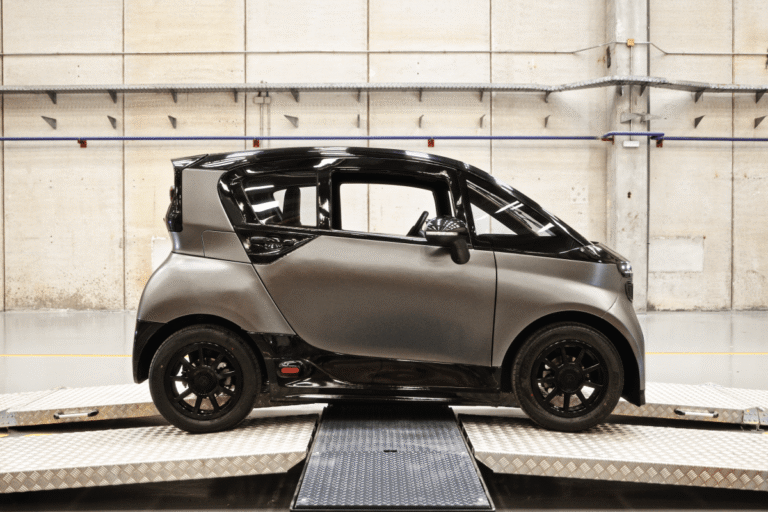
The company’s vehicle, the Liux Big, is designed to park perpendicular to a curb despite fitting no larger than other ultracompact cars—a design constraint that reveals the startup’s engineering ambitions. Co-founder Antonio Espinosa de los Monteros told TechCrunch: “The idea of a European car does not exist,” a statement that captures how Liux approaches its positioning.
Monteros previously founded Auara, a Spanish bottled water company structured as a B Corp, which later sold to a larger competitor. His focus on circular economy principles carried over to Liux. Co-founder David Sancho brought electric vehicle engineering expertise, having previously engineered the Bóreas hybrid supercar unveiled at the 24 Hours of Le Mans in 2017.
After Sancho and Monteros connected and founded Liux, their first prototype—the Animal, a five-seater—debuted in 2022 and was constructed almost entirely from recycled or plant-based materials. The founders reconsidered their approach soon after and concluded that achieving regulatory homologation would be easier with a smaller vehicle. The Liux Big, their pivot, received Europe-wide homologation and is set to enter production in the first half of 2026.
The Sustainability Wager
Liux’s differentiation rests on circularity rather than full European supply chain independence, which Monteros called unattainable. The car’s fiber body uses a novel linen-based biocomposite designed to be extracted and recycled after the vehicle’s life. Batteries are not manufactured in Europe but are engineered to be easily replaceable, extending the vehicle’s serviceable lifespan.
Material Integrity and Second Lives
Monteros emphasized in an interview that recycling requires more than laboratory feasibility. “When you build something, you have to try to preserve the integrity of the material and the components so that a second life is possible,” he said. This philosophy informed material selections across the Liux Big, prioritizing ease of disassembly and component reuse.
Avoiding Planned Obsolescence
The design targets durability and repairability to sidestep the rapid obsolescence patterns common in modern vehicles. Replaceable battery modules allow users to extend ownership periods without full vehicle replacement, reducing pressure to upgrade.
The Biocomposite Innovation
The linen-based composite body represents the most visible sustainability choice. The material allows for post-use extraction and recycling, embedding circularity into the product rather than treating it as an afterthought. This approach directly contradicts the sealed, difficult-to-recycle designs typical of mass-market electric vehicles.
Manufacturing and Production
Liux opened Spain’s first new car plant in over 30 years, housed in Azuqueca de Henares, roughly one hour from Madrid. The facility operates under Toyota’s lean management principles, focusing on final assembly and production steps rather than component manufacturing.
Beatriz Belda, the company’s head of production and a former BMW engineer based in Munich, leads operations at the facility. Despite its modest footprint, Liux projects production capacity of 20,000 units annually by 2030. The startup currently employs 65 people across three Spanish manufacturing sites.
The scaled-back factory design reflects the chosen production methodology: efficiency over vertical integration. This approach allows Liux to scale production while maintaining quality control over the assembly stages most critical to the vehicle’s integrity and performance.
Engineering the Ultracompact
The Liux Big operates within the L7e regulatory category for slightly heavier ultralight four-wheelers, as opposed to the smaller L6e classification. This distinction creates specific design constraints around weight and size, which Liux’s head of R&D, Celso Fernández, identified as the category’s binding limitations.
Liux engineered a 240-liter trunk despite the category’s restrictions, an achievement that required deliberate choices at every design stage. More fundamentally, the company prioritized making the vehicle feel and function like a car rather than a motorized two-wheeler.
Safety Beyond Requirements
Notably, the L7e category does not mandate crash testing. Liux nonetheless subjected the Liux Big to crash testing and performed braking, slalom, and handling evaluations—safety measures it publicly demonstrated to validate the vehicle’s structural integrity and handling characteristics. David Sancho stressed that lightweight design must not compromise frame strength or lateral stability during turns.
Battery and Powertrain Options
The production version will ship with two battery configurations: 15 kWh and 20 kWh. A cargo variant is planned, and Sancho has signaled that future models could include higher-performance versions, though specific timelines remain unannounced.
Market Position and Pricing
Liux has not finalized pricing but confirmed the Liux Big will cost below €18,000 (approximately $21,000 USD) before potential EV subsidies, positioning it at the higher end of the microcar market.
The company has secured €16 million in funding (about $18.5 million including European sources) to support market entry and production ramp-up. Initial sales will flow through partnerships with European car dealerships.
More than 7,500 people have joined the waiting list without paying a deposit, giving Liux insight into prospective buyers. The typical profile is a 55- to 60-year-old urban resident, and the company now assumes the Liux Big will serve as a household’s second vehicle rather than replacing traditional car ownership.
This positioning limits the vehicle’s ability to disrupt conventional ownership patterns, though Monteros acknowledged that Liux must focus on achievable market segments. The company remains open to partnerships with fleet operators and autonomous vehicle developers.
The Showroom Experience
Liux’s showroom doubles as a preview of its long-term sales model. Ana Terrado, head of brand, highlighted textile screens, linoleum flooring (referencing the linen material), and 3D models displaying the three available colors. These aesthetic choices reinforce the sustainability positioning against competitors, particularly Chinese EV makers.
The three-color palette exceeds the historical Ford Model T offering, a subtle nod to automotive tradition reinterpreted through a modern, eco-conscious lens.
What’s Next
The startup expects to launch sales in the first half of 2026, with three production facilities already established across Spain. While a single-car brand strategy could limit growth, Sancho’s presence suggests future performance variants remain possible.
Liux’s bet is that a microcar built for longevity, repairability, and end-of-life recyclability can capture a segment of European urban drivers willing to prioritize sustainability and circularity over the cost advantages of Chinese mass production.
Frequently Asked Questions
What makes the Liux Big different from other microcars?
The Liux Big features a linen-based biocomposite body engineered to be extracted and recycled, replaceable battery modules to extend vehicle lifespan, and undergoes crash testing despite not being required. These design choices prioritize circularity and durability over planned obsolescence.
Who founded Liux and what is their background?
Liux was co-founded by Antonio Espinosa de los Monteros, previously of Auara, a Spanish bottled water B Corp, and David Sancho, an EV engineer who designed the Bóreas hybrid supercar unveiled at the 24 Hours of Le Mans in 2017. Both prioritize circular economy principles and engineering excellence.
How is the Liux Big priced and who is the target customer?
The Liux Big is priced below €18,000 (approximately $21,000 USD) before EV subsidies. The typical customer is a 55-to-60-year-old urban resident, and Liux expects the vehicle to serve as a household's second car rather than a primary vehicle.
