
Key takeaways
- Wabi 2.0 generates applications on demand within messaging conversations rather than requiring users to operate separate tools.
- Kuyda argues that chat-only agents create information overload as task history buries in endless scrolling, requiring traditional software interfaces to coexist with conversation.
- The pivot positions Wabi to compete with task-oriented agents by merging conversation with software design, supporting both individual and collaborative workflows.
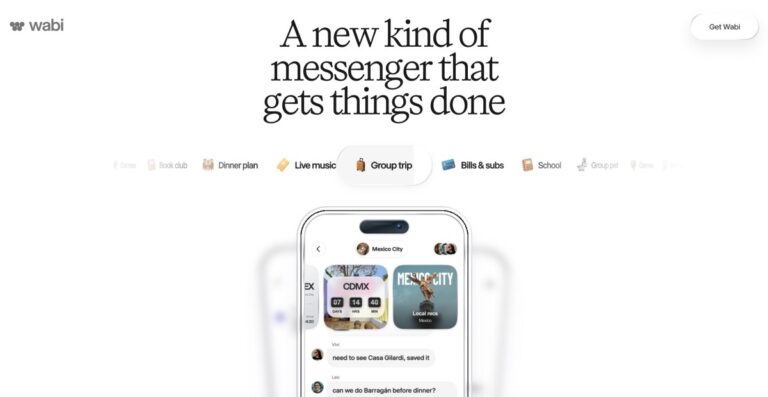
Wabi, an artificial intelligence startup that pioneered prompt-based application building, is undergoing a strategic repositioning that reflects broader industry momentum toward agent-style systems. The company announced this week the launch of Wabi 2.0, reconceiving its platform as an AI messenger that generates applications on demand while maintaining conversation as the primary user experience. The pivot responds to surging demand for AI agents like Meta’s Muse and Instinct, which integrate task execution and conversation into unified messaging environments rather than requiring users to jump between specialized tools.
Eugenia Kuyda, who founded Wabi and previously established the AI companion platform Replika, describes Wabi 2.0 as a “personal agent that does stuff for you and builds the interface you need in the moment.” The framing signals a reconception of the company’s positioning from a system where users request custom applications and then operate them separately, to one where applications emerge contextually within ongoing conversation.
Evolution From Low-Code Builder to Agentic Messaging
Wabi’s original value proposition centered on democratizing software development for non-technical users. The company pitched itself to business professionals, entrepreneurs, and citizen developers, offering a path to application creation without programming knowledge. Users could describe what they needed in natural language, and Wabi’s system would generate functioning software. The startup competed directly against other low-code and no-code platforms, selling rapid, conversational application development.
The Market Has Shifted Toward Agents
Today’s startup landscape looks markedly different. Demand has progressively migrated away from standalone app-building tools toward AI agents that consolidate multiple functions—conversation, information retrieval, task execution, and software interaction—within single interfaces. The transition reflects changing expectations about how AI should work. Rather than specialized tools for specialized purposes, users increasingly want systems that handle broad ranges of requests without context switching. Companies like Meta have recognized this pattern and embedded agent thinking into their infrastructure strategy. By repositioning Wabi 2.0 as a messenger rather than an application builder, Kuyda is reading these market signals and adjusting her company’s trajectory accordingly.
Industry Movement Toward Messaging-First Platforms
The technological infrastructure actively facilitates this shift. At its recent Dev Day event, OpenAI announced expansions to ChatGPT’s plugin ecosystem, allowing applications to deliver interactive experiences directly within ChatGPT’s interface. Users no longer need to navigate away from chat to use third-party tools. The changes also elevate application visibility by pinning app names more prominently in ChatGPT’s sidebar. These moves by OpenAI validate the assumption that future software distribution will flow primarily through messaging platforms rather than through traditional app stores.
How Wabi 2.0’s Dynamic Interface Generation Works
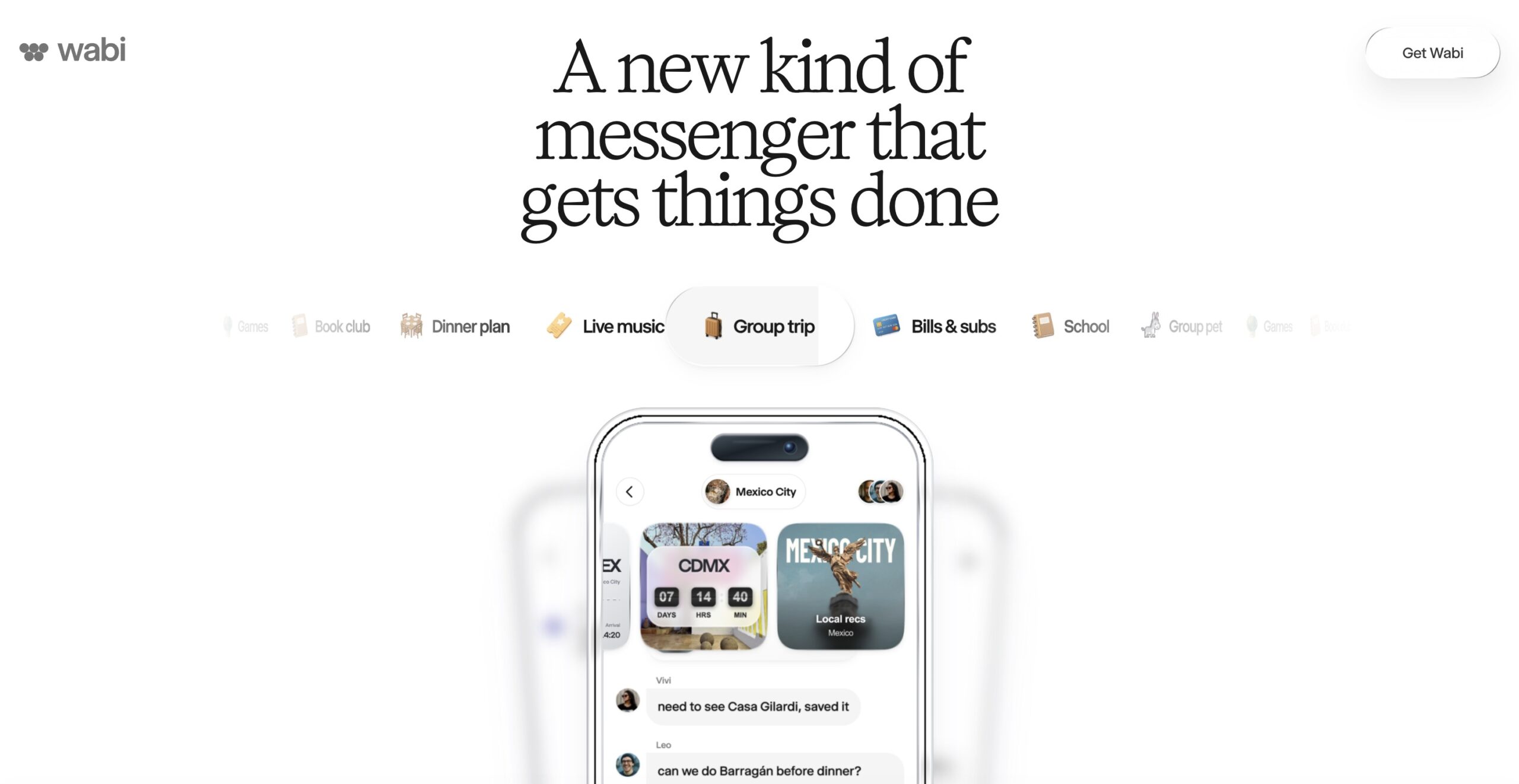
The core innovation reverses the sequence of interaction. Traditional systems force users to make decisions about requirements upfront. Wabi 2.0 waits for a user’s request within conversation, then immediately generates the interface required to fulfill it. When a user asks the agent to complete a task, the system assembles whatever interface components are necessary—forms, data tables, calendar views, progress trackers—directly within the same messaging thread. The generated interface remains accessible for future use within that conversation context.
Solving the Information Overload Problem in Chat Interfaces
Kuyda articulated the usability problem she believes chat-only agents create. As conversations lengthen, important information becomes buried in message history. She explained: “The more you use a chat-only agent, the worse the experience gets. Your history and ongoing tasks end up buried in one endless scroll.” Chat interfaces excel at conversation but struggle with information organization. Users cannot easily scan their task list, adjust previous settings, or reference past data without manually scrolling. Kuyda’s solution preserves conversational elements while allowing structured, visually organized interfaces to coexist in the same space. When users need to see information at a glance—a calendar, a list, a form—those elements are immediately visible rather than scattered across message history.
Rethinking How Users Interact With Agents
Kuyda made a case about how users actually want to interact with systems. Typing is intuitive for conversation but inefficient for many tasks. She noted that users “want to tap-tap-tap, scroll, and look,” implying that buttons, visual hierarchies, and direct interaction matter. Traditional software interfaces offer affordances that text-based chat cannot: clickable buttons, dropdown selectors, date pickers, text input fields with labels, visual feedback about state. Her analysis suggests that powerful agents must combine conversational input with conventional software design patterns. She stated the principle plainly: “They love what agents can do, but they also like software. The most powerful agent will be the one that combines both.” This positioning separates Wabi from agents that operate purely through conversation.
Practical Examples of Dynamic Application Generation
The company illustrated its approach through concrete use cases. Imagine a conversation thread focused on health and wellness. Within that thread, a user could request specific tools: a calorie counter to track dietary intake, a weightlifting log to record exercise sessions, or a weight tracker monitoring fitness progress. Each application emerges on demand and remains accessible within the thread. In a family-oriented conversation, capabilities expand differently. Users might request a calendar for managing children’s schedules, a language-learning application supporting multilingual interests, or a tool aggregating nearby child-friendly events and programs. The examples illustrate how Wabi adapts to context. Rather than offering generic tools, it generates applications responsive to the specific domain of conversation, staying within the same interface for every function.
Competitive Positioning Against Agents and Chat Systems
Wabi 2.0 enters a landscape increasingly populated with AI agents designed to handle complex tasks through conversation. Meta’s strategic bets on agents like Muse represent one mainstream approach: systems that execute tasks primarily through natural language, expecting users to type requests and accept text-based responses. Wabi’s differentiation lies in explicit rejection of text-only interaction as the primary mode. The company argues that managing sophisticated tasks—especially those requiring ongoing refinement, visualization, or status tracking—demands richer interaction modalities than conversation alone. Users need visual feedback about state, structured data entry to guide complex operations, and persistent, organized information they can reference without searching through history. By refusing to constrain itself to text-based interaction, Wabi positions itself as a more complete solution for users wanting agents to handle serious productivity work.
Vision of Collaborative, Shared Agents
Kuyda’s articulation extends beyond single users managing personal tasks. She described the target experience as enabling “your agent, your apps, and your people in one place, running the parts of life that matter most, together.” This language hints at deeper architectural ambitions around collaborative workflows. Rather than a one-person, one-agent model, Wabi appears designed to support scenarios where multiple people interact with shared applications within group conversations. This would depart significantly from the dominant paradigm in AI agents, which largely assumes single-user interaction. Supporting true collaboration would require the system to handle concurrent access, manage state changes from multiple users, preserve audit trails about modifications, and display updates in real time across participants.
Access and Launch Timeline
Wabi 2.0 currently exists in invite-only form. Access is limited to users who receive invitation codes distributed via X. The company has not communicated a public launch date or timeline for general availability. The controlled rollout reflects standard practices for AI products, allowing the company to gather feedback from early users, identify edge cases, and refine performance and reliability before public release.
Source: TechCrunch
Frequently Asked Questions
What makes Wabi 2.0 different from the original Wabi?
The original Wabi let users create applications through prompts, which they then accessed separately. Wabi 2.0 keeps applications and conversation in the same messaging interface, generating interfaces on demand as users make requests without leaving the chat environment.
What is Kuyda's main criticism of chat-only AI agents?
She argues that as conversations grow, task history becomes buried in endless scrolling, making information hard to locate. Users want to interact with traditional software elements—buttons, forms, visuals—not just type messages, and the most powerful agents combine both capabilities.
When will Wabi 2.0 be publicly available?
The platform is currently available only through invite codes distributed on X. No public launch date or timeline has been announced by the company.
